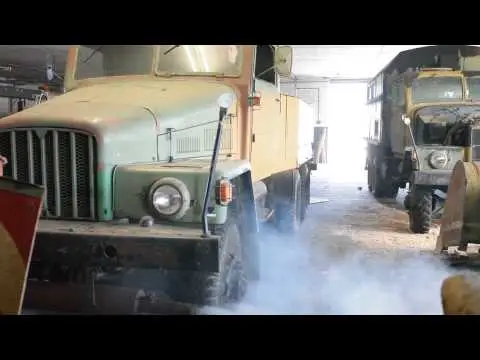
The IFA G5 was a three-axle lorry built by IFA at Werdau between 1952 and 1964. It was a 6×4 with a switchable front axle, and its chassis was used for tippers, tankers, crane trucks, fire engines and water cannon.
IFA G5 at a glance
| Maker | VEB Kraftfahrzeugwerk «Ernst Grube», Werdau |
|---|---|
| Production | 1952–1964 |
| Layout | three axles, rear-wheel drive with switchable front drive (6×4 / 6×6) |
| Differential | none between the axles |
| Generations | G5/1 and G5/2 |
| Cab variants | closed cab, crew cab, soft top, folding windscreen |
| Bodies | tipper, crane, box, tarpaulin, tanker, water cannon, fire engine |
| Main users | Alert police, National People’s Army, People’s Police |
| Rival | Soviet ZIS-151 |
| Unbuilt successor | G5/3 with a 12.5-litre V8 diesel |
based on one source (English Wikipedia).
History of the IFA G5
Development of the G5 began during the Second World War at the Vogtland Maschinenfabrik (Vomag). Although the Soviet occupation forces dissolved Vomag shortly after the war, work continued at Auto Union and Horch, and the lorry entered production at the VEB Kraftfahrzeugwerk «Ernst Grube» in Werdau, a plant that had succeeded the Schumann works and was part of the IFA combine. In the eastern bloc its rival was the Soviet ZIS-151.
The G5 was a three-axle lorry with rear-wheel drive and a switchable front axle. It had no central differential, so engaging front-wheel drive sent different amounts of torque to the front and rear axles and there was no way to equalise them; the all-wheel-drive system was therefore not suited to road use. The cab was built in several versions — closed, crew cab, soft top and a version with a folding windscreen — and the G5 shared several components with the H6 series, which was built at Werdau at the same time.
The chassis was adaptable and appeared as a dump truck, crane truck, box-body lorry, tarpaulin lorry, tanker, water cannon and fire engine. The main customers were the Alert police, the National People’s Army and the People’s Police; vehicles of the Combat Groups of the Working Class served as water cannon on 13 August 1961, during the building of the Berlin Wall. Although demand was low, the number built never met it, and decommissioned army G5s later worked in agricultural production cooperatives, as Minol fuel tankers and as TLF 15 fire engines with a crew cabin.
There were two production generations, the G5/1 and the G5/2. A successor, the G5/3, was developed in the late 1950s with a 150 PS (110 kW) V8 diesel of 12.5 litres, single tyres instead of twin tyres and a tyre-pressure control system; four prototypes and two pre-series vehicles were built in 1958/59 and 1961. Further development was cancelled in favour of the new IFA W 50, partly because of the economic situation, partly because of the complexity of the engine and tyres, the low demand and the cost of upgrading the Werdau plant.
Design and features
- Three axles: a 6×4 with switchable front drive, intended for off-road work rather than road haulage.
- No central differential: front and rear axles could not share torque evenly, which limited road use in four-wheel drive.
- Many bodies: the chassis carried tippers, cranes, tankers, fire engines and water cannon.
- Shared parts with the H6: the two Werdau lorry series were built side by side and used common components.
IFA G5 versions
- G5/1: the first production generation.
- G5/2: the second production generation.
- Body variants: dump truck, crane truck, box body, tarpaulin, tanker, water cannon, fire engine.
- G5/3 (1958–1961): prototype successor with a 150 PS V8 diesel, never put into production.
The G5 was built alongside the IFA H6 at Werdau, and its planned successor was dropped for the IFA W 50. More lorries are in the IFA collection.
Video: IFA G5 tanker
Video on YouTube.
Sources
- IFA G5, English Wikipedia: history, technical description, users, successor