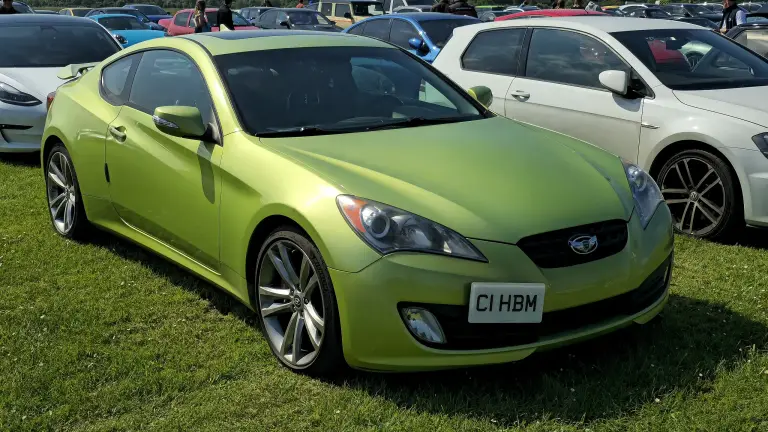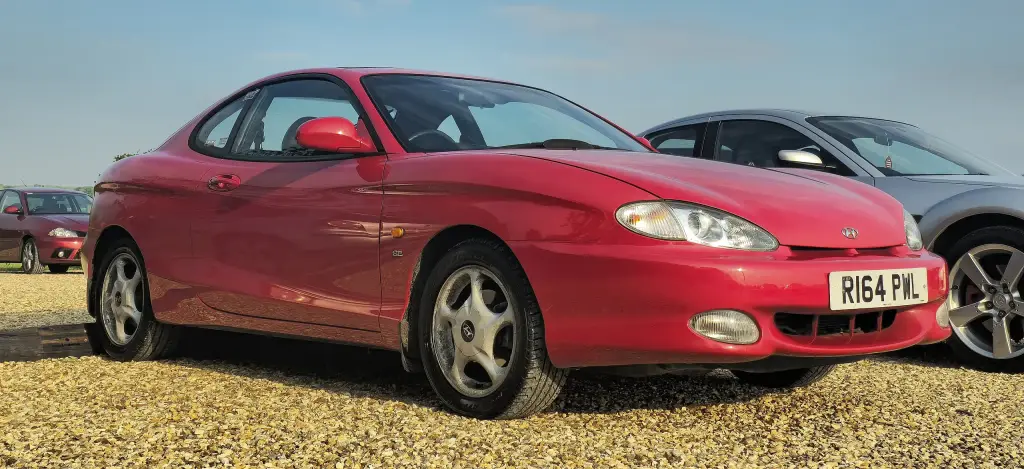
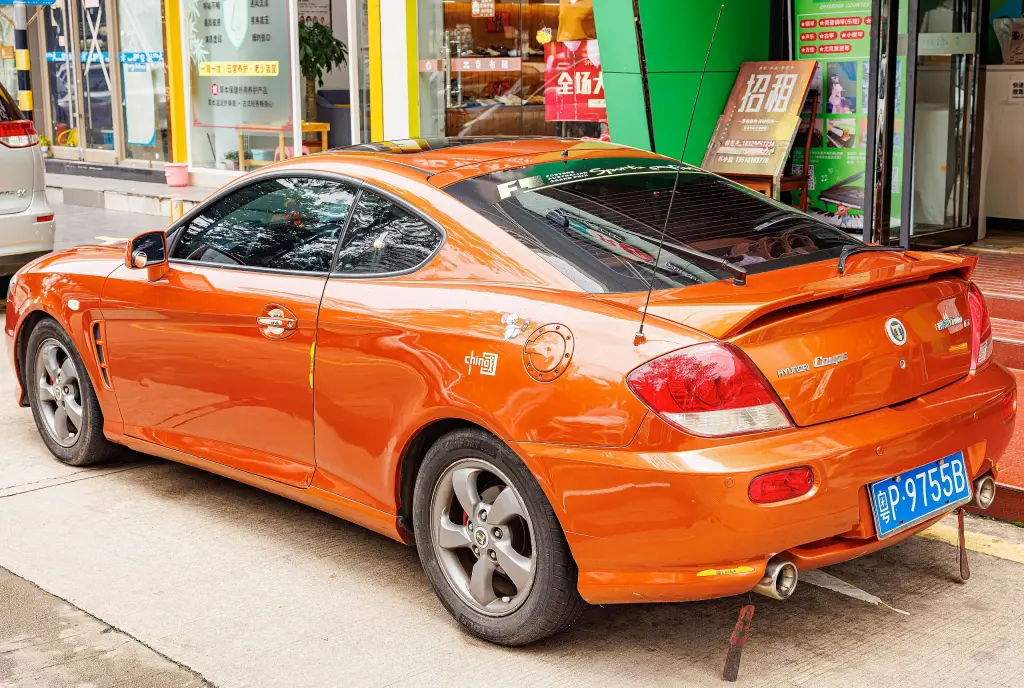
The Hyundai Tiburon, known in Europe as the Hyundai Coupé, is the front-wheel-drive sports coupé Hyundai made from 1996 to 2008. Its name is a variation of “tiburón”, the Spanish word for shark, and it was sold in Korea as the Turbulence and later the Tuscani. The car ran for two generations and was replaced by the Veloster.
Hyundai Tiburon at a glance
| Maker | Hyundai Motor Company |
|---|---|
| Production | 1996–2008 |
| Layout | front-wheel drive |
| First generation | RD, 1996–2001 |
| Second generation | GK, 2002–2008 |
| European name | Hyundai Coupé |
| Korean names | Turbulence, Tuscani |
| Design cue | HCD-II Epoch concept of 1993 |
| RD engines | 1.6 and 1.8 litres, then 2.0 litres only |
| US power | 1.8-litre 130 hp, 2.0-litre 140 hp |
| Suspension | MacPherson struts, co-developed with Porsche |
| Replaced by | Hyundai Veloster |
History of the Hyundai Tiburon
The first Tiburon went into production in late 1996 as a 1997 model and took several design cues from the HCD-II Epoch concept shown at the 1993 Detroit auto show, including a revival of the “coke bottle” styling of the 1960s and 1970s. Foreign markets could choose 1.6 or 1.8-litre engines; in the United States the base car used the Elantra’s 1.8-litre engine of 130 hp and the upscale FX a 2.0-litre four with 140 hp at the crankshaft. The 2.0-litre took the car to 60 mph in about 8.3 seconds. In 1998 the weaker 1.8-litre engine was dropped in America, leaving the 2.0-litre across the range. The MacPherson strut suspension was co-developed with Porsche.
In Britain, Hyundai’s entry into the Formula 2 World Rally Championship produced the F2 and F2 Evolution special editions. The F2 arrived in July 1998 with 16-inch multi-spoke DTM-style alloy wheels, carbon-fibre effect centre caps, a deeper front spoiler with an oval chrome mesh grille, F2 badging, a Sony CD tuner, monogrammed aluminium kick plates and a leather-and-aluminium gear lever; about 1,100 were sold for £17,999. The F2 Evolution followed on 14 June 1999 in silver or cobalt blue, designed with input from McLaren F1 stylist Peter Stevens and the Hyundai World Rally Team’s support company, and 1,513 were made against an intended 1,500.
The second generation, the GK, arrived in 2002 as a 2003 model and stayed in production until 2008. Both generations went through periodic facelifts aimed at keeping the car current, with safety improvements and changes to the exterior and interior, and the model was replaced by the Hyundai Veloster.
Design and features
- Shark name: Tiburon is a variation of the Spanish word for shark.
- Two generations: the RD of 1996 and the GK of 2002, with periodic facelifts.
- Porsche input: the first car’s MacPherson strut suspension was co-developed with Porsche.
- Rally editions: the British F2 and F2 Evolution specials of 1998 and 1999.
Hyundai Tiburon versions
- Tiburon RD (1996–2001): the first generation, 1.6, 1.8 and 2.0-litre engines.
- FX: the American 2.0-litre specification of the RD.
- Coupé F2 (1998): the British rally-linked special edition.
- Coupé F2 Evolution (1999): the Peter Stevens-designed edition of 1,513 cars.
- Tiburon GK (2002–2008): the second generation.
The Tiburon replaced the Scoupe and was replaced by the Veloster; its styling grew out of the HCD series, including the HCD-7. More Hyundai models are in the Hyundai collection.
Video: 2007 Hyundai Tiburon GS 2.0L Start Up, Quick Tour, & Rev
Video by Intechdude300 on YouTube.
Sources
- Hyundai Tiburon, English Wikipedia: name, generations, engines, design cues, British editions