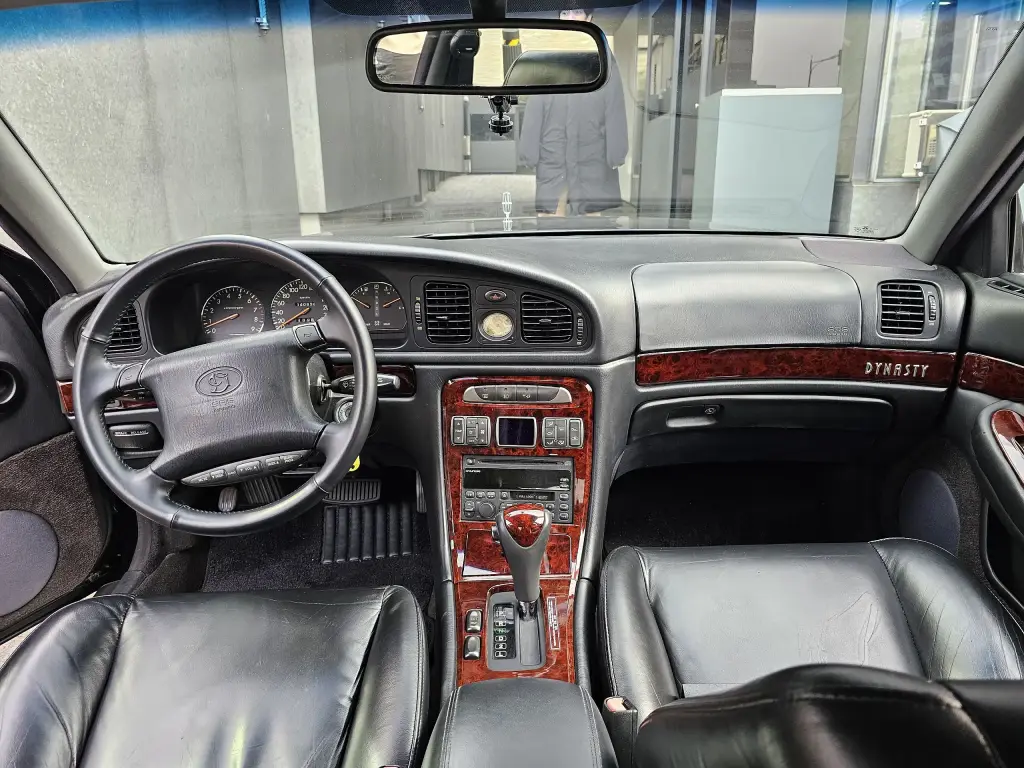
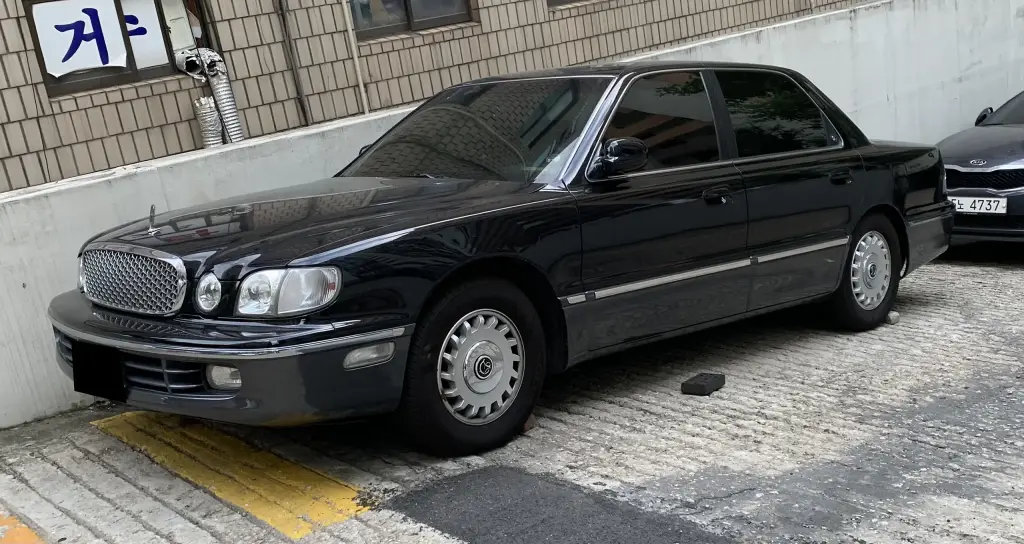
The Hyundai Dynasty is a premium executive sedan that appeared in 1996. Built on a platform shared with the smaller Grandeur, it stood apart through a different badge – a stylised D – and through a higher level of equipment, including electronically controlled suspension, dual climate control and power memory seats front and rear. It was made in Ulsan until 2005.
Hyundai Dynasty at a glance
| Maker | Hyundai Motor Company |
|---|---|
| Production | 1996–2005 |
| Built at | Ulsan, South Korea |
| Class | premium executive sedan |
| Layout | front-wheel drive |
| Engines | 2.5, 3.0 and 3.5-litre V6 petrol |
| Power | 167 PS, 205 PS and 225 PS |
| Later outputs | 162 PS, 194 PS and 210 PS |
| Badge | stylised D of its own |
| Equipment | electronically controlled suspension, dual climate control, power memory seats front and rear |
| Bodies | standard and extended length |
| Replaced in the range by | Hyundai Aslan |
History of the Hyundai Dynasty
The Dynasty was introduced in 1996 as Hyundai’s most luxurious car. It shared its platform with the smaller Grandeur, but Hyundai separated the two with a different badge and a much longer equipment list. The Dynasty was front-wheel drive, and it came with electronically controlled suspension, dual climate control and power memory seats for both front and rear passengers. Buyers could order an extended-length body to put more distance between themselves and the Grandeur.
The engine range started with a 2.5-litre V6 producing 167 PS at 6,000 rpm and went on to 3.0 and 3.5-litre units with 205 and 225 PS at 6,000 and 5,500 rpm. Claimed outputs later fell to 162, 194 and 210 PS, and the 3.0-litre eventually dropped to 185 PS.
In April 1999 the joint luxury flagship Mitsubishi Proudia and Hyundai Equus arrived, and the flagship label was taken away from the Dynasty; sales suffered, and the 3.5-litre engine was dropped at that point. The car remained in production until 2005. When Hyundai set up Genesis Motors as a separate rear-drive channel, the place in the range once filled by the front-wheel-drive Dynasty was taken by the Hyundai Aslan.
Design and features
- Own identity: a stylised D badge separated it from the Grandeur it was based on.
- Long equipment list: electronically controlled suspension, dual climate and power memory seats.
- Extended body: a longer version for buyers who wanted more rear space.
- Front-wheel drive: unusual for a flagship, and a point of contrast with the later Equus.
Hyundai Dynasty versions
- Dynasty 2.5: the entry V6 with 167 PS.
- Dynasty 3.0: 205 PS, later 194 and then 185 PS.
- Dynasty 3.5: 225 PS, dropped in 1999.
- Extended length: a longer body offered alongside the standard car.
The Dynasty shared its platform with the Grandeur and lost its flagship role to the Equus in 1999. Hyundai’s later large sedan was the Genesis. More Hyundai models are in the Hyundai collection.
Video: Hyundai Dynasty 1996 V6 3000 DOHC Engine Start up
Video by n35a2 on YouTube.
Sources
- Hyundai Dynasty, English Wikipedia: dates, equipment, engines, badge, extended body, end of flagship role