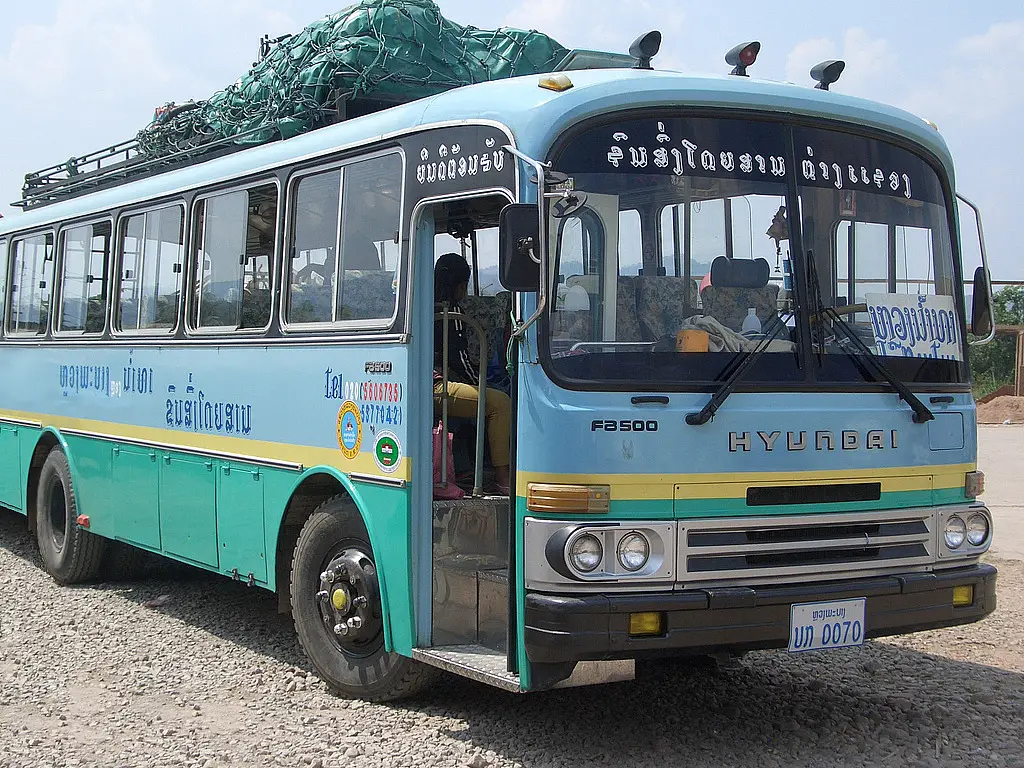
The Hyundai FB is a line of front-engined buses built by Hyundai Motor Company; the letters simply mean Front engine Bus. The range began with the FB485 and FB500, which became the reference vehicles for a programme of constant revision, and it was popular with Korean bus operators in the 1980s before demand collapsed at the end of the decade.
Hyundai FB at a glance
| Maker | Hyundai Motor Company |
|---|---|
| Type | front-engined bus and coach chassis |
| Name | FB stands for Front engine Bus |
| First models | FB485 and FB500 |
| Revision | new models in 1986 with a lowered floor |
| Engine position | at the front, ahead of the front axle |
| Rivals | Asia AM907, Daewoo BF101 and BF105 |
| Home market | South Korea |
| End of production | after 1988, when demand fell |
| Today | a few survive as tour buses and car transporters |
Based on one source, the short English Wikipedia article on the Hyundai FB.
History of the Hyundai FB
The FB range grew out of designs by Hyundai’s Thames commercial vehicle subsidiary. The engine sat at the front of the vehicle, ahead of the front axle, which is what gave the range its name. The original models, the FB485 and the FB500, then became the benchmark for a programme of constant revision rather than a single fixed design.
New models replaced the FB485 and FB500 in 1986, keeping the same front-engine layout but lowering the floor, which was possible because the supercharged diesel engine was tilted over to one side. The FB485 was sold as an economy bus for urban and suburban work, the FB500 as an economy and city bus.
The design was popular with South Korean bus companies in the 1980s, partly because operators could get considerable financial assistance for renewing their fleets. That changed with the election of a more conservative government in 1988 and the recession that followed: demand for new buses fell rapidly and production of the FB was halted. Only a small number remain in passenger service in Korea today, though many have been adapted for private use as tour buses and stock car transporters.
Design and features
- Front engine: the engine sat ahead of the front axle, the layout the name describes.
- Low floor for its time: the 1986 cars tilted the diesel engine to lower the floor.
- Two roles: the FB485 was the economy bus, the FB500 the city bus.
- Second life: many survivors were converted into tour buses and car transporters.
Hyundai FB versions
- FB485: economy bus for urban and suburban service.
- FB500: economy and city bus.
- 1986 models: replacements for the two originals with a lowered floor.
Hyundai’s later buses include the Chorus minibus and the larger Aero. More Hyundai models are in the Hyundai collection.
Sources
- Hyundai FB, English Wikipedia: origin, models, 1986 revision, end of production