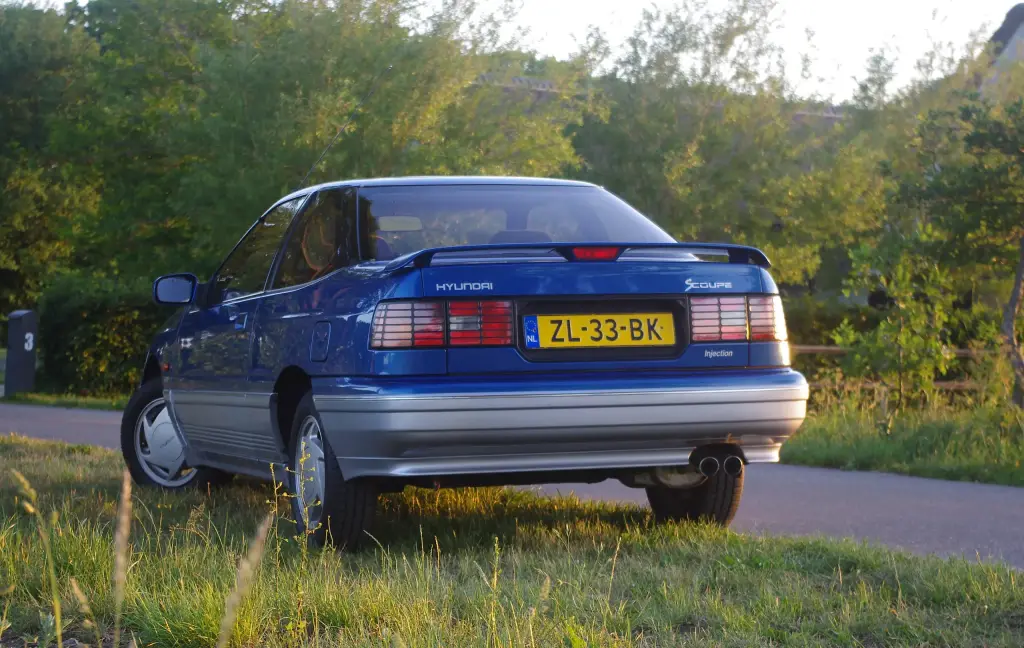
The Hyundai Scoupe, also written S-Coupe, is the two-door coupé Hyundai produced from 1990 to 1995 on the running gear of the Excel and Pony. Its name is a portmanteau of “sporty” and “coupé”, pronounced “scoop”. It was Hyundai’s first attempt at a sports car, and its turbo version used the first engine designed in Korea.
Hyundai Scoupe at a glance
| Maker | Hyundai Motor Company |
|---|---|
| Production | February 1990 – 1995 |
| Bodies | two-door coupé |
| Based on | Hyundai Excel and Pony |
| Development began | 1985 |
| Concept shown | Tokyo motor show 1989, the SLC study |
| Launch engine | 1.5-litre Mitsubishi 4G15, 81 hp |
| Alpha engine | 1,495 cc, 92 hp naturally aspirated, 115 hp turbo |
| US price at launch | 8,495 dollars |
| Total built | 242,441 |
| Sold in Korea | 63,998 |
| Replaced by | Hyundai Tiburon, 1996 |
History of the Hyundai Scoupe
Work on the Scoupe began in 1985. At the 1989 Tokyo motor show Hyundai showed a prototype called the Sports-looking Car, or SLC, and series production started in February 1990. The drivetrain and underpinnings were largely those of the Excel and Pony, with marginally shorter gearing to improve acceleration and give the car a sportier feel. In the United States it arrived for the 1991 model year at 8,495 dollars, thousands less than comparable sporty coupés, and it wore an enlarged stylised S followed by COUPE.
The first cars used an 81 hp 1.5-litre Mitsubishi 4G15 engine with a five-speed manual or four-speed automatic. In April 1991 that was replaced by Hyundai’s own 1,495 cc Alpha engine, at first naturally aspirated with 92 hp at 5,500 rpm and 132 N·m at 4,000 rpm, and from October 1991 also turbocharged with 115 hp at 5,500 rpm and 167 N·m at 4,500 rpm. The turbo came only with the five-speed manual, while the Base and LS models could have a four-speed automatic. Hyundai says the Scoupe was the first production application of Garrett’s T15 turbocharger.
The Scoupe GT, sold as the LS Turbo in America, had South Korea’s first domestically designed engine, with a cast-iron block and crankshaft, an aluminium head, aluminium pistons and steel con-rods, a compact pentroof combustion chamber with a central spark plug, Bosch engine management and a knock sensor. Externally the turbo car could be told by its black roof and TURBO badges on the rocker sills. Rod Millen drove a modified Scoupe GT to victory in the Showroom Stock 2WD class at the 1992 Pikes Peak hill climb.
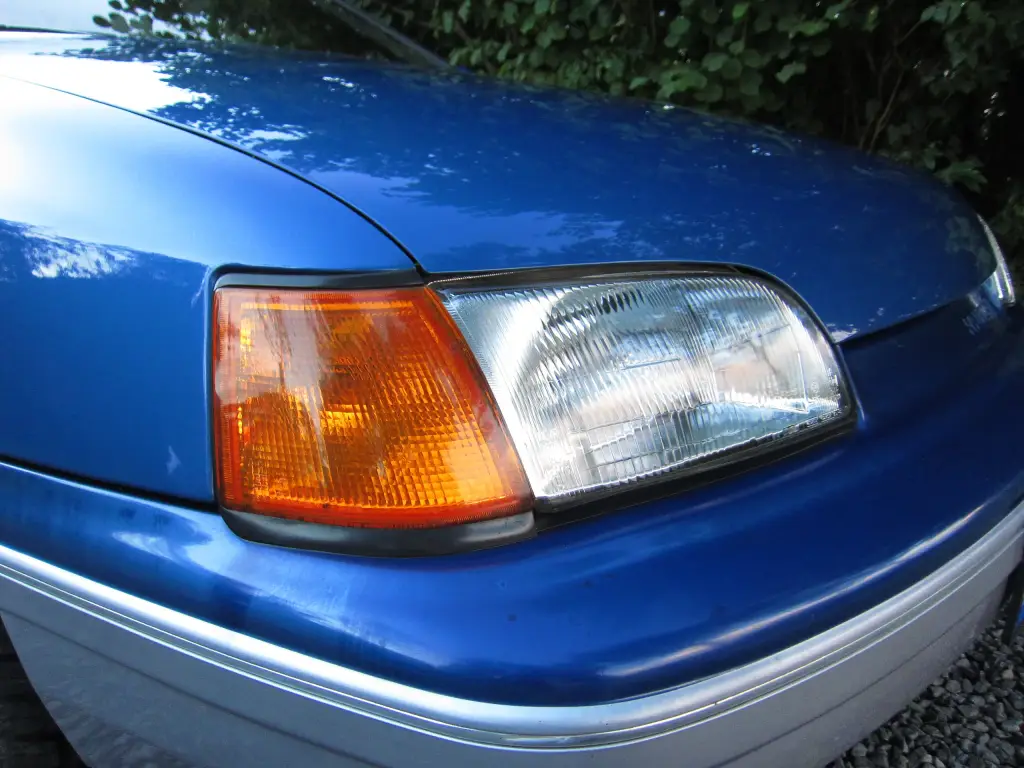
For the 1993 model year the American car was facelifted with the stylised H logo, flush headlamps, body-coloured side mouldings and a redesigned front end, tail lamps and rear bumper. When production ended in 1995 the Scoupe was one of the last cars sold in the United States with motorised seat belts instead of airbags. In total 242,441 were built, 63,998 of them for Korea and 178,443 for export, and the Tiburon replaced the car in 1996. A white facelifted Scoupe is kept at the Hyundai Namyang research institute’s history hall, together with Millen’s Pikes Peak car.
Design and features
- First Hyundai sports car: Hyundai’s first attempt at a sporting model.
- Own engine: the turbo used Korea’s first domestically designed engine.
- Cheap thrills: it undercut comparable sporty coupés in the United States.
- Rally link: a Scoupe GT won its class at Pikes Peak in 1992.
Hyundai Scoupe versions
- Scoupe (1990–1991): the original car with the Mitsubishi 4G15 engine.
- Scoupe with Alpha engine (1991–1995): 92 hp naturally aspirated.
- Scoupe GT / LS Turbo: the 115 hp turbocharged version with a black roof.
- Facelift (1993): new logo, flush headlamps and redesigned ends for the American market.
The Scoupe was based on the Excel and was replaced by the Tiburon. More Hyundai models are in the Hyundai collection.
Video: Hyundai S-Coupe 1.5 LS
Video by U2BRRK on YouTube.
Sources
- Hyundai Scoupe, English Wikipedia: development, engines, turbo, production totals, facelift