The Hyundai Elantra is the compact car with which Hyundai entered the class above the Pony and Excel. It appeared in October 1990, replaced the Stellar, and was sold as the Avante in Korea and as the Lantra in Australia and parts of Europe. From the second generation the Korean car carried the Avante name, while export markets kept Elantra.
Hyundai Elantra at a glance
| Maker | Hyundai Motor Company |
|---|---|
| Production | since 1990 |
| First generation | J1, October 1990 |
| Replaced | Hyundai Stellar |
| Also sold as | Avante, Lantra, Bimantara Nenggala |
| First engine | 1.6-litre Mitsubishi-designed four, 113 PS |
| From 1993 | 1.8-litre four, 135 PS; 1.5-litre for Korea |
| Second generation | RD/J2, March 1995 |
| Second generation bodies | sedan, station wagon (Avante Touring, Lantra Sportswagon) |
| Rivals | Ford Sierra, Vauxhall Cavalier, Opel Vectra |
History of the Hyundai Elantra
The first Elantra, codename J1, was launched in October 1990 and went on sale in Europe in spring 1991. It was larger than the Stellar it replaced, and it competed with cars such as the Ford Sierra and the Vauxhall Cavalier or Opel Vectra at a considerably lower price. Power came from a Mitsubishi-designed 1.6-litre sixteen-valve engine of 113 PS, which took the car to 60 mph in 9.5 seconds and on to 187 km/h. From the 1993 facelift a Mitsubishi-designed 1.8-litre unit of 135 PS was offered, and a twin-cam 1.5-litre engine was added for the Korean market, where 1.5 litres was a tax threshold.
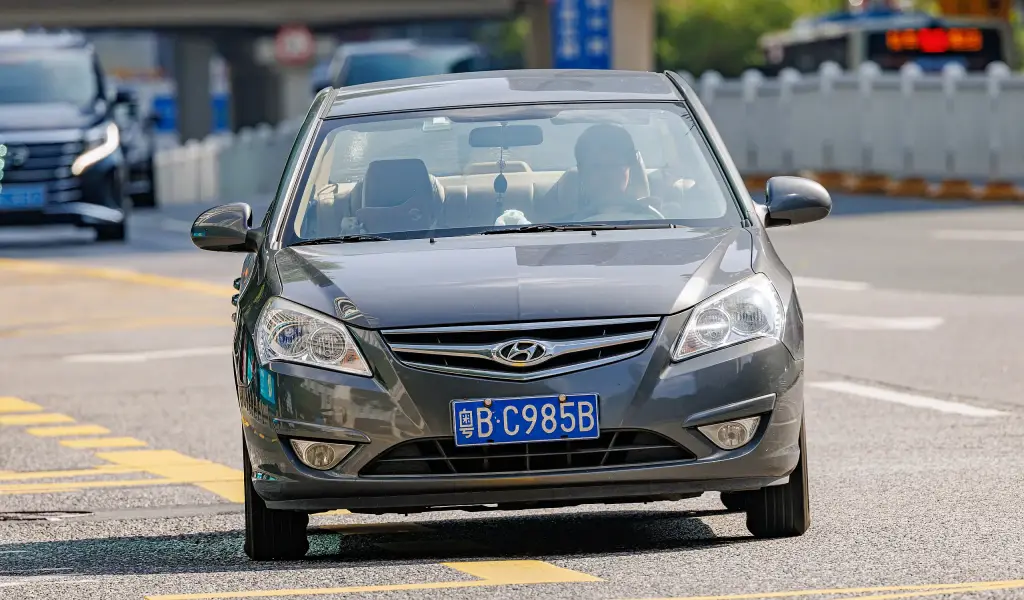
The J1 was refreshed for Europe in 1992 and facelifted in April 1993, when it gained revised front and rear ends, more organic headlights and tail lights, ABS, front airbags, fog lamps, power mirrors and optional seven-spoke alloy wheels. Between 1996 and 1998 the facelifted first-generation car was also built in Indonesia as the Bimantara Nenggala, with a 1.6-litre engine and a choice of manual or automatic transmission.
The second generation arrived in March 1995 as a sedan, with a station wagon six months later. In Korea it was the Avante in sedan form and the Avante Touring as a wagon; Australia and several European countries called it the Lantra, with the estate sold in Australia as the Lantra Sportswagon. Chief designer Choi Jong-min said the grilleless, organic shape was inspired by Korean blue and white pottery. The suspension, developed with the help of a newly acquired Cray supercomputer, used MacPherson struts at the front and a multi-link coil-sprung rear axle.
European testers found the steering imprecise and the seats short on support for tall drivers, but the car’s equipment, power and low price compensated. Korean Avantes came with the twin-cam 1.5-litre Alpha II or the 1.8-litre Beta engine, with 107 and 138 PS, raised slightly in October 1996. The European 1.6-litre Beta was offered in 90 or 114 PS form, the lower one matching German insurance and tax classes, and a single-cam 1.5-litre Alpha with 88 PS appeared in July 1996 for some export markets. The Lantra name lasted until 2001, when the third generation standardised Elantra in Australia and Europe.
Design and features
- Class above the Pony: the Elantra took Hyundai into the compact segment in 1990.
- Mitsubishi engines: the first two generations used Mitsubishi-designed four-cylinders.
- Three names: Elantra, Avante and Lantra described the same car in different markets.
- Low price: the Elantra undercut the Sierra and Vectra it was aimed at.
Hyundai Elantra versions
- Elantra J1 (1990–1995): 1.6 and 1.8-litre four-cylinders, facelifted in 1993.
- Avante (Korea): the Korean name from the second generation.
- Lantra (1995–2001): Australian and European name for the first two generations.
- Avante Touring and Lantra Sportswagon: estate versions of the second generation.
- Bimantara Nenggala: Indonesian assembly of the facelifted J1.
The Elantra replaced the Stellar and sat above the Accent in the range. More Hyundai models are in the Hyundai collection.
Video: 2014 Hyundai Elantra – Redline: Review
Video by Redline Reviews on YouTube.
Sources
- Hyundai Elantra, English Wikipedia: names, first and second generations, engines, facelifts, markets