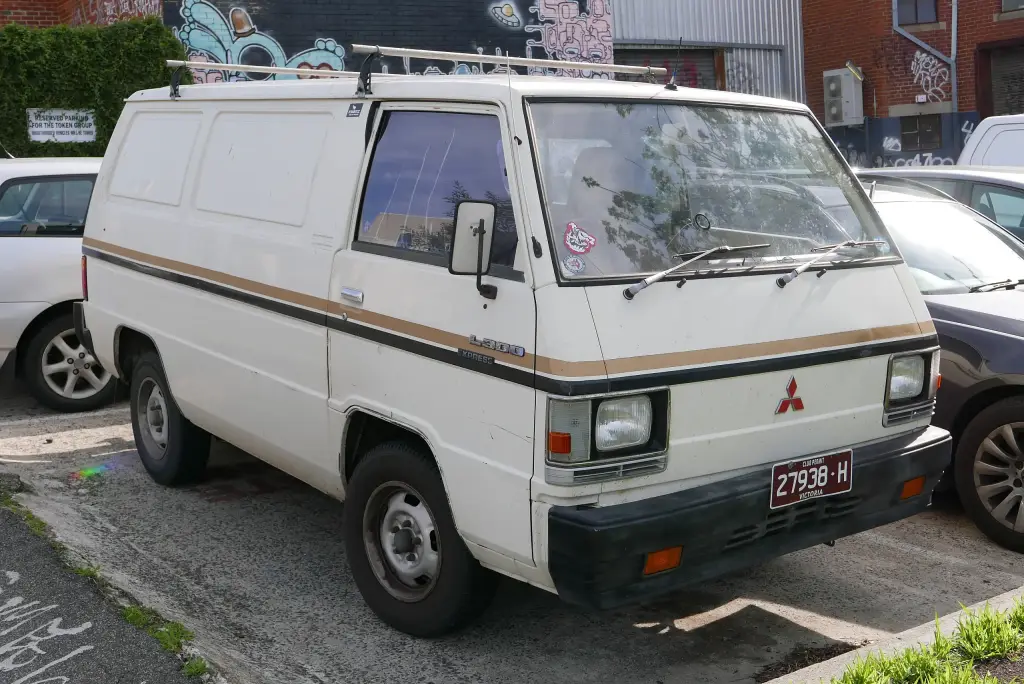
The Hyundai Grace is Hyundai’s version of the Mitsubishi Delica, the cab-over van and small bus that Mitsubishi Motors has built since 1968. The Grace is one of two vehicles Hyundai sells in export markets under the H-100 name, the other being the Porter light truck. The source used here describes the Mitsubishi original, so this page covers the Delica family that the Grace belongs to.
Hyundai Grace at a glance
| Maker in Korea | Hyundai Motor Company |
|---|---|
| Original model | Mitsubishi Delica |
| Name origin | Delica is short for “Delivery car” |
| First Delica | July 1968, T100 cab-over pickup |
| First engine | 1,088 cc KE44, 58 PS |
| Second generation | June 1979 |
| Also sold as | L300 and L400 in Europe, Express and Starwagon in Australia |
| Export name in Hyundai range | Hyundai H-100 |
| Body styles | van, minibus and passenger wagon |
Based on one source, the English Wikipedia article on the Mitsubishi Delica, which does not describe the Hyundai Grace itself; the page therefore covers the van family the Grace belongs to.
History of the Hyundai Grace
The Delica began in July 1968 as a cab-over light pickup with the chassis code T100; a cargo van and a nine-seat passenger van called the Delica Coach followed a year later. In 1971 a facelifted Delica 75 arrived with a small grille in place of bare metal and a new 1.4-litre Neptune engine of 86 PS, and after a 1974 facelift the range was sold as the Delica 1400. In export markets these early vans were usually called Colt T100, T120 or 1400, and in Indonesia the Colt name became a synonym for minibus.
The Delica was replaced in June 1979 by an all-new design that used the full 1,690 mm width allowed for compact Japanese vehicles. It had independent wishbone front suspension, leaf springs at the rear, sliding side doors and a one-piece gas-strut tailgate, and the range grew to ten versions covering passenger, cargo and recreational use. Engines were four-cylinders taken from Mitsubishi’s passenger cars, from the 1.4-litre Saturn to a 2.3-litre Astron diesel that was replaced by a 2.5-litre unit in 1986. A four-wheel-drive version appeared in October 1982, a first in the Japanese van market, using a modified Pajero chassis.
In Australia the same van was launched by Chrysler Australia in April 1980 as the Chrysler L300 Express, and it became a Mitsubishi when Mitsubishi took control of Chrysler Australia later that year. Passenger versions were known as the Delica Star Wagon until the 1994 Delica Space Gear, which was sold in Europe simply as the Space Gear. Hyundai built its own version of this van family for Korea as the Grace, and exported it under the H-100 name.
Design and features
- Cab-over layout: the engine sits under the cab, which frees length for the load area.
- Many names: L300, Express, Starwagon, Space Gear and Hyundai Grace describe the same family.
- Four-wheel drive: available in the Delica from 1982, a first for Japanese vans.
- H-100 link: in export markets Hyundai sells the van as the H-100.
Hyundai Grace versions
- Delica T100 and T120: the first cab-over pickup and van of 1968–1979.
- Delica 1400: the 1974 facelift with the single 1.4-litre engine.
- Second-generation Delica: the 1979 van with ten body and trim versions.
- Delica 4WD: the four-wheel-drive van of 1982.
- Hyundai Grace: the Korean version, exported as the H-100.
The Grace is one of the two vehicles Hyundai sells abroad as the H-100, the other being the Porter. More Hyundai models are in the Hyundai collection.
Video: Hyundai Grace 1987-1995 commercial (Korea)
Video by n35a2 on YouTube.
Sources
- Mitsubishi Delica, English Wikipedia: origins, generations, engines, export names