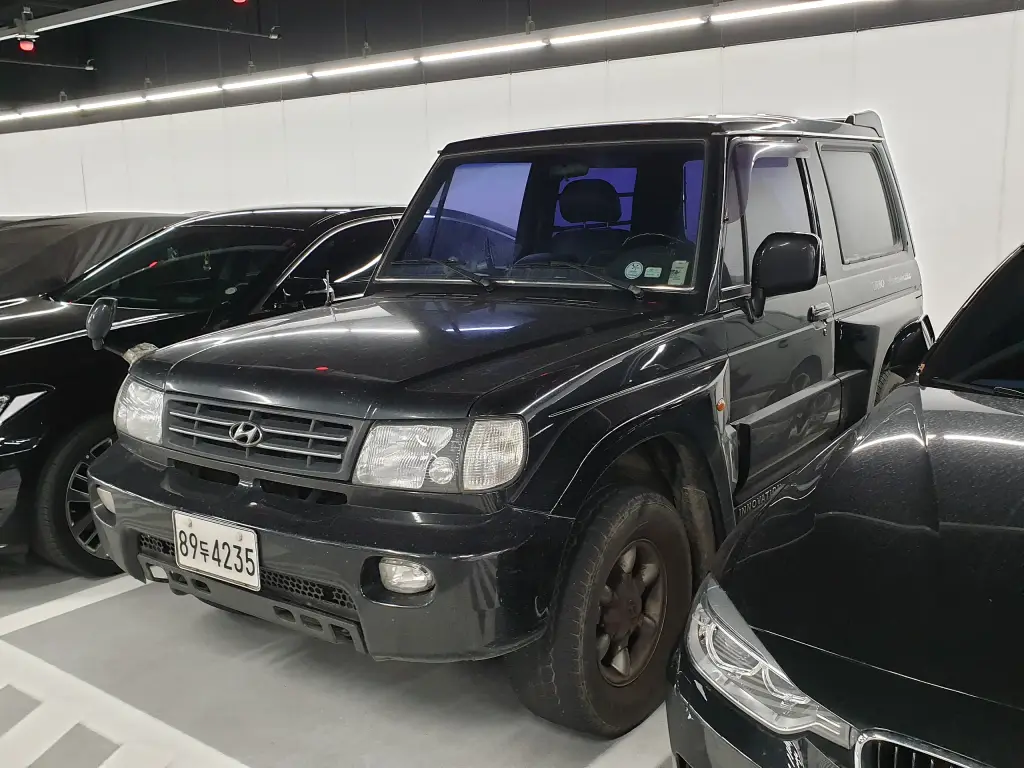
The Hyundai Galloper is the full-size SUV Hyundai made from 1991 to 2004. It was a localised version of the first-generation Mitsubishi Pajero, assembled by Hyundai Precision, and it was also sold as the Galloper Exceed, Galloper Innovation, Mitsubishi Galloper, Asia Galloper and, in China, the Hawtai Jitian.
Hyundai Galloper at a glance
| Maker | Hyundai Precision, for Hyundai Motor Company |
|---|---|
| Production | 1991–2004 |
| Based on | first-generation Mitsubishi Pajero |
| Launch event | Seoul Hyatt Hotel, 25 September 1991 |
| Bodies | three-door short wheelbase, five-door long wheelbase |
| Engines | 2.5-litre D4BA diesel, D4BF and D4BH turbodiesels, 3.0-litre V6 petrol |
| Power at launch | 73 hp diesel, later 81 and 101 hp |
| Gearbox | five-speed manual, automatic from November 1991 |
| Suspension | double wishbone and torsion bar front, live axle with leaf springs rear |
| Brakes | ventilated discs front, drums rear |
| Korean market share | 52 per cent in 1992 |
| Also sold as | Mitsubishi Galloper, Asia Galloper, Hawtai Jitian |
History of the Hyundai Galloper
Chung Mong-koo led the localisation of the Galloper at Hyundai Precision and Industry. Hyundai’s car division was sedan-oriented and reluctant to develop a utility vehicle, so the project went to the precision division, which first worked with Roush Enterprises on a four-wheel-drive vehicle; the resulting X-100 ECS ROUSH was rejected after test audiences panned it. Hyundai Precision then chose the Mitsubishi Pajero for local production and rebuilt a former container factory in Yeompo-dong as a dedicated car plant.

The launch event was held at the Seoul Hyatt Hotel on 25 September 1991, and within a year the Galloper was the best-selling SUV in Korea. Hyundai Precision assembled its 5,000th car in February 1992 and sold 24,000 Gallopers that year, taking 52 per cent of the domestic market and unseating the SsangYong Korando. To advertise the car, three Gallopers drove 73,000 km from Mumbai through 35 countries to Cabo da Roca in Portugal between March 1992 and January 1993 on what Hyundai called the route of Marco Polo.
At launch the car had round sealed-beam headlamps and came as the Standard, a five-seat short-wheelbase model, or the Exceed, a long-wheelbase version with six seats. Power came from a 2.5-litre naturally aspirated D4BA diesel of 73 hp and 108 lb·ft, with a five-speed manual and, from November 1991, an automatic option; a D4BF turbodiesel with 81 hp followed in December, and a 3.0-litre V6 petrol in February 1992. An intercooler added in 1993 turned the turbodiesel into the 101 hp D4BH. The chassis used double wishbones and torsion bars at the front and a live axle with asymmetric leaf springs at the rear, with ventilated front discs, rear drums and a load-sensing valve.
A mild restyling in 1994 brought square headlights and horizontal door mirrors, along with new body styles and engines including a nine-seat version. Exports began in 1994 with China, the 100,000th car was built in December 1994, and from 1997 the Galloper was sold in most European markets in left-hand drive. Since the early 2010s early cars have risen in value: customers pay more than 30 million won to restore vehicles bought for a twentieth of that, and Mohenic Garage builds restomod Gallopers as the Mohenic G for up to 85 million won. Because of the engine’s obsolete pollution control, driving a Galloper into central Seoul has been restricted since 2021.
Design and features
- Pajero base: the body, chassis and engines came from the first-generation Mitsubishi Pajero.
- Korean changes: steel brush guards, running boards and door-mounted mirrors for the home market.
- Seven seats: five seats as standard, with a third row for two more.
- Restomod fame: the Galloper has become a cult car for Korean restorers.
Hyundai Galloper versions
- Galloper Standard: five-seat short-wheelbase car.
- Galloper Exceed: six-seat long-wheelbase car with the brush guards and running boards.
- Galloper Innovation: short-wheelbase three-door version.
- 1994 restyling: square headlights, new engines and a nine-seat body.
- Mohenic G: a restomod built by Mohenic Garage.
The Galloper was Hyundai’s first serious SUV, a role later taken by the Terracan and the Tucson. More Hyundai models are in the Hyundai collection.
Video: Hyundai Galloper off road
Video by Deividas Daugela on YouTube.
Sources
- Hyundai Galloper, English Wikipedia: development, launch, sales, engines, restyling, restomod scene