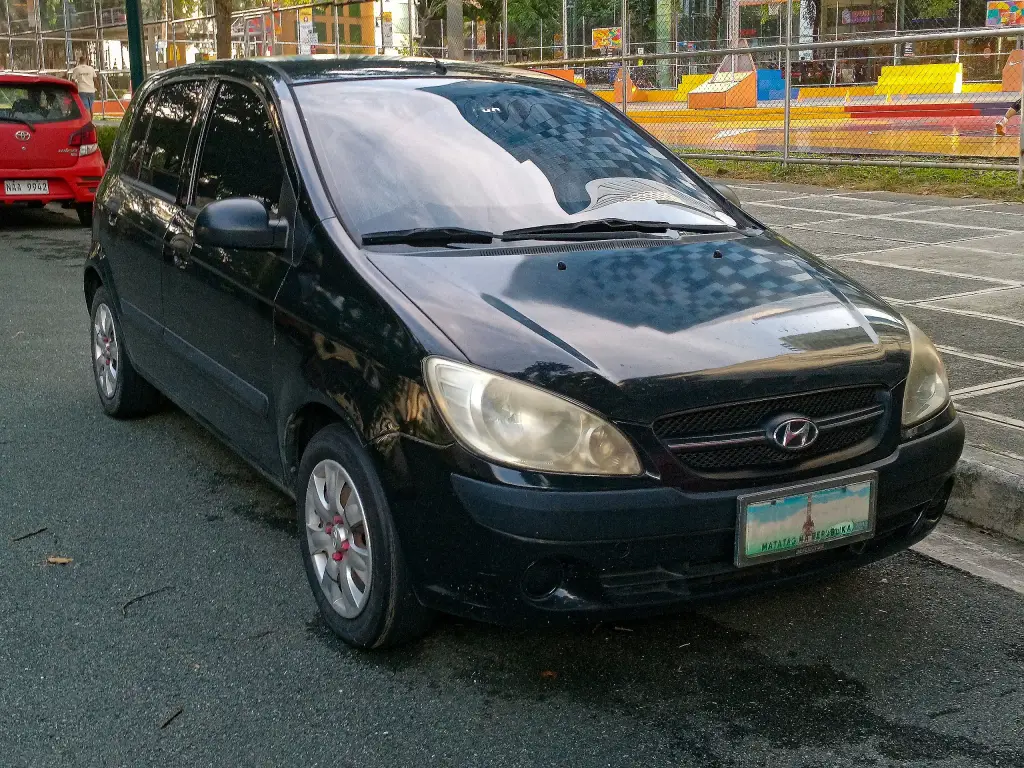
The Hyundai Getz is the supermini Hyundai sold from 2002 to 2011. It was designed at the company’s European engineering centre in Frankfurt, made in Korea, India, Venezuela, Malaysia and Taiwan, and sold almost everywhere except the United States, Canada and China. In Korea it was the Click, in Japan the TB, in Malaysia the Inokom Getz, and in Venezuela the Dodge Brisa.
Hyundai Getz at a glance
| Maker | Hyundai Motor Company |
|---|---|
| Production | 2002–2011 |
| Bodies | three-door and five-door hatchback |
| Designed at | Hyundai European engineering centre, Frankfurt |
| Shown as a concept | Hyundai TB, Tokyo motor show 2001 |
| Premiere | Geneva motor show, 2002 |
| Built in | Ulsan; Chennai, India; Barcelona, Venezuela; Kulim, Malaysia; Taipei, Taiwan |
| Petrol engines | 1.1, 1.3, 1.5, later 1.4 and 1.6 litres |
| Diesel engines | 1.5-litre three-cylinder, then 1.5-litre VGT |
| Gearboxes | five-speed manual, four-speed automatic |
| Facelift | autumn 2005 |
| Also sold as | Click, TB, Getz Prime, Inokom Getz, Dodge Brisa |
History of the Hyundai Getz
The Getz first appeared as a concept called the Hyundai TB, for “Think Basic”, at the 2001 Tokyo motor show. The production car had its world premiere at the 2002 Geneva motor show in three and five-door hatchback form, designed in Frankfurt and built at Ulsan in Korea from 2002 to 2011 and at Hyundai Motor India’s Chennai plant from 2004 to 2009. It was also assembled in Barcelona in Venezuela, in Kulim in Malaysia and in Taipei, Taiwan. Hyundai has said the name stands for “achieved by desirability”, a link-up of “get” and “it”.
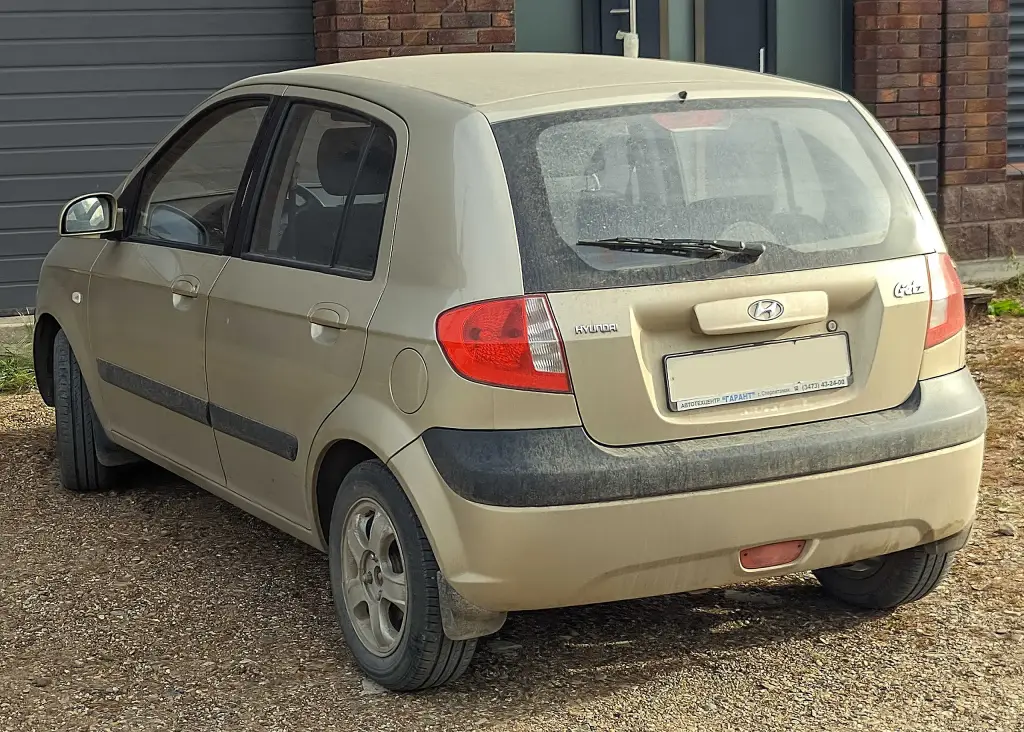
At launch there were three petrol engines of 1.1, 1.3 and 1.5 litres and a 1.5-litre three-cylinder diesel licensed from VM Motori. Australia took only the 1.5-litre petrol at first. There were four-speed automatics with overdrive for the 1.3 and 1.6-litre cars and five-speed manuals across the range. The facelift arrived at the Frankfurt motor show in autumn 2005 with revised front and rear styling, rounder headlights, a new grille, a new 1.4-litre petrol engine in place of the 1.3 and an updated 1.5-litre diesel with variable geometry turbocharging; the dashboard and trim were also upgraded.
Trim levels differed widely. Britain had GSI, CDX and Sport, New Zealand had XD and XE, and Australia started with XL, GL and FX before moving to the SXi and then, in 2008, to S and SX. The top versions generally came with front and side airbags, ABS with electronic brakeforce distribution, remote central locking, 14 or 15-inch alloy wheels, fog lights, air conditioning, heated electric mirrors, a sunroof, electric windows, a CD player and a trip computer.
Local production produced several variants. In Venezuela the car was assembled with a 1.6-litre engine and also badge-engineered as the Dodge Brisa with a 1.3-litre engine and four-speed manual; assembly there continued until 2014. In Malaysia it was built as the Inokom Getz with a single 1.4-litre engine, and a limited Getz SE of 300 cars appeared in late 2009. Between 2008 and 2014 an Australian company, Blade Electric Vehicles, converted the Getz into an electric car called the Blade Electron, the first commercially available electric car in Australia at AU$52,000; about 50 were made. The Getz was replaced in Europe by the i20 in 2008 and in Korea by the Accent.
Design and features
- Frankfurt design: drawn at Hyundai’s European engineering centre.
- Global reach: built in five countries and sold on every continent except North America and China.
- Wide engine range: petrol units from 1.1 to 1.6 litres, plus 1.5-litre diesels.
- Electric conversion: the Blade Electron turned the Getz into Australia’s first series electric car.
Hyundai Getz versions
- Getz (2002–2005): the original three and five-door car.
- Getz facelift (2005–2011): new front and rear, 1.4-litre petrol engine, updated diesel.
- Click: the Korean-market name.
- Inokom Getz: Malaysian assembly with a 1.4-litre engine.
- Dodge Brisa: the Venezuelan version with a 1.3-litre engine.
- Blade Electron: an Australian electric conversion of 2008–2014.
The Getz sat between the smaller Atos and the larger Accent, and it was replaced in Europe by the i20. More Hyundai models are in the Hyundai collection.
Video: Hyundai Getz: Demonstration test
Video by Рафаэль Мингазов on YouTube.
Sources
- Hyundai Getz, English Wikipedia: production, names, engines, facelift, trims, local variants