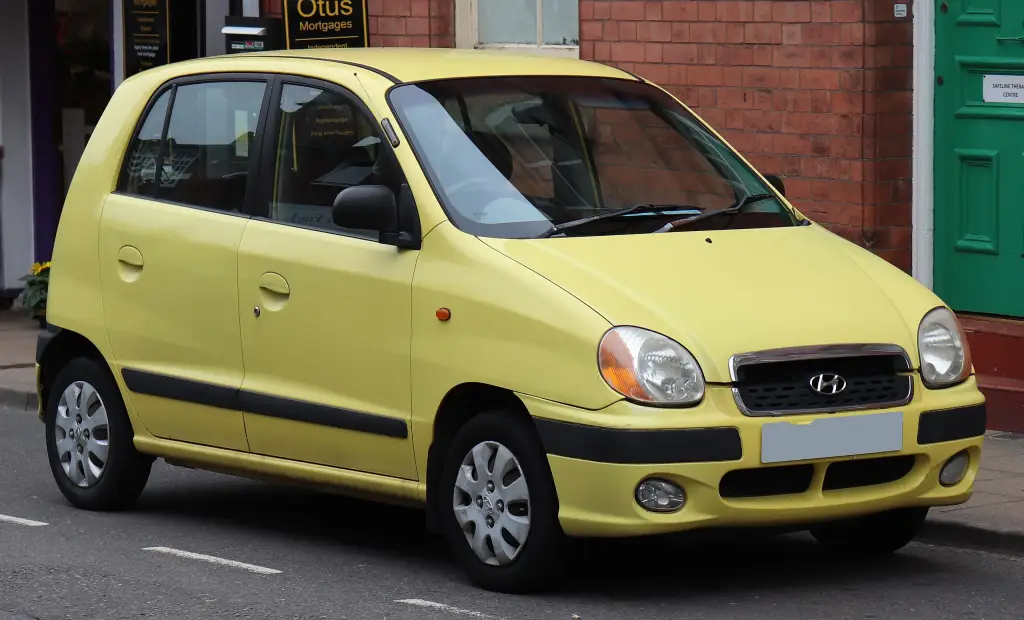
The Hyundai Atos is the city car that Hyundai launched in September 1997. Less than 3.50 metres long, it used a mini-van shape to make the most of a tiny footprint, and it became the Amica in Britain, the Atoz in some markets, the Santro in India and the Kia Visto in Korea. Hyundai replaced it with the i10 in most markets in 2007, but Indian production continued until late 2014.
Hyundai Atos at a glance
| Maker | Hyundai Motor Company |
|---|---|
| Production | 1997–2014 |
| Also sold as | Amica, Atoz, Santro, Kia Visto |
| Built at | Ulsan, South Korea |
| Body | five-door hatchback |
| Engines | 0.8 Epsilon (Korea), 1.0 Epsilon (export), 1.1 Epsilon 12v from 2003 |
| Power, 1.1 | 59 hp (44 kW) |
| Suspension | MacPherson struts front, torsion beam rear |
| Brakes | discs front, drums rear |
| Boot | 263 litres, 1,064 litres with the rear seat folded |
| Atos Prime boot | 219 litres, 889 litres maximum |
| Length | under 3.50 m |
History of the Hyundai Atos
Hyundai began work on a minicar in October 1995, after its main Korean rival Daewoo had already put a city car into production. The company went from blank sheet to production in 23 months with a total investment of 155 million dollars. The result was the Atos, released in September 1997: under 3.50 metres long, five doors, five seats, with a soft one-box shape that gave it an unusually roomy interior. The Korean car used a four-cylinder 800 cc Epsilon engine; export versions got the larger 1.0-litre Epsilon. The European car was shown at the Frankfurt motor show in September 1997 and went on sale in March 1998.
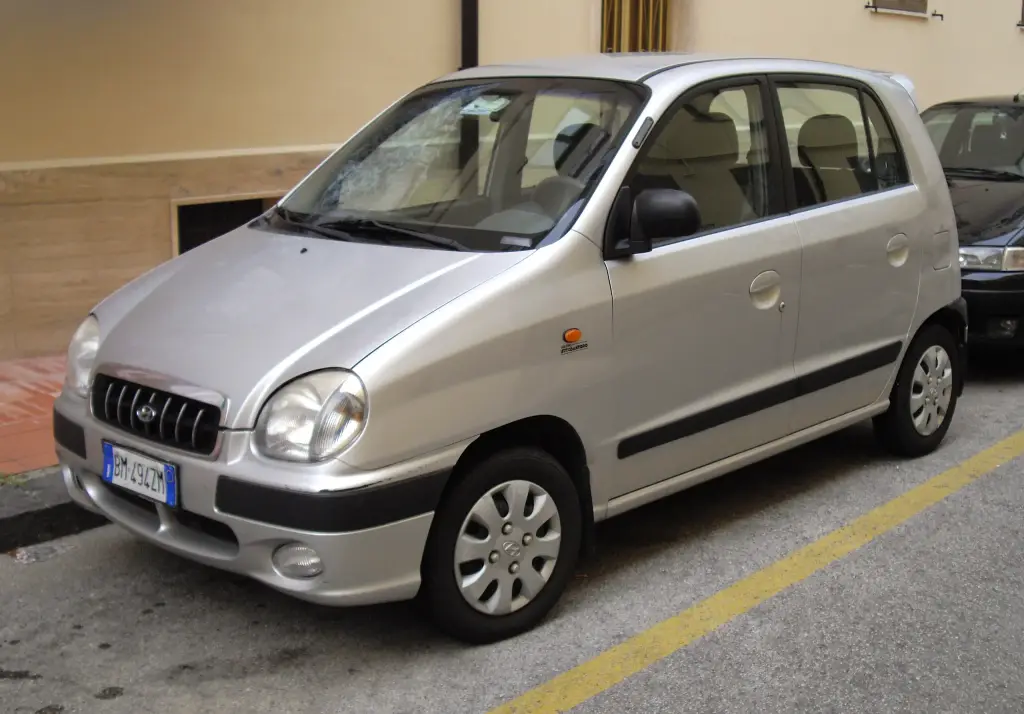
The technical package was deliberately simple and cheap: front-wheel drive, MacPherson struts at the front, a torsion beam at the rear, front disc and rear drum brakes. The boot held 263 litres, or 1,064 litres with the rear seat folded. Airbags and ABS were standard only on the better-equipped versions. The design is remembered for round headlights, unpainted plastic bumpers, upright tail lights and a very large tailgate.
A restyled version with a different rear and new rear doors appeared in 1999 as the Atos Prime. Hyundai had just taken a majority stake in Kia and planned to sell the car through Kia dealers as the Kia Visto; European Hyundai dealers objected, so it was renamed Atos Prime and sold as a better-equipped companion to the original car. In Korea and Indonesia it kept the Visto name. The Prime had a roof 4.5 cm lower, a smaller boot of 219 litres and the same 1.0-litre engine.
The Indian version, the Santro, started production in October 1998 with a redesigned body. The 2003 facelift brought an entirely new nose and tail in a more angular style and a new 1.1-litre twelve-valve Epsilon engine of 59 hp with a five-speed manual gearbox or a four-speed automatic. A further facelift in 2005 updated the engine to Euro 4 in Europe. In India the car carried on as the Santro Xing until late 2014.
Design and features
- Mini-van shape: a tall, short body that made the most of the interior space.
- Two engines: an 800 cc unit for Korea and a 1.0-litre for export markets.
- Simple running gear: front-wheel drive, torsion-beam rear suspension, front discs.
- Big tailgate: easy access to a 263-litre boot that grew to 1,064 litres.
Hyundai Atos versions
- Atos (1997): the original five-door with the 800 cc or 1.0-litre engine.
- Atos Prime (1999): lower roof, restyled tail, smaller boot.
- Santro and Santro Xing: Indian versions, the later one with the 2003 body.
- Kia Visto: the same car sold through Kia dealers in Korea and Indonesia.
- Amica: the British-market name.
The Atos was replaced in most markets by the i10, and its Indian career continued as the Santro. More Hyundai models are in the Hyundai collection.
Video: Hyundai ATOS 1.0 Sprint 0-100km/h
Video by TOMEK Sitek Car Vlog on YouTube.
Sources
- Hyundai Atos, English Wikipedia: development, engines, dimensions, Atos Prime, Santro, facelifts