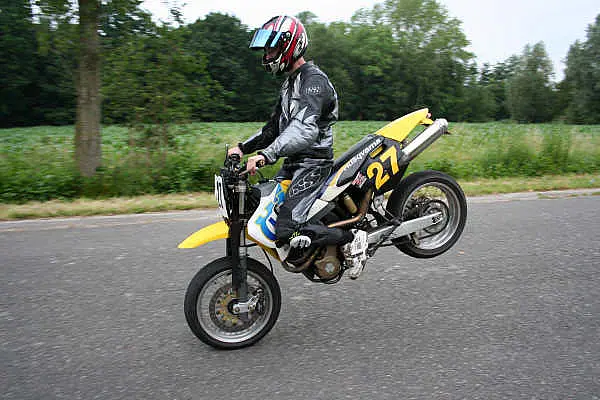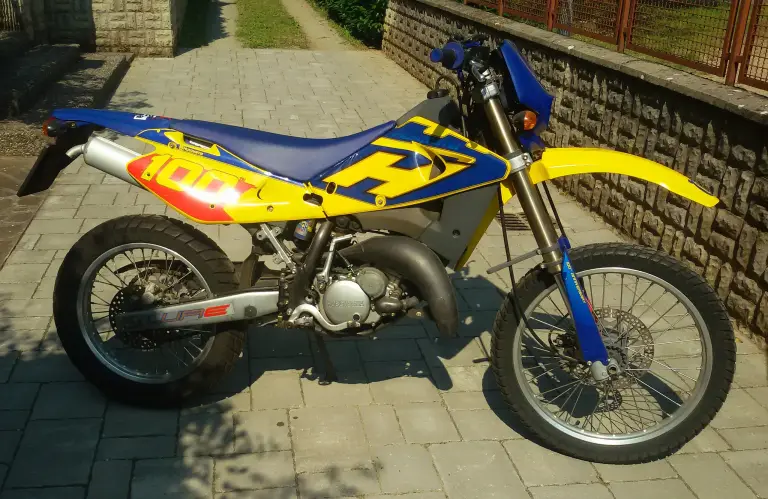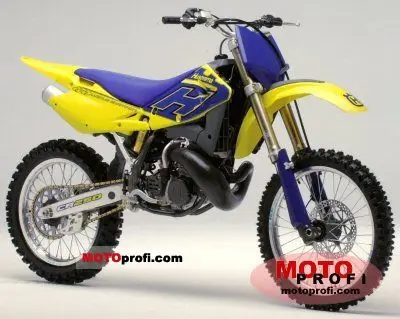
The Husqvarna CR was the Swedish firm’s line of two-stroke motocross motorcycles, presented in 1972 with a 400 and produced in capacities from 50 to 430 cc. From 2002 the range was joined by the four-stroke Husqvarna TC.
Husqvarna CR at a glance
| Type | motocross, two-stroke |
|---|---|
| Introduced | 1972, with a 400 cc model |
| Capacities | 50, 65, 125, 250 cc and the 360, 390, 400 and 430 cc group |
| Four-stroke sibling | Husqvarna TC, from 2002 |
| 50 and 65 | introduced to the market in the middle of 2010 |
| CR 125 | motocross bike from 1975 |
| CR 250 | from 1973 to 2005 |
| Big-bore group | 400 in 1972, 360 in 1973, 390 in 1974 and 430 in 1981, built until 1989 |
| Cooling | air-cooled until 1984, liquid-cooled from 1984 |
| Rear suspension | Doublecross until 1985, then Monocross with linkages |
| Brakes | front disc from 1985, discs front and rear from 1989 |
Based on one source: the Italian Wikipedia article on the CR line.
History of the Husqvarna CR
The line
The CR was presented in 1972 with a 400 cc machine and was produced in several capacities: 50, 65, 125 and 250 cc, and the 360, 390, 400 and 430 cc group. From 2002 the two-stroke motocross range was accompanied by the Husqvarna TC, which is distinguished by its four-stroke engine.
50 and 65
The two smallest CR models, the 50 and the 65, were introduced to the market in the middle of 2010.
CR 125
The CR 125 was a motocross competition bike from 1975, with an air-cooled two-stroke engine. Liquid cooling arrived in 1984 together with a change from the Doublecross rear suspension to a Monocross layout with linkages, and the engine dimensions moved from 55.75 x 51 mm to 55 x 52.5 mm; they changed again in 1988 to 56 x 50.6 mm and in 1997 to 54 x 54.5 mm. A front disc replaced the all-drum braking system in 1985, and the bike went to discs front and rear in 1989.
In 1988, after Cagiva had bought Husqvarna the previous year, the engine and frame were changed and taken directly from the Cagiva WMX, and the CTS (Cagiva Torque System) exhaust system was introduced. In 1989 the Cagiva lettering disappeared, the system became the HTS (Husqvarna Torque System), and a new inverted fork was fitted. New bodywork in 2000 and again in 2006 reduced the size of the machine, and 2009 brought a new frame and smaller side number plates.
CR 250
The CR 250 was a motocross bike from 1973, also with an air-cooled engine. Liquid cooling came in 1984; in 1985 the Doublecross rear suspension gave way to a Monocross with linkages and a front disc replaced the drum brakes, with discs all round from 1989. The engine measured 69.5 x 65 mm until 1987, when it became 70 x 64 mm, and 66.4 x 72 mm from 1999. An inverted fork and the HTS exhaust system arrived in 1989, the bodywork was renewed in 2000, and 2005 was the model’s last year of production.
CR 360, 390, 400 and 430
This group began in 1972 with a 400 cc engine, reduced to 360 cc in 1973, enlarged to 390 cc in 1974 and to 430 cc in 1981; the 430 was built until 1989. Liquid cooling and the Monocross rear suspension arrived in 1985, and a front disc brake followed in 1986.
Design and features
- Wide range: two-stroke motocross bikes from 50 to 430 cc, presented in 1972 with the 400.
- Liquid cooling: adopted across the range in 1984.
- Monocross suspension: replaced the Doublecross layout in 1985.
- Brakes: a front disc in 1985 and discs front and rear from 1989.
- Cagiva engineering: from 1988 the 125 used the engine and frame of the Cagiva WMX, with the CTS exhaust that became the Husqvarna HTS in 1989.
Husqvarna CR versions
- CR 50 and CR 65: the smallest motocross models, on sale from the middle of 2010.
- CR 125: in production as a motocross bike from 1975.
- CR 250: built from 1973 to 2005.
- CR 360, 390, 400 and 430: one family of big-bore motocross bikes built from 1972 to 1989.
- TC: the four-stroke motocross range that joined the CR from 2002.
The two-stroke CR was the basis of the enduro Husqvarna WR, and its supermoto relative was the SM. More Husqvarna models are in the Husqvarna collection.
Video: Husqvarna CR 125 2008 first ride of the season
Video by OFFensywa on YouTube.
Sources
- Husqvarna CR, Italian Wikipedia: history, capacities, technical changes by year