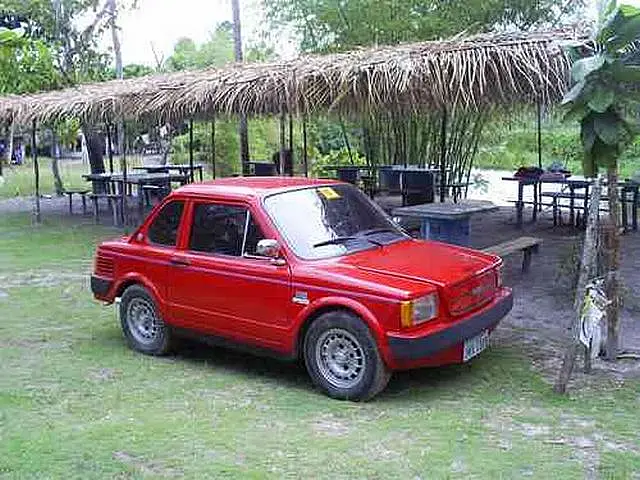
The Gurgel XEF was a compact sedan produced by the Brazilian manufacturer Gurgel from 1982 to 1986. It combined a body of glassfibre-reinforced plastic with Volkswagen running gear and styling details that deliberately echoed Mercedes-Benz, the dream car of Brazilian buyers at a time when imports were forbidden.
Gurgel XEF at a glance
| Maker | Gurgel, Brazil |
|---|---|
| Production | 1982–1986 |
| First shown | São Paulo motor show, 1981, as the GTA |
| Renamed XEF | 1983 |
| Engine | VW 1600 air-cooled flat-four |
| Power | 48 hp petrol, 56 hp ethanol with twin carburettors |
| Gearbox | four-speed plus reverse, VW 1300 ratios |
| Length | 3.12 m |
| Wheelbase | 1.80 m |
| Width | 1.70 m |
| Top speed | about 140 km/h |
| Built and licensed | 145 cars, 58 on ethanol and 87 on petrol |
Based on one source: the XEF has a detailed Portuguese Wikipedia article and no English page.
History of the Gurgel XEF
From GTA to XEF
Gurgel had always wanted to build a small, quick car for crowded cities. As a student, João Gurgel had designed a vehicle with a two-cylinder engine; once he was a maker of utilities built around Beetle mechanics, he used that mechanical package for his first compact urban car. The new model was shown at the São Paulo motor show in 1981 as the GTA, Grã Turismo Articulado. In 1983 it was modified and renamed XEF, gaining a Fiat 147 quarter light, a hatch-shaped window, and the windscreen and rear window of the Volkswagen Brasília. At first, because luggage space was so small, a little trailer could be coupled behind the car as a removable boot — an idea buyers rejected.
Development
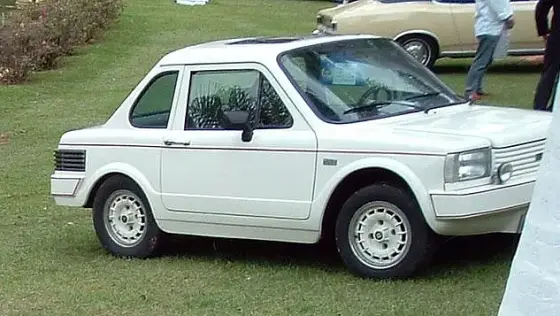
Production began in 1982 and the car was revised repeatedly: the rear step was removed, the hatch was made oval, the engine lid and air outlets were moved behind the number plate, cooling fins were added and the bumpers received two claws. Inside, the instruments became horizontal, the rev counter grew to the size of the speedometer and the head restraints were separated from the seats. The G emblem moved from the bonnet to the rear pillar. The model was built until 1986, in which year the grille was integrated into the bonnet and the bumpers lost their claws in favour of rubber protection; a single bench seat became an option and the handbrake moved under the dashboard. A pickup version called the E-250 was presented at the same time but never produced.
The name
The letters XEF were chosen by Maria Cristina, João Gurgel’s daughter. She came home driving the prototype and, when asked whose car it was, answered “É do chefe!” — it is the boss’s — which showed that her father had designed it.
Design and interior
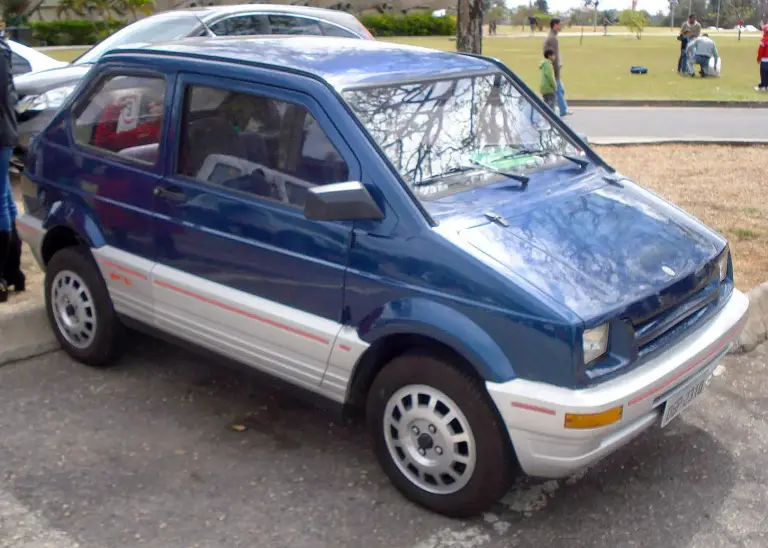
The shape imitated the details of 1980s Mercedes-Benz models: the styling of the front wing, the rectangular headlights from the Volkswagen Voyage with indicator lenses at their ends, a matt black false grille and a stylised G on the bonnet. The three-box profile was unusual in such a small car, and the tail lights came from the Volkswagen Brasília. Inside there was room for three abreast thanks to the 1.70 m width, the driver’s seat was separate from the passenger bench, and the trim was far from Gurgel’s usual spartan standard: carpet throughout, electric windows and a factory cassette player. Air conditioning was considered and dropped. All 145 cars built were licensed for the road, 58 running on ethanol and 87 on petrol.
Design and features
- Mercedes-inspired styling: rectangular Voyage headlights, a false black grille and a G emblem.
- Three-box body: a saloon profile rare among very small cars.
- Volkswagen mechanics: 1600 air-cooled engine, four-speed gearbox with VW 1300 ratios and Beetle suspension.
- Unusual equipment: electric windows, cassette player and a five-instrument dashboard.
- Rarity: fewer than 200 cars in six years, all of them licensed.
Gurgel XEF versions
- GTA (1981): the show car that became the XEF.
- XEF (1982–1986): the production sedan.
- Petrol and ethanol: 48 hp with a single carburettor or 56 hp with twin carburettors.
- E-250 pickup: shown but never built.
The XEF was Gurgel’s first attempt at a city car, before the BR-800 and the Supermini. The X-12 remained the company’s main product, and more cars are in the Gurgel collection.
Video: Gurgel XEF
Video by HeimLabor on YouTube.
Sources
- Gurgel XEF, Portuguese Wikipedia: history, design, interior, specification, licensing