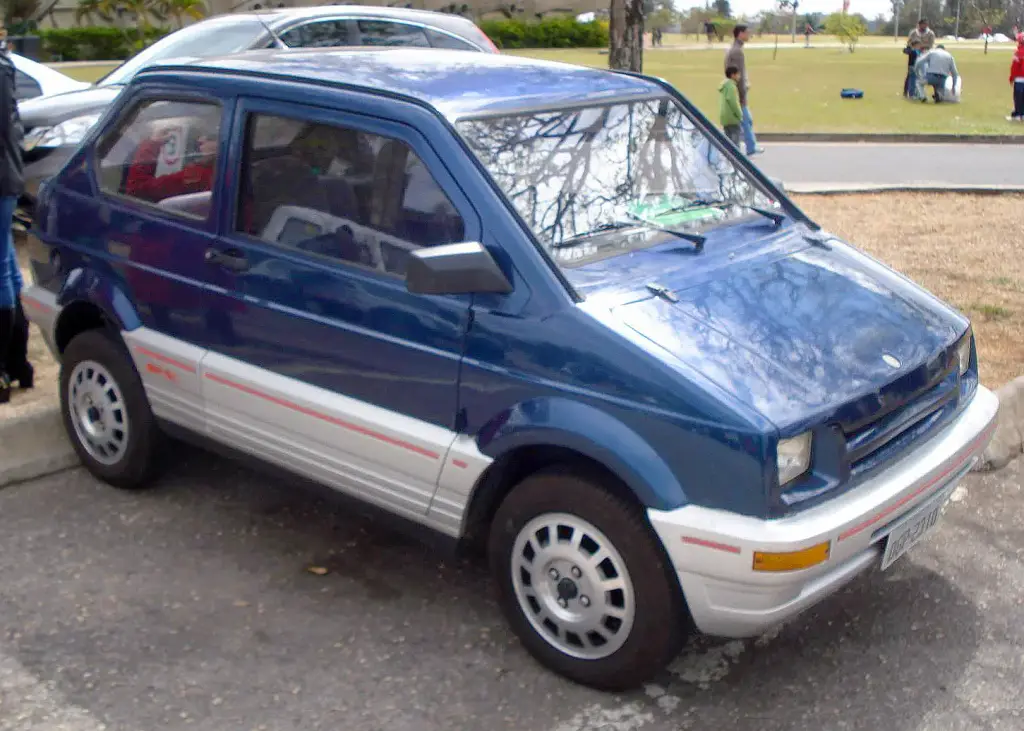
The Gurgel Supermini was a Brazilian city car produced by Gurgel from 1992 to 1994. It was the successor of the BR-800, with a better finish, a revised body and a more powerful version of the company’s own flat-twin engine.
Gurgel Supermini at a glance
| Maker | Gurgel Motores, Brazil |
|---|---|
| Production | 1992–1994 |
| Engine | Gurgel Enertron, 792 cc water-cooled flat-twin |
| Carburettor | single Brosol H 36, Alfa 1 28 optional |
| Power | 36 hp at 5,500 rpm |
| Torque | 65 N·m at 2,500 rpm |
| Gearbox | four-speed manual, rear-wheel drive |
| Weight | 645 kg |
| Top speed | 110 km/h |
| Body | three-door hatchback, four seats |
| Length | 3,195 mm |
| Wheelbase | 2,000 mm |
History of the Gurgel Supermini
An answer to the new 1.0-litre cars
The Supermini was Gurgel’s answer to the one-litre models arriving from the competition. It followed the same idea as the BR-800 — a compact, economical city car — but with a more modern shape, better trim and more power. Compared with its predecessor it gained some curves, a better-designed dashboard, higher and better seats, a fully carpeted interior and a wheelbase 10 cm longer.
Equipment
The SL, the most common version, came with a rev counter, an analogue clock, a cassette player with a roof aerial, a brake light, indicator repeaters on the roof and a split folding rear seat, at a time when rivals in the one-litre class did not even offer a right-hand mirror or head restraints. The body was still of glassfibre, and the front of the chassis had a “fuse” that deformed in a collision to absorb the impact. About 65 per cent of the Supermini was made of fibreglass, including the dashboard and door trims, and some engine parts.
Mechanically
The engine remained the Enertron, now with 36 hp, and the car kept rear-wheel drive with a new gearbox — an Argentine unit, so the Supermini was not entirely Brazilian like the BR-800. The front suspension was independent with coil springs, and the rear used Gurgel’s patented Leaf Coil system combining parallel steel leaves with coil springs and dampers. The steering was rack and pinion with an 8.8 m turning circle, and the brakes were discs at the front and drums at the rear.
The end
Despite the technical progress, the competition offered more powerful, roomier and more comfortable cars. Sales fell sharply, production continued to the end of 1994, and a few cars were sold in 1995 as 1995 models before Gurgel Motores S/A went bankrupt. Many Superminis still run in Brazil today, often with a Volkswagen Beetle or Gol engine fitted in place of the original.
Design and features
- Enertron flat-twin: 792 cc, 36 hp at 5,500 rpm and 65 N·m at 2,500 rpm.
- Light weight: 645 kg with room for four and a 350 kg payload.
- Glassfibre body: about 65 per cent of the car, over a steel space frame.
- Leaf Coil rear suspension: parallel leaves and coil springs, a Gurgel patent.
- Well equipped for its class: rev counter, cassette player and split rear seat in the SL.
Gurgel Supermini versions
- Supermini (1992–1994): the standard three-door hatchback.
- SL: the most common and best-equipped version.
- 1995 cars: a few units sold as 1995 models after production ended.
- SuperCross (1992): an off-road prototype based on the same car.
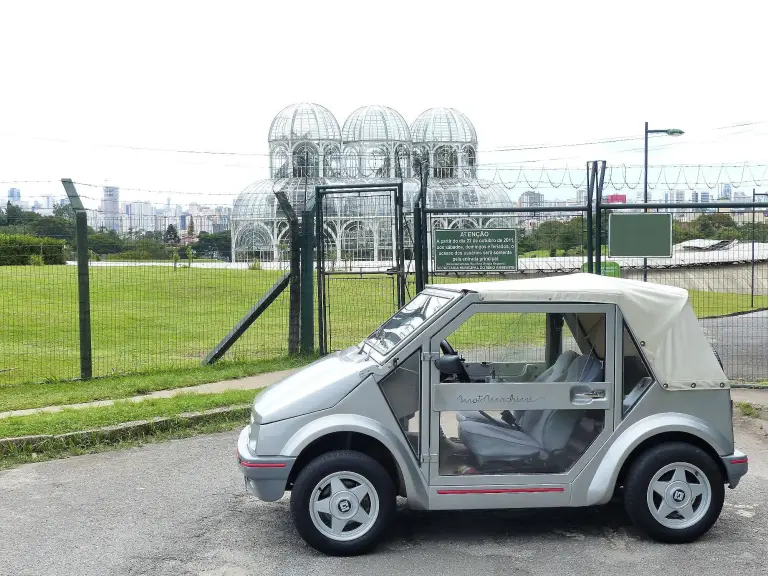
The Supermini replaced the BR-800 and lent its mechanical package to the Motomachine. The off-road SuperCross was its last derivative, and more cars are in the Gurgel collection.
Video: Gurgel Supermini 92/92
Video by Marcelo Conceição on YouTube.
Sources
- Gurgel Supermini, English Wikipedia: engine, weight, transmission
- Gurgel Supermini, Portuguese Wikipedia: equipment, body, specification, production end