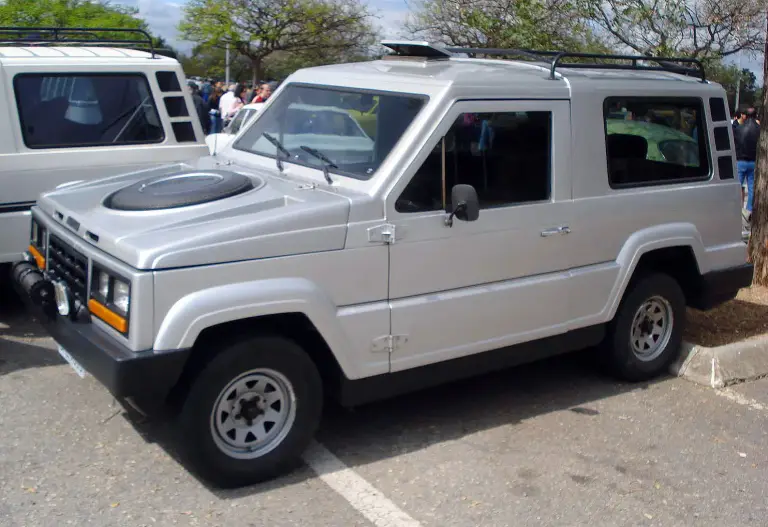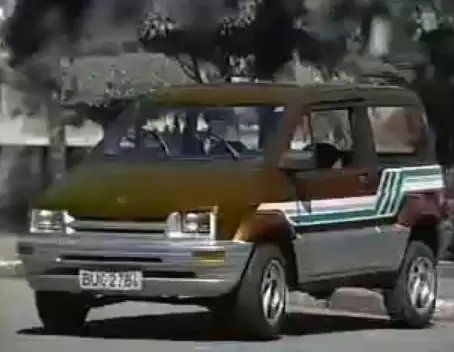
The Gurgel SuperCross was a prototype presented by Gurgel at the 1992 motor show in both civilian form, painted yellow, and military form, painted olive green. It was a Gurgel Supermini with a vertical rear end, raised suspension and widened wheel arches to take off-road tyres, and it could have been a success had Gurgel not been sinking in debt.
Gurgel SuperCross at a glance
| Maker | Gurgel, Brazil |
|---|---|
| Shown | motor show, 1992 |
| Status | prototype, never produced |
| Bodies | civilian (yellow) and military (olive) |
| Engine | Gurgel Enertron, 792 cc flat-twin, petrol |
| Power | 36 hp at 5,500 rpm |
| Torque | 6.6 mkgf at 2,500 rpm |
| Gearbox | four-speed manual, rear drive |
| Length | 3,195 mm |
| Wheelbase | 2,000 mm |
| Weight | 738 kg |
| Ground clearance | 175 mm |
| Tyres | 175 SR 13 |
| Fuel tank | 40 litres |
Based on one source: the SuperCross has a Portuguese Wikipedia article only, and there are no free photographs of the prototype on Wikimedia Commons.
History of the Gurgel SuperCross
A Supermini for the rough
The SuperCross took the small Supermini city car and gave it a different character: the rear was made vertical, the suspension was raised and the wheel arches were widened to house wheels with off-road tyres. Gurgel described the design as robust, aggressive and elegant. The company presented two versions at the 1992 motor show, a civilian car in yellow and a military one in olive green.
Under the skin
The mechanical layout followed the Supermini’s own patents. The engine was Gurgel’s Enertron, a water-cooled flat-twin of 792 cc with an aluminium-silicon block, 85.5 mm bore and 69 mm stroke, a compression ratio of 8.7:1 and 36 hp at 5,500 rpm. Ignition was controlled by an electronic microprocessor that did away with the distributor and fired two sparks per cycle to cut pollution. Drive went to the rear axle through a four-speed gearbox and a 4.10:1 differential, with an optional “Dual Track” gearbox with synchronised low range.
The chassis
The body was a steel space frame with tubular sections and modular engineering-plastic panels. The front of the chassis had a safety “fuse” that deformed in a collision to absorb the impact. The front suspension was independent with coil springs and double-acting telescopic dampers; at the rear Gurgel used its patented Leaf Coil system, which combined parallel steel leaves with coil springs and dampers, the leaves absorbing differential torque and acting as an anti-roll device. Brakes were discs at the front and drums at the rear, steering was by rack and pinion, and the turning circle was 8.8 m.
Why it never happened
The factory was in debt, and Gurgel gave up the project and went bankrupt in December 1994. The SuperCross is remembered as a precursor of the urban adventure vehicles that later became popular in Brazil.
Design and features
- Off-road stance: raised suspension, a vertical rear and wide arches for off-road tyres.
- Two versions: civilian in yellow and military in olive green.
- Leaf Coil rear suspension: parallel leaves combined with coil springs, a Gurgel patent.
- Chassis fuse: a deformable front section designed to absorb a collision.
- Enertron engine: 792 cc flat-twin with distributorless electronic ignition.
Gurgel SuperCross versions
- Civilian: the yellow show car.
- Military: the olive-green version.
- Dual Track option: a gearbox with synchronised low range offered for the model.
The SuperCross was based on the Gurgel Supermini, itself the successor of the BR-800. More cars are in the Gurgel collection.
Sources
- Gurgel SuperCross, Portuguese Wikipedia: prototype, versions, full specification