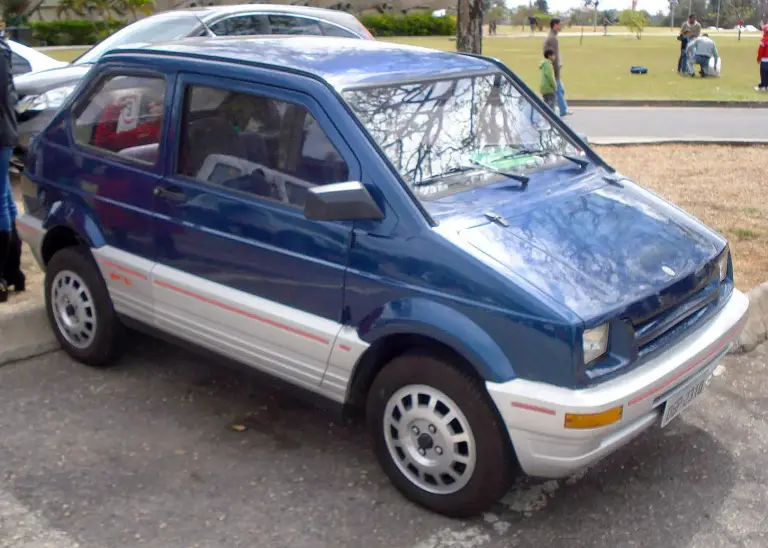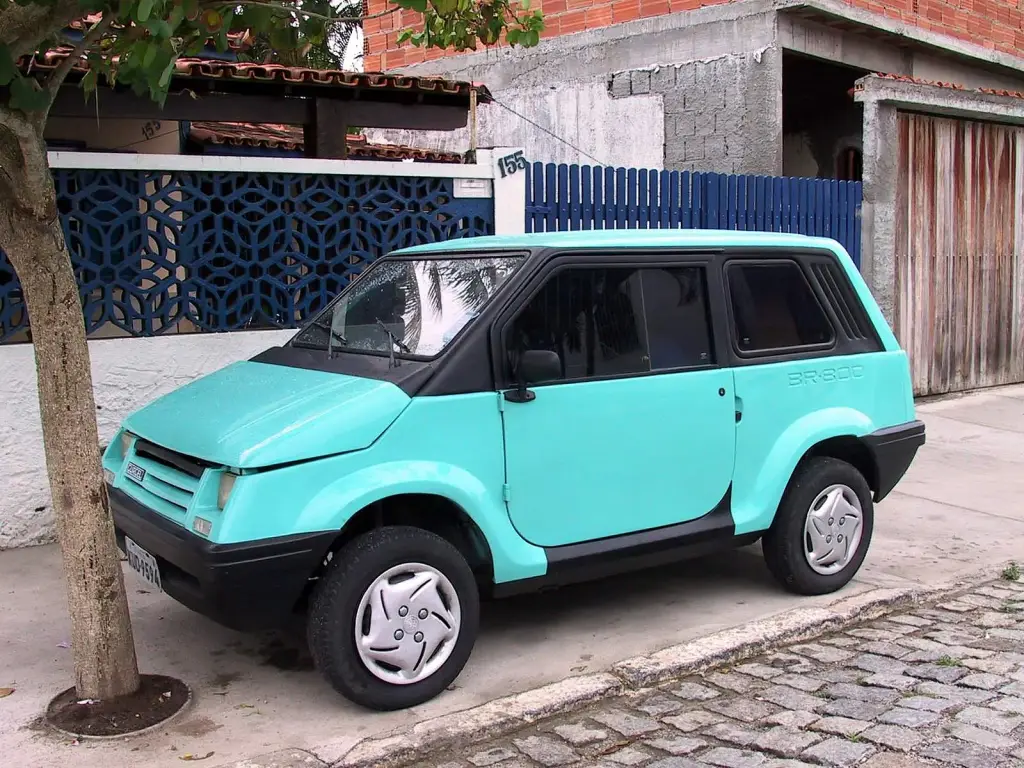
The Gurgel BR-800 was a small Brazilian city car built between 1988 and early 1992. It grew out of the CENA project — Carro Econômico Nacional, the national economical car — and was the first automobile designed and manufactured entirely in Brazil, engine included.
Gurgel BR-800 at a glance
| Maker | Gurgel Motores, Rio Claro, São Paulo |
|---|---|
| Production | 1988–early 1992 |
| Project name | CENA, Carro Econômico Nacional |
| Shown as | Gurgel 280 in September 1987 |
| Engine | Gurgel Enertron, water-cooled flat-twin, 800 cc |
| Power | 32 hp at first, 36 hp in the later SL |
| Top speed | 110 km/h |
| Body | Plasteel, a fibreglass and steel-tube structure |
| Length | under 3.2 m |
| Seats | four |
| Built | about 40,000 |
History of the Gurgel BR-800
Gurgel had spent more than a decade building a successful line of jeeps and utility vehicles, always with Volkswagen engines and transmissions, and had tried the urban market with the small XEF. The BR-800 was a different proposition: a light car with an engine of Gurgel’s own design. The idea first appeared in April 1986 as the CENA project, alongside the creation of the Brazilian ministry of science and technology and the end of Beetle production in the country.
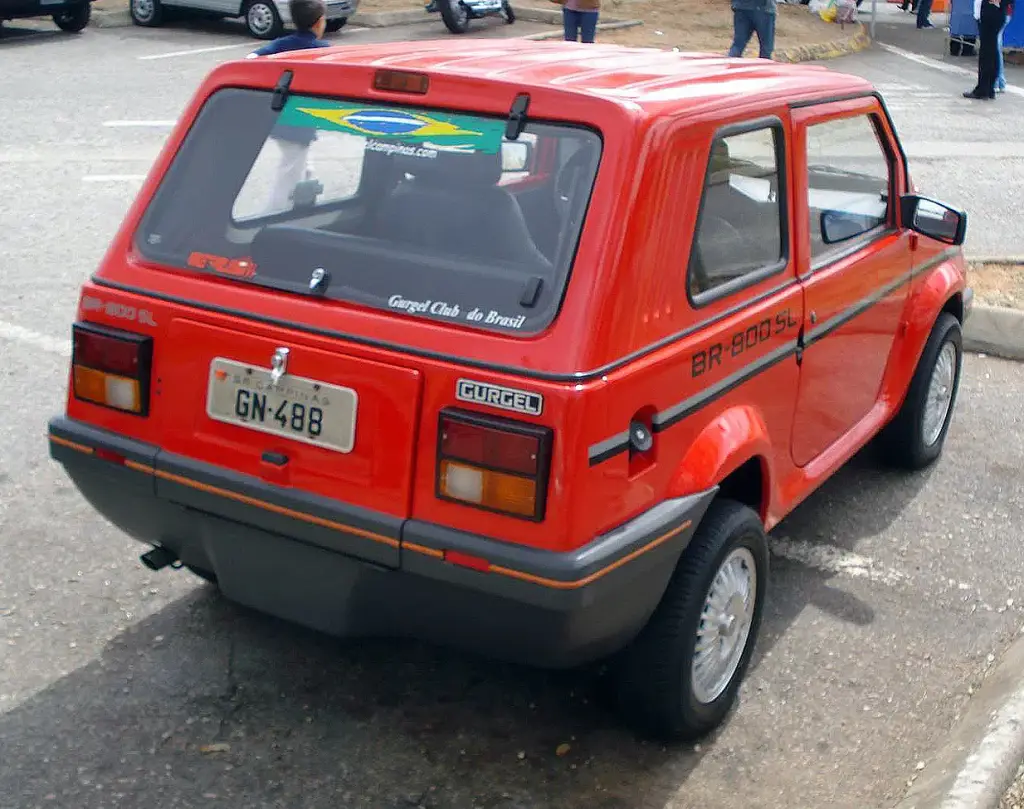
The project had strong official backing. The science minister Renato Archer saw it as a way of building a national automotive technology and arranged financing through FINEP together with a reduced IPI tax of 5 per cent, against 37 to 42 per cent for other cars. Prototypes paraded in Brasília on Independence Day in 1987 and series production began in 1988. During development the car was known as the 280-M, for two cylinders, 800 cm³ and multiple bodywork; it was presented as the Gurgel 280 in September 1987 and renamed BR-800 by the time sales started. The CENA name had to be dropped after a legal dispute with the racing driver Ayrton Senna.
Sales were tied to the company’s finances: to pay for a new factory, Gurgel created Gurgel Motores S/A and floated shares, and for the first two years a BR-800 could only be bought by someone who also bought 750 shares. That made the little car more expensive than the bigger Chevrolet Chevette, then the cheapest new car in Brazil, and kept it out of direct competition with Volkswagen and Fiat.
The advantage lasted until July 1990, when president Fernando Collor extended a similar tax cut to every car with an engine below one litre. The Fiat Uno Mille arrived in August 1990, imported cars returned, and Gurgel stopped building jeeps in January 1991. The BR-800 was constantly revised — new rear lights and a tilting rear window in 1990, a modified front suspension shortly after, then a sealed radiator, retractable seat belts, roof ventilation and a redesigned chassis. At the end of 1991 it was restyled as the BR-SL, which then became the Gurgel Supermini.
Design and features
- Enertron engine: a water-cooled flat-twin of 650 or 800 cc, essentially half a Volkswagen flat-four, with the alternator driven from the crankshaft and the water and oil pumps from the camshaft.
- Plasteel body: fibreglass panels over a steel tube frame, with flat windows to keep costs down.
- Compact package: four seats inside a body less than 3.2 m long.
- Springshock suspension: Gurgel’s own synthetic-material system, widely criticised for its ride and dropped for the Supermini.
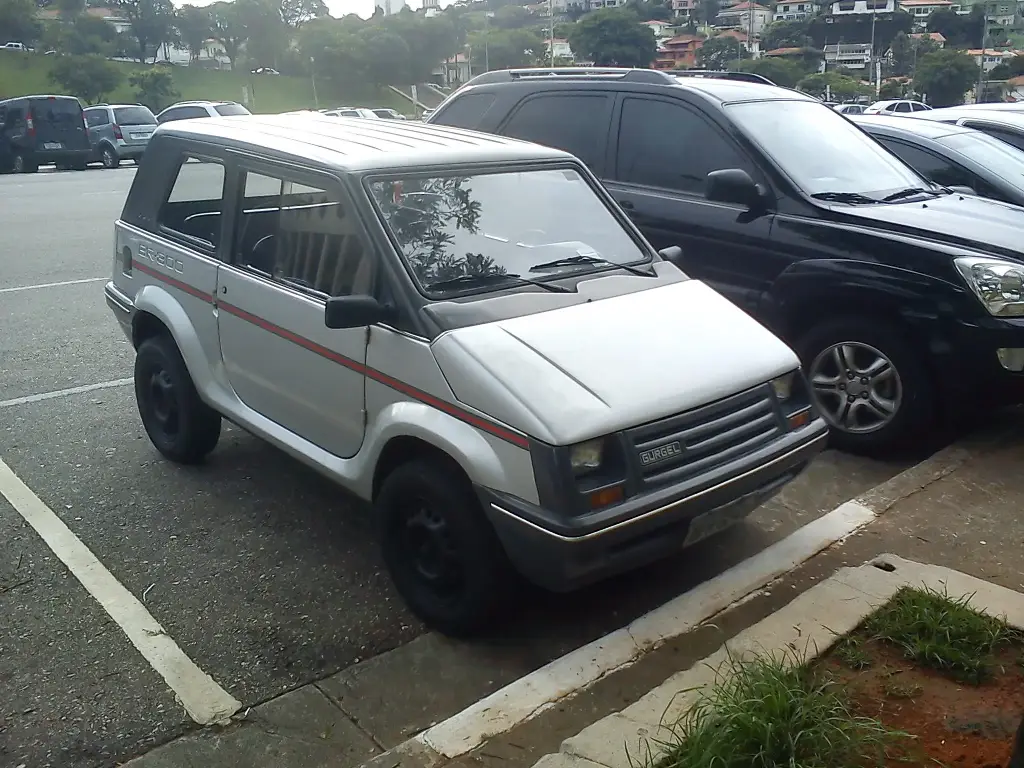
Gurgel BR-800 versions
- CENA prototypes (1987): the pre-production cars shown in Brasília.
- BR-800 (1988–1991): the standard car with the 32 hp 800 cc engine.
- BR-800 SL (1991): restyled and more powerful, with 36 hp.
- BR-SL (late 1991): the final specification that led to the Supermini.
The BR-800 was replaced by the Gurgel Supermini, and the shortened Motomachine was built on the same mechanical package. More cars are in the Gurgel collection.
Video: Gurgel BR800: Publicidade de Lançamento 1988
Video by GurgelBrasil on YouTube.
Sources
- Gurgel BR-800, English Wikipedia: production, engine, sales scheme
- Gurgel BR-800, Portuguese Wikipedia: CENA project, tax rate, updates