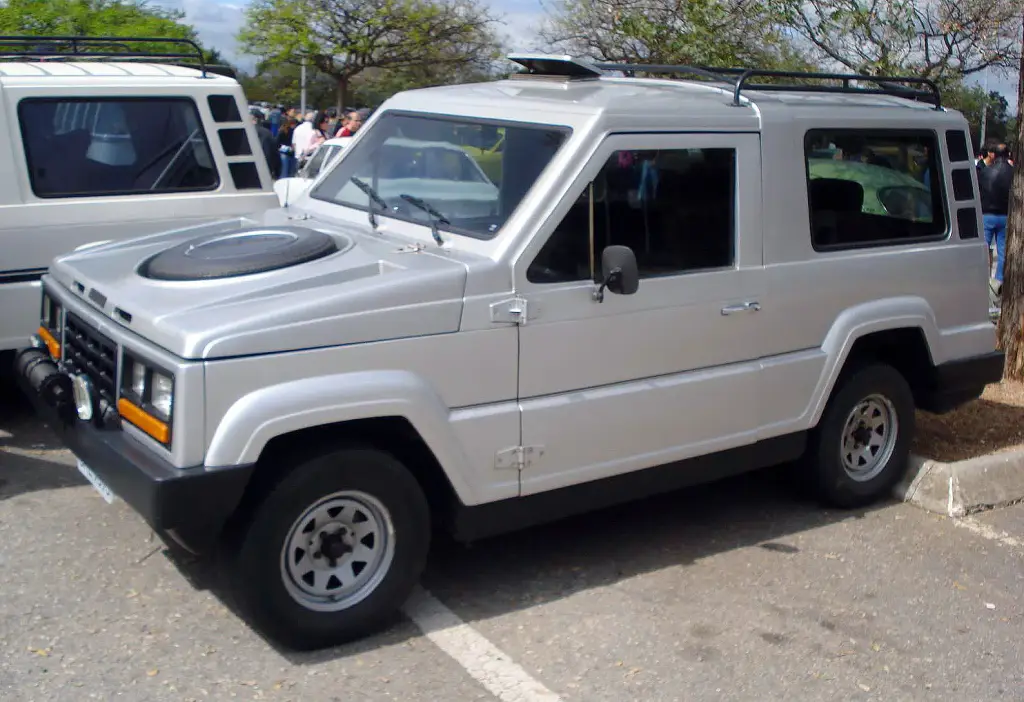
The Gurgel Carajás was a Brazilian sport utility vehicle produced by the small manufacturer Gurgel between late 1984 and 1994. The name comes from a mountain range in western Brazil and the indigenous people who live there. It was the company’s largest utility vehicle and, for five years, the best-selling vehicle in its class in the country.
Gurgel Carajás at a glance
| Maker | Gurgel Motores, Brazil |
|---|---|
| Production | late 1984–1994 |
| Body | Plasteel: fibreglass panels over a steel tube frame |
| Drive | rear-wheel drive only |
| Engines | 1.8 petrol 85 hp, 1.8 ethanol 97 hp, 1.6 diesel 50 hp |
| Transmission | four-speed gearbox in a rear transaxle, Tork Tube System |
| Traction aid | Selectraction, individual braking of either rear wheel |
| Body styles | two-door, four-door from 1989 |
| Trim levels | base and luxo, LE and VIP from 1988 |
| Class share in 1989 | 75 per cent |
| Cruising speed | about 100 km/h |
History of the Gurgel Carajás
Gurgel aimed the Carajás at a niche that had no direct offer in Brazil: a comfortable, reasonably luxurious vehicle for five people that was also tough enough for bad dirt roads and light off-road use. In its publicity the company used the term “Social Country”, aiming at well-off rural buyers. Although it was small on the outside — barely longer than a Ford EcoSport — the very square body and tubular chassis gave it an unusually large cabin.
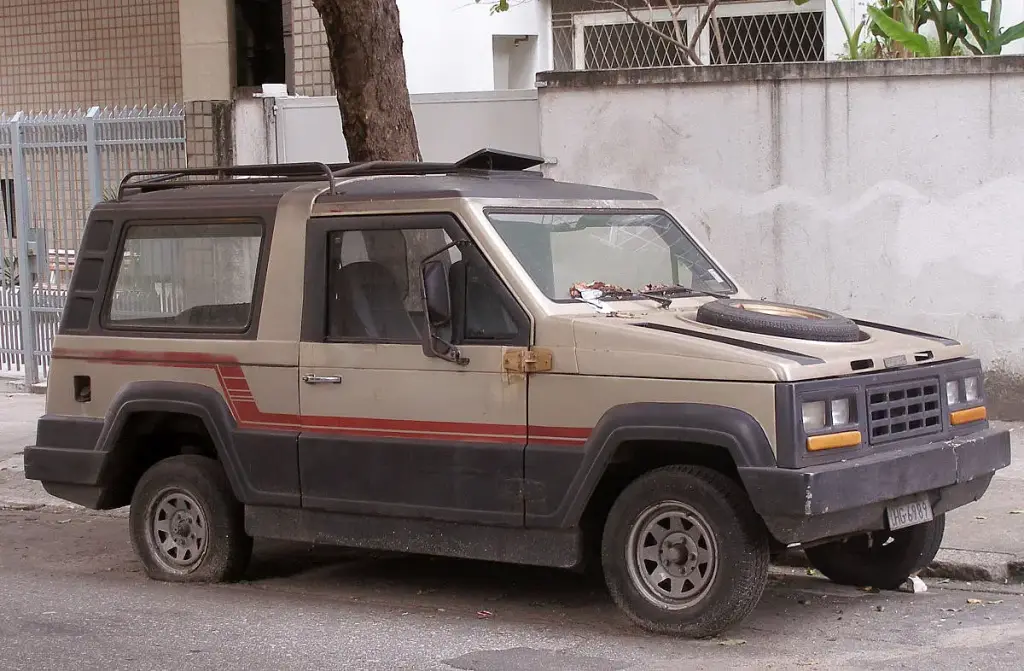
The first range was entirely two-door, in base or luxo form, with four body variants: the TR with a fixed roof, the TL with a canvas top, the RL with a fixed roof and canvas sides, and the MM for military use. Almost all sales were TR, and the TL and RL soon disappeared from the catalogues. In 1988 the equipment levels were renamed LE and VIP, and in 1989 a four-door model arrived on a slightly longer wheelbase, using the same front doors as the two-door cars.
The front end was deliberately American in its arrangement of elements, and the spare wheel half-recessed into the bonnet gave the car its unmistakable look. Inside, the left front seat slid forward on tubular rails to give access to the rear, ventilation was built into the roof with five individual outlets, and the floor was fully carpeted.
Mechanically the Carajás used the Tork Tube System: a solid flexible steel shaft inside a protective tube carried drive from the front engine and clutch to a gearbox at the rear axle, giving a 50/50 weight distribution, independent suspension all round and useful traction without the cost of four-wheel drive. The Selectraction system, worked by two levers, let the driver brake either rear wheel individually and so send power to the other one. With its independent suspension, high ground clearance and smooth underside the Carajás was capable off the road, though its modest suspension travel and weight distribution limited it in really difficult terrain.
Between 1985 and 1990 the Carajás was the best-selling vehicle in its class in Brazil; in 1989 it held 75 per cent of the category, the expensive Toyota Bandeirante taking the rest, in a market where new vehicle imports were not permitted. The success ended in the second half of 1990 with the arrival of the Lada Niva. Sales collapsed, regular production stopped in January 1991, and the Carajás remained available to order until Gurgel’s bankruptcy in 1994.
Design and features
- Tork Tube System: front engine, rear transaxle and a 50/50 weight split without four-wheel drive.
- Selectraction: two levers that brake either rear wheel separately to transfer torque.
- Plasteel body: glassfibre-reinforced plastic over steel tubes, the company’s own patent.
- Roof ventilation: a built-in system with five individual outlets.
- Big cabin, small footprint: the square shape and tube frame gave space for five in a compact shell.

Gurgel Carajás versions
- TR (Teto Rígido): the fixed-roof model that accounted for nearly all sales.
- TL and RL: canvas-top and part-canvas versions, dropped early.
- MM: a military variant.
- LE and VIP (1988): the renamed equipment levels.
- Four-door (1989): a longer-wheelbase body with the two-door front doors.
The Carajás followed the X-12 in the Gurgel range and shared its Plasteel construction with the G-15. The Gurgel collection has more cars.
Video: Gurgel Carajás LE – 1987
Video by José Eduardo Maia Maluf on YouTube.
Sources
- Gurgel Carajás, English Wikipedia: production, engines, variants, market
- Gurgel Carajás, Portuguese Wikipedia: design, TTS, chassis, interior