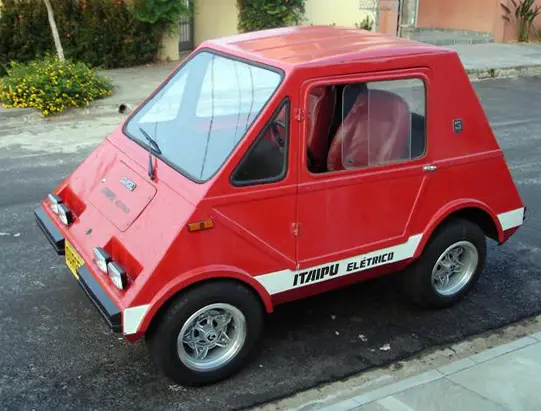
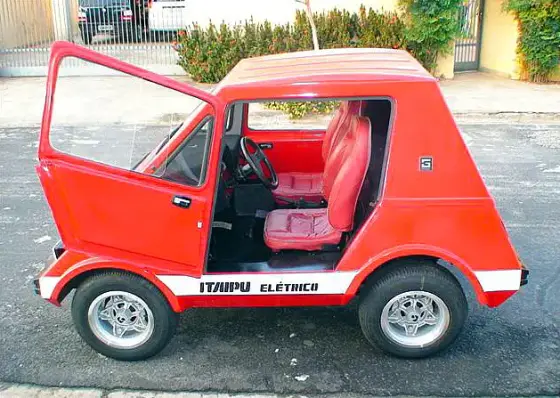
The Gurgel Itaipu E150 was an electric car built by the Brazilian manufacturer Gurgel and presented at the São Paulo motor show in 1974, with production planned to begin in December 1975. It was the first electric car built in Latin America, but only about twenty pre-series cars were made and it was never put on sale.
Gurgel Itaipu at a glance
| Maker | Gurgel, Brazil |
|---|---|
| Shown | São Paulo motor show, 1974 |
| Planned production | from December 1975 |
| Built | about twenty pre-series cars |
| Type | electric two-seater |
| Body | compact trapezoidal shape |
| Weight | 460 kg, plus about 320 kg of batteries |
| Top speed | about 30 km/h in the first prototypes, up to 60 km/h later |
| Named after | the Itaipu hydro-electric dam on the Brazil–Paraguay border |
| Successor | Itaipu E400 of 1980, based on the Gurgel G800 |
History of the Gurgel Itaipu
An electric car before its time
Electric vehicles had existed since the nineteenth century, and they had enjoyed modest success until about 1915, when the Ford Model T settled the question in favour of petrol. In Brazil in the 1970s the idea was almost unheard of. The Itaipu was developed by the mechanical and electrical engineer João Augusto Conrado do Amaral Gurgel, the company’s founder, and its prototype was shown at the São Paulo motor show in 1974.
The car
The design was unlike anything else in the range: a very compact, trapezoidal two-seater. The car weighed only 460 kg, with a further 320 kg of batteries. The first prototypes reached about 30 km/h; later cars managed up to 60 km/h. Its specifications were comparable with similar electric models of the period abroad.
The name and the sequel
The car was named after the huge hydro-electric dam and power station being built on the border of Brazil and Paraguay, a project of national pride at the time. The name was brought back in 1980 for a larger commercial vehicle, the Itaipu E400, which was based on the Volkswagen-engined Gurgel G800. The E150 itself never reached customers and is today a collector’s item.
Design and features
- First in Latin America: the first electric car designed and built in the region.
- Lightweight construction: a 460 kg car carrying 320 kg of batteries.
- Trapezoidal two-seater: a narrow, very compact body for city use.
- National symbolism: named after the Itaipu dam then under construction.
Gurgel Itaipu versions
- E150 prototypes (1974): the first cars, with a top speed of about 30 km/h.
- Later E150s: developed to reach about 60 km/h.
- Itaipu E400 (1980): a larger commercial vehicle on the G800 base, sharing only the name.
The G-15 and the X-12 show what Gurgel was building with petrol engines at the time. More cars are in the Gurgel collection.
Video: Gurgel Itaipú – Auto Esporte
Video by gurgel800 on YouTube.
Sources
- Gurgel Itaipu, English Wikipedia: production, weight, speed, E400
- Gurgel Itaipu, Portuguese Wikipedia: development, motor show, name