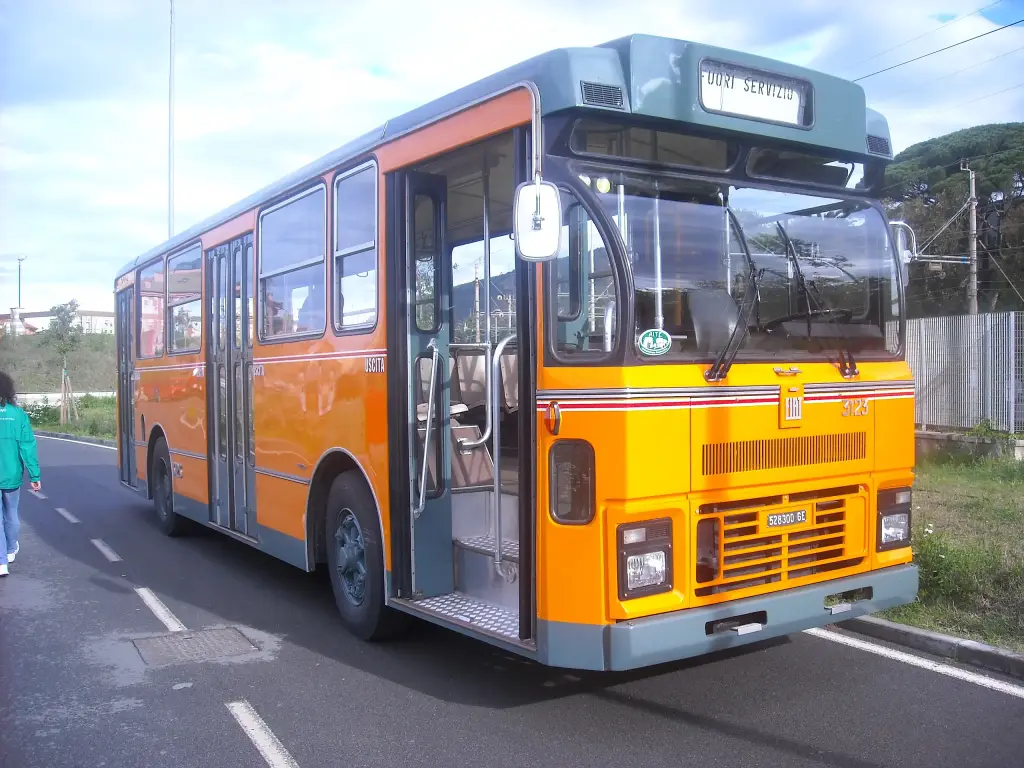
The Fiat 418 was an Italian city bus produced from 1971 to 1982. Developed by Fiat Veicoli Industriali together with the larger 421, it replaced a range of buses designed in the early 1960s and became for many years the most widespread urban bus in Italy, with about 6,900 examples built.
Fiat 418 at a glance
| Production | 1971–1982 |
|---|---|
| Maker | Fiat Veicoli Industriali |
| Class | urban and interurban bus |
| Predecessor | Fiat 410 |
| Engine | Fiat 8200.12.035, 9,819 cc |
| Power | 183 to 194 hp |
| Engine position | central, underfloor |
| Transmission | five-speed manual, Voith-Diwa 501-JSR or OM DRS 09 automatic |
| Versions | 418 A, 418 AC, 418 AL |
| Lengths | 10 to 11 metres, 18 metres articulated |
| Built | about 6,900 |
| Exports | Tunisia and Denmark |
Based on one source, the Italian Wikipedia article.
History of the Fiat 418
A range that needed replacing
At the beginning of the 1970s the bus range offered by Fiat Veicoli Industriali consisted of vehicles designed mostly in the early 1960s, by then technically obsolete and no longer competitive. To modernise its offer, Fiat put two new models into production: the 418, a medium-capacity bus of great versatility, and the 421, designed for use in the large cities.
Mechanics
Although deeply renewed in its mechanical parts and styling, the 418 derived closely from its predecessor, the Fiat 410, which could be seen in its dimensions and in its modest capacity. The engine was the Fiat 8200.12.035 of 9,819 cc, producing between 183 and 194 hp and mounted in the centre of the chassis in the underfloor position. Three types of transmission were available: a five-speed manual, a Voith-Diwa 501-JSR automatic or an OM DRS 09.
The 418 was one of the first buses to include a rev counter in its standard equipment and one of the first to be built without a conductor’s seat, which was replaced at that time by ticket-issuing machines.
Versions and bodywork
The bus was built by Fiat at its Cameri plant in the province of Novara, and also by outside firms including Autodromo, Dalla Via, Desimon, Portesi, Menarini, Breda in both its Pistoia and Sofer plants, Padane, Viberti, Minerva and Macchi. Three main versions were offered. The 418 A was 10 metres long, in urban trim, on diesel, with three folding doors, some models using sliding plug doors. The 418 AC measured 10.17 metres or came as an 18-metre articulated bus, in urban or interurban trim with three folding doors. The 418 AL was 11 metres long in urban or suburban form, the latter called ALS, with two or three folding doors.
In service
The 418 was for many years the most widespread urban bus in Italy, with about 6,900 examples produced. Besides the home market, some were sold in Tunisia and Denmark, and many others reached developing countries as donations from Italian transport companies after retirement. The type formed the backbone of urban transport in many Italian cities throughout the 1970s and 1980s and part of the 1990s, when operators began to withdraw it gradually. Some cities, among them Rome, Modena, Genoa, Livorno, San Remo and Catania, kept part of their fleets in service into the early 2000s, and restored examples are still kept running by enthusiast associations.
Design and features
- Underfloor engine: the 9,819 cc unit sat in the centre of the chassis, in the so-called sole position.
- Three transmissions: five-speed manual, Voith-Diwa 501-JSR or OM DRS 09 automatic.
- Rev counter as standard: the 418 was one of the first buses to have one.
- No conductor’s seat: ticket-issuing machines took its place.
- Coachbuilt bodies: supplied by a long list of Italian bodybuilders as well as by Fiat itself.
Fiat 418 versions
- 418 A: 10 metres, urban trim, three folding doors.
- 418 AC: 10.17 metres or an 18-metre articulated bus, urban and interurban.
- 418 AL: 11 metres, urban or suburban, with two or three doors.
- 418 ALS: the suburban form of the 418 AL.
The 418 was a development of the Fiat 410 and was launched alongside the larger Fiat 421. The older Fiat 343 shows the intercity side of the range, and more vehicles are in the Fiat collection.
Sources
- Fiat 418, Italian Wikipedia: project, mechanics, versions, bodybuilders and diffusion