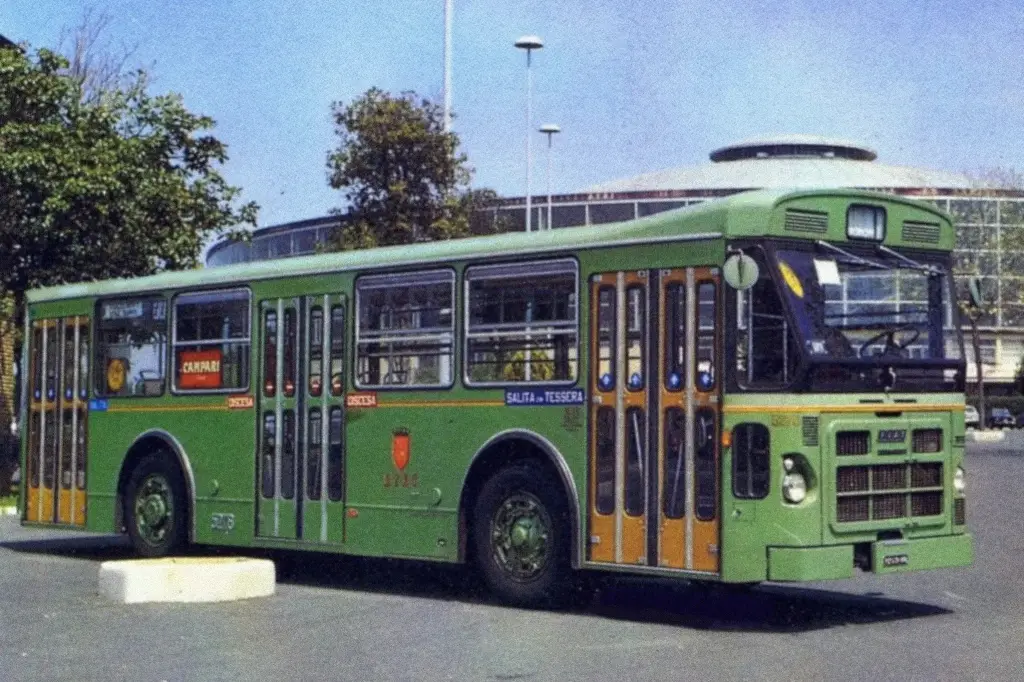
The Fiat 421 is an Italian bus produced from 1973 to 1983. It was designed expressly for the heavily loaded lines of large cities, alongside the medium-capacity Fiat 418, and used a front-mounted diesel with automatic transmission.
Fiat 421 at a glance
| Type | city bus |
|---|---|
| Production | 1973–1983 |
| Engine | Fiat 8210.12, 13,798 cc inline six |
| Power | 220 hp |
| Layout | front engine under the driver’s cab |
| Transmission | automatic, OM DRS 09 gearbox |
| Length | 10.9 m (421A), 11.9 m (421AL) |
| Doors | three folding (421A), three or four (421AL) |
| Coachbuilders | Fiat-Cameri, Pistoiesi, Menarini, SEAC, Viberti |
| Operators | ATAC Rome, ATM Milan and Turin, AMT Genoa, ATC Bologna, AMAT Palermo |
Based on one source, the Italian Wikipedia article. No free photographs of the bus were available, so the article has no photographs.
History of the Fiat 421
At the beginning of the 1970s Fiat’s city bus range still consisted of vehicles designed at the start of the previous decade, most of them using technical solutions that had become obsolete and offering limited capacity. Fiat therefore began production of two new models: the Fiat 418, a medium-capacity bus of great flexibility, and the Fiat 421, designed specifically for the heavily loaded lines of large cities.
The 421 was given advanced technical solutions for its time. A Fiat 8210.12 engine of 13,798 cc and 220 hp was mounted at the front, beneath the driver’s cab, and drove through an automatic transmission using the OM DRS 09 gearbox also fitted to the 418. The braking system was undersized in relation to the power of the engine and the weight of the vehicle, which was imposing for the period, and the unbalanced weight distribution made the bus prone to losing grip. Fuel consumption was also high compared with most buses of the era.
The model was built in two versions, each with variations and details specific to individual orders. Vehicles with the original body came from the historic Cameri plant near Novara, but the 421 was also sold as a chassis for external coachbuilders. Examples were bodied by Pistoiesi, to a design by Giovanni Klaus Koenig, by SEAC-Viberti and by Menarini, each with differences that often reflected the requirements of the operating company.
The 421A measured 10.9 metres and had three folding doors, in urban trim, with bodies by Fiat-Cameri, Pistoiesi or Menarini. The 421AL measured 11.9 metres and had three or four folding doors, with bodies by Fiat-Cameri, SEAC, Menarini or Viberti. A particular batch was made for ATAC of Rome: a hundred vehicles were ordered from the Bologna coachbuilder Menarini and modified at the design stage to meet the Roman operator’s specification, so that they combined the soft lines typical of the Menarini 421 with the austere, angular front of the original model.
Although built in large numbers, the 421 served with a relatively small number of municipal transport companies, since it was intended by design for the largest cities. It was used by ATAC in Rome, ATM in Milan, ATM in Turin, AMT in Genoa, ATC in Bologna and AMAT in Palermo. Some withdrawn vehicles passed to operators in smaller towns such as CAT in Tivoli, AMT in Catania and Onorati in Aprilia, while others were sent to Cuba or, as humanitarian aid, to developing countries. One Menarini-bodied car, number 4030 of the ATC fleet working route 37, carried the bodies of the victims of the Bologna station bombing to Bologna Centrale; the vehicle was in the square in front of the station when the bomb exploded, killing 85 people.
Design and features
- Front-mounted diesel: a 13,798 cc six of 220 hp placed under the driver’s cab.
- Automatic transmission: the OM DRS 09 gearbox shared with the Fiat 418.
- High capacity: designed for the busiest lines of large Italian cities.
- Coachbuilt bodies: original Cameri bodies or designs by Pistoiesi, Menarini, SEAC and Viberti.
- Known weaknesses: marginal brakes, uneven weight distribution and high fuel consumption.
Fiat 421 versions
- 421A: 10.9 metres, three folding doors, urban trim.
- 421AL: 11.9 metres, three or four folding doors.
- 421 Pistoiesi: body designed by Giovanni Klaus Koenig.
- 421 Menarini for ATAC: a hundred cars combining Menarini lines with the original front.
- 421 SEAC-Viberti: alternative coachbuilt version.
The 421 was developed together with the medium-capacity Fiat 418 and followed earlier Fiat city buses such as the Fiat 306. More vehicles are in the Fiat collection.
Sources
- Fiat 421, Italian Wikipedia: production dates, engine, transmission, versions, operators, Bologna bombing