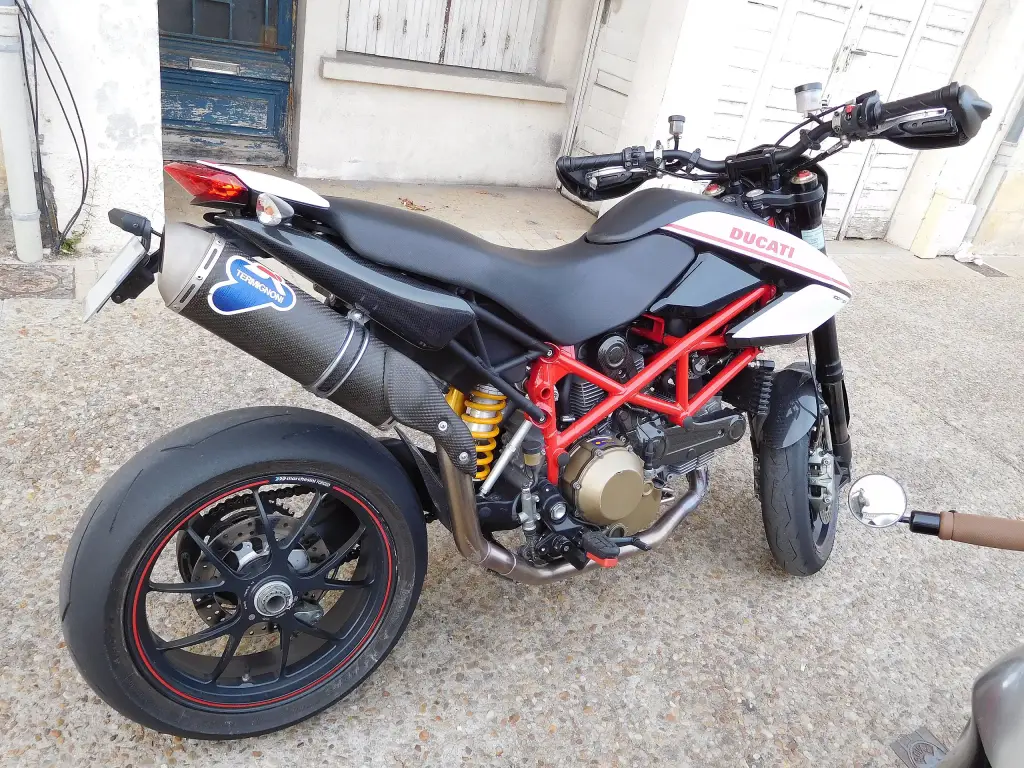
The Ducati Hypermotard is a supermotard motorcycle designed by Pierre Terblanche, first seen at the November 2005 EICMA trade show in Milan. It was awarded Best of Show at EICMA and has since won other show awards.
Ducati Hypermotard at a glance
| Maker | Ducati, Borgo Panigale |
|---|---|
| Designer | Pierre Terblanche |
| First shown | EICMA, Milan, November 2005 |
| Engine | 937 cc liquid-cooled desmodromic four-valve 90° V-twin |
| Weight | under 180 kg |
| Top speed | about 201 km/h |
| Frame | rigidly triangulated trellis |
| Forks | 50 mm Marzocchi R.A.C. inverted |
| Front brakes | Brembo four-piston radial calipers on 305 mm discs |
| Rear brake | 245 mm disc with a two-piston caliper |
History of the Ducati Hypermotard
A concept that caused outages
There had been rumours that Ducati would build a supermotard, a growing sector served mostly by KTM and Husqvarna. The Hypermotard concept was unveiled through a dedicated mini-site linked from the main Ducati website in March 2006, and interest was such that it apparently caused outages of the whole site. The mini-site asked visitors to complete an online survey on the Hypermotard and to vote on configurations such as engine size, brakes and favourite features. The bike was still a concept and production was not guaranteed, but a post on the blog of then CEO Federico Minoli on 31 March 2006 confirmed it would be built and gave some survey results.
Almost unchanged into production
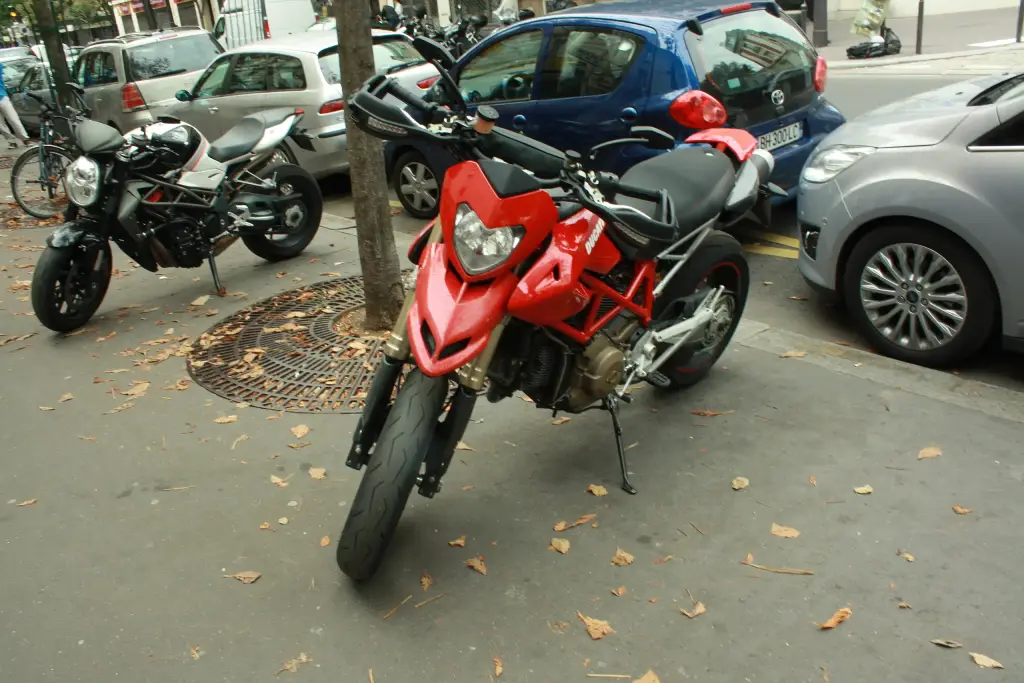
Very few changes were made to the prototype for the first production version, and quirky details such as the “duck bill” front fender and handguards with integrated LED indicators and folding mirrors reached the final machine. Later blog entries showed concept drawings that were extremely close to the finished bike. The Hypermotard has a 937 cc dual-spark desmodromic liquid-cooled four-valve 90° V-twin with fuel injection, weighs under 180 kg and reaches about 201 km/h. The rigidly triangulated trellis frame carries 50 mm Marzocchi R.A.C. inverted forks, a Sachs or Öhlins remote-reservoir shock on a single-sided swingarm and Marchesini racing wheels, with radially mounted Brembo four-piston two-pad calipers on 305 mm discs at the front and a 245 mm disc at the rear.
The 1100 and 1100S
The first 2007 Hypermotard came in two forms, the base 1100 and the higher-specification 1100S. The S had a diamond-like carbon coating on the fork sliders, an Öhlins remote-reservoir rear shock, the Brembo Monobloc calipers used on the 1098, lighter forged aluminium Marchesini wheels with a red pinstripe, Pirelli tyres and carbon-fibre fork protectors, belt covers, front mudguard and tail panels. Those parts saved 2 kg, 177 kg against 179 kg. For 2009 the S received 48 mm Kayaba forks with DLC coating in place of the 50 mm Marzocchi units and gained Ducati’s DDA telemetry device.
Evo and Evo SP
For 2010 the two models were renamed 1100 Evo and 1100 Evo SP. They received a redesigned engine that was no longer dual spark and used Siemens fuel injection instead of Marelli. The higher-compression engine gave 5 bhp more, 95 bhp at a slightly lower 7,500 rpm, with torque peaking 1,000 rpm higher at 5,750 rpm, and a new oil cooler with 85% more cooling area. Final drive changed from 15/42 to 15/41. The Evo had 50 mm Marzocchi forks and a Sachs shock, the Evo SP taller 50 mm Marzocchi forks and an adjustable Öhlins shock, with a seat height of 875 mm against 845 mm. The bikes were considerably lighter thanks to vacuum-cast engine casings and a lighter crankshaft, flywheel and alternator, at 172 kg for the Evo and 171 kg for the Evo SP. In November 2007 NCR announced the Leggera, a modified Hypermotard more than 30 kg lighter with around 40 hp more.
Pikes Peak
In 2008 Greg Tracy won the 1200 Pro Class Division of the Pikes Peak International Hill Climb on a Hypermotard 1100S. It was the first Hypermotard to win an international competition and the first Ducati to win at Pikes Peak since the race began in 1916.
Design and features
- Concept to production: almost unchanged from the 2005 show bike, including the duck-bill fender and LED handguards.
- Supermotard chassis: trellis frame, 50 mm inverted forks and a single-sided swingarm.
- 1100S equipment: Öhlins shock, Monobloc brakes, forged Marchesini wheels, 177 kg.
- Evo changes: Siemens injection, 95 bhp, a larger oil cooler and 172 kg.
- Pikes Peak: Greg Tracy’s 2008 class win on an 1100S.
Ducati Hypermotard versions
- Hypermotard 1100 (2007–2009): the base model, 179 kg.
- Hypermotard 1100S (2007–2009): Öhlins shock, Monobloc brakes and forged wheels.
- Hypermotard 1100 Evo (2010): Siemens injection, 95 bhp, 172 kg.
- Hypermotard 1100 Evo SP (2010): taller forks, Öhlins shock, 171 kg, 875 mm seat.
- NCR Leggera (2007): a factory-approved special over 30 kg lighter.
The Hypermotard was designed by Pierre Terblanche in the same period as the Ducati 999 and the Multistrada. More Ducatis are in the Ducati collection.
Video: First test video | Ducati Hypermotard 2013
Video by 1000PS on YouTube.
Sources
- Ducati Hypermotard, English Wikipedia: concept, technical details, 1100, S, Evo, Pikes Peak