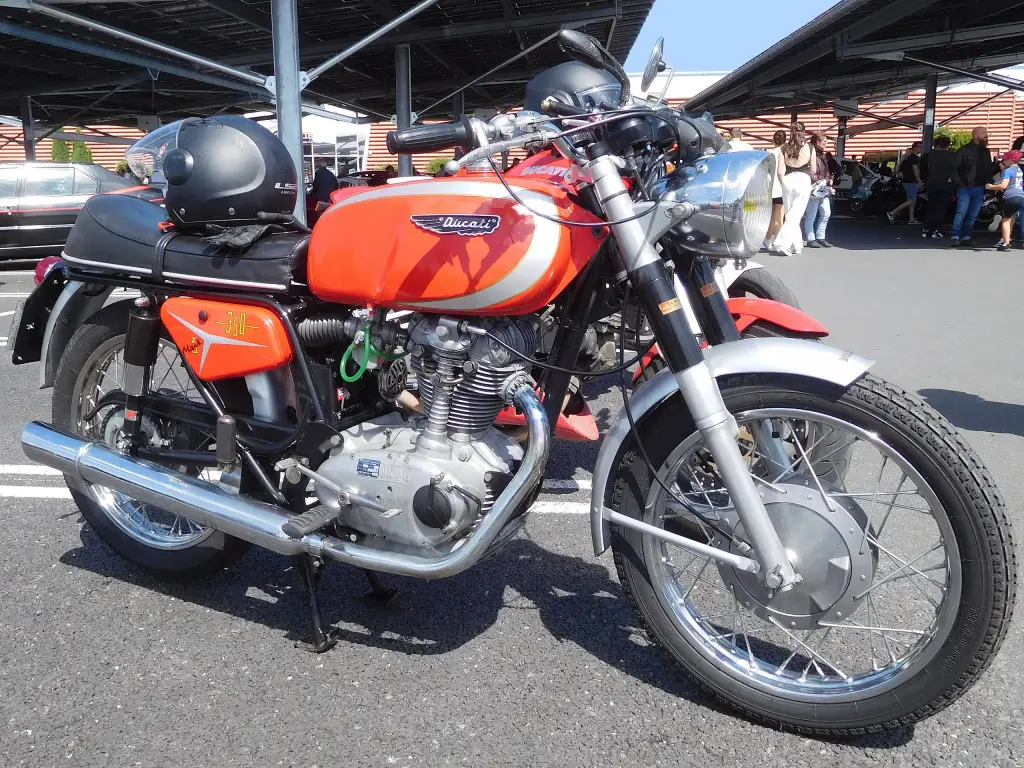
The Ducati 350 Mark 3 is a 340 cc single-cylinder bevel-drive SOHC motorcycle produced by Ducati from 1968 to 1974. It was one of the first wide-case Ducati singles. A higher-performance version, the 350 Mark 3D with desmodromic valves, was also available.
Ducati 350 Mark 3 at a glance
| Maker | Ducati, Borgo Panigale |
|---|---|
| Production | 1968–1974 |
| Engine | 340 cc bevel-drive SOHC single, wide case |
| Bore × stroke | 76 × 75 mm |
| Compression | 10:1 |
| Power | 24 bhp at 8,500 rpm; 34 bhp for the Mark 3D |
| Top speed | 150 km/h; 165 km/h for the Mark 3D |
| Carburettor | 29 mm Dell’Orto |
| Suspension | 31.5 mm forks; 35 mm Marzocchi from 1972 |
| Brakes | 180 mm front and 160 mm rear drums; twin-sided Grimeca front from 1972 |
| Production | about 2,300 Mark 3 and 1,350 Mark 3D |
Facts in this article come from one source, the English Wikipedia page on the Ducati 350 Mark 3.
History of the Ducati 350 Mark 3
From Sebring to wide case
Ducati introduced the 350 Sebring in 1967 at the request of its American importer, Berliner Motor Corporation, then its primary market. The Sebring was an enlargement of the existing 250, but Fabio Taglioni worried about the reliability of the bottom end, so it was produced in a mild state of tune. Taglioni had meanwhile designed strengthened racing engines, culminating in the 1967 250SCD and 350SCD, Sport Corsa Desmo. Those racers used a duplex frame with wider engine mountings at the rear to match its twin rear tubes.
The 1968 Mark 3
For 1968 Ducati introduced new engines for the 250 and 350 road bikes based on the racing unit. They kept the wider rear mountings and became known as wide-case engines. The Mark 3 shared the Sebring’s 76 × 75 mm bore and stroke but had a higher compression ratio, a hotter cam and a bigger carburettor. The 1968 model had a Leopoldo Tartarini-designed bread-box tank of 13 litres with twin filler caps; a single-filler version came in 1969.
Import disputes and restyling
Few Italian-made models were imported in 1970–71 while Berliner and the British importer Vic Camp were in dispute with the factory over prices; Spanish-built MotoTrans models were imported instead. A new tank came for 1971, and in 1973 the bike received a revised dual seat, side covers, instruments and headlight styled like the 750 GT, finished in blue and gold, with 35 mm Marzocchi forks and a twin-sided Grimeca front brake. The factory stopped making OHC singles in 1974; the remaining stock was bought by the British importer Coburn & Hughes, who sold it until early 1976, the last Mark 3s using engines built under licence by MotoTrans.
The Mark 3D and the Desmo
The Mark 3D had a different head with desmodromic valves, derived from the 350 SCD racers, though light hairspring valve springs were kept. The rest of the engine and the cycle parts were unchanged, and it produced 34 bhp with a 165 km/h top speed. Options included a race kit, a megaphone silencer and a fairing, which raised power to 36 bhp and top speed to 180 km/h. In 1971 the desmo model became the 350 Desmo with café racer styling, clip-ons, a fibreglass tank and a monoposto seat in metal-flake silver, the “silver shotgun”. From 1973 it had a metal tank, different side panels and a combined seat and rear mudguard in yellow and black, and in 1974 Ceriani forks with a single 280 mm Brembo disc.
Design and features
- Wide-case engine: stronger bottom end and wider rear mountings taken from the SCD racers.
- Bread-box tank: Tartarini’s 13-litre tank with twin filler caps on the first model.
- Mark 3D: the desmodromic version with 34 bhp and 165 km/h.
- Race kit: megaphone silencer and fairing took the 3D to 36 bhp and 180 km/h.
Ducati 350 Mark 3 versions
- 350 Mark 3 (1968–1974): the standard model, 24 bhp.
- 350 Mark 3D: the desmodromic version, 34 bhp.
- 350 Desmo (1971–1974): café racer version, the “silver shotgun”.
- Mark 3 Tourer and Mark 3 Special: the names used for the standard and desmo models in some markets.
The 350 shared its chassis with the 250 Mark 3 and 450 Mark 3. Its follow-up from Spain was the Ducati Vento. More Ducatis are in the Ducati collection.
Video: 1969 Ducati 350 Desmo started for the first time
Video by Prostanc3 on YouTube.
Sources
- Ducati 350 Mark 3, English Wikipedia: history, engine, cycle parts, Mark 3D