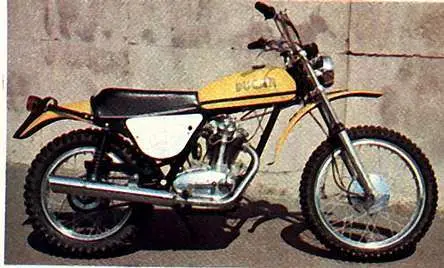
The Ducati 450 Mark 3 is a 436 cc single-cylinder bevel-drive SOHC motorcycle produced by Ducati from 1969 to 1974. The 450 was the largest displacement of the overhead-cam single series and used the wide-case engine. A higher-performance version, the 450 Mark 3D with desmodromic valves, was also available.
Ducati 450 Mark 3 at a glance
| Maker | Ducati, Borgo Panigale |
|---|---|
| Production | 1969–1974 |
| Engine | 436 cc bevel-drive SOHC single, wide case |
| Bore × stroke | 86 × 75 mm |
| Compression | 9.3:1, or 8:1 on the Tourer |
| Power | 27 bhp at 7,000 rpm; 31 bhp for the Mark 3D |
| Carburettor | 29 mm Dell’Orto VHB |
| Gearbox | five-speed |
| Suspension | 31.5 mm forks, twin Marzocchi shocks; 35 mm forks from 1972 |
| Brakes | 180 mm front and 160 mm rear drums; Grimeca twin-sided front from 1972 |
| Production | about 1,800 Mark 3 and 1,400 Mark 3D |
Facts in this article come from one source, the English Wikipedia page on the Ducati 450 Mark 3.
History of the Ducati 450 Mark 3
The wide-case limit
The wide-case engine, introduced in 1968, had been designed with the possibility of enlarging the existing largest 340 cc displacement. In 1969 the 436 cc 450 was introduced to compete with machines such as the BSA B44. It was the largest displacement the engine could reach without a redesign. Apart from a strengthened frame, the 450 shared its cycle parts with the 250 and 350 Mark 3s. A 13-litre coffin-style tank was normal, though some 450s used the scrambler tank.
Import troubles
Few 450s reached the United States and Britain in 1970–71 because the importers, Berliner in the US and Vic Camp in the UK, were in dispute with the factory over prices. The Mark 3 received a new larger tank in 1971. For the Italian home market two touring variants appeared, the 450T and 450TS, with 12-volt electrics, deeper mudguards, panniers, crash bars and a lower compression ratio. An American ban on fibreglass tanks in 1972 and a dealer dispute limited US distribution.
The 1973 restyle
In 1973 all models were restyled by Leopoldo Tartarini of Italjet, with a revised dual seat, side covers, Smiths instruments and a CEV headlight styled like the 750 GT, finished in blue and gold. That year brought 35 mm Marzocchi forks and a twin-sided Grimeca front brake. The factory stopped making OHC singles in 1974.
The Mark 3D
The desmodromic Mark 3D used a different head with valves closed by extra cam lobes and levers, derived from the 350 SCD racers, though light hairspring valve springs were kept. The rest of the engine and the cycle parts were the same, and the 3D produced 31 bhp. In 1971 the desmo model became the 450 Desmo with café racer styling: clip-ons, a fibreglass tank and a monoposto single seat in bowling-ball metal-flake silver, nicknamed the silver shotgun. From 1973 it had a metal tank, different side panels, Smiths clocks and a combined seat and rear mudguard in the yellow and black of the 750 S. In its final year, 1974, it received Ceriani forks and a single 280 mm Brembo disc.
Design and features
- Largest OHC single: 436 cc from an 86 mm bore, the limit of the wide-case engine without a redesign.
- Shared cycle parts: the 250 and 350 Mark 3 chassis with a strengthened frame.
- Desmo option: the Mark 3D’s desmodromic head gave 31 bhp instead of 27.
- Tourers: the Italian-market 450T and 450TS with 12-volt electrics and panniers.
Ducati 450 Mark 3 versions
- 450 Mark 3 (1969–1974): the standard single, 27 bhp.
- 450 Mark 3D: the desmodromic version, 31 bhp.
- 450 Desmo (1971–1974): café racer version, the “silver shotgun”.
- 450T and 450TS: Italian touring variants with lower compression and panniers.
The 450 shared its chassis with the 250 Mark 3 and 350 Mark 3. Its sleeves and pistons were used to enlarge the 860 GT. More Ducatis are in the Ducati collection.
Video: 1974 Ducati 450 Desmo
Video by Richard OBrien on YouTube.
Sources
- Ducati 450 Mark 3, English Wikipedia: history, engine, cycle parts, production