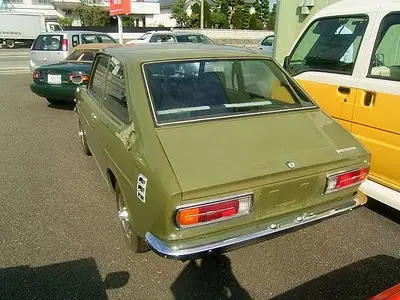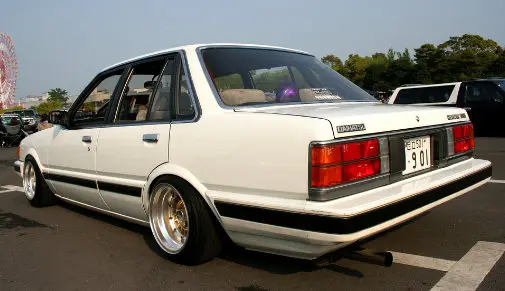
The Daihatsu Charmant was a subcompact car built in two generations between 1974 and 1988. It was heavily based on the Toyota Corolla and Sprinter platforms and used Toyota inline-four engines from 1.2 to 1.6 litres. Until the Delta Wide minivan arrived in 1982, it was the largest passenger car Daihatsu sold in Japan.
Daihatsu Charmant at a glance
| Maker | Daihatsu, Japan |
|---|---|
| Production | 1974–1988 |
| Class | subcompact family car |
| Platform | Toyota Corolla E20 and E70 |
| Engines | Toyota inline fours, 1.2 to 1.6 litres |
| First generation | A10/A20/A30/A40, 1974–1981 |
| Second generation | A35/A45/A55/A60, from 1981 |
| Layout | front engine, rear-wheel drive |
| Body styles | two- and four-door saloon, estate |
| Successor | Daihatsu Applause |
| Largest Daihatsu | until the Delta Wide of 1982 |
Based on one source.
History of the Daihatsu Charmant
A Corolla by another name
First presented in November 1974, the Charmant was based on the Toyota Corolla E20 platform, which was already outdated because Toyota had introduced the newer E30 seven months earlier. The body shell looked more like the Sprinter saloon, especially from the C-pillar back. Daihatsu marketed the car as a luxury model: it had twin headlights, a feature then usually reserved for more expensive cars, and was offered in Deluxe, Custom and Hi-Custom grades.
The first cars used a 1.2-litre 3K-H engine of 71 PS or a 1.4-litre T unit of 86 PS, both quoted in gross figures. Transmissions were four- or five-speed manuals or a two-speed automatic. Base cars had drum brakes all round, while the higher grades received front discs with a booster. Unique to the first generation was an estate, called a van in Japan where it was classed as a commercial vehicle; it came only as a five-door and arrived in December 1974, a month after the saloons.
Emissions and updates
In 1975 the engines were revised with the DECS-C emission system and a catalytic converter to meet Japanese rules, becoming the 3K-U of 64 PS and the T-U of 78 PS. A facelift in November 1976 brought a new grille and two more saloon grades, Grand Custom and Sporty Custom. In March 1978 the 1.2- and 1.4-litre units gave way to a 1.3-litre 4K-U of 72 PS and a 1.6-litre 12T-U lean-burn engine of 88 PS, along with a boxier front, new tail lights and a three-speed automatic with overdrive for the 1.6.
Exports and the second generation
From 1976 the Charmant was exported widely, usually in a single unnamed grade with simplified engines: a 3K of 55 PS and a T of 62 PS in net figures, with a four-speed manual. A 1.6-litre 2T engine of 75 PS joined the export range in 1979, available with a five-speed manual or a three-speed automatic. Left-hand-drive cars used a Corolla E20 dashboard with a thicker upper panel and the Charmant’s square instrument cluster. It was also the first Daihatsu sold in Iceland, where a large batch of surplus cars from the Netherlands arrived in the summer of 1979 and sold at a very low price.
A new Charmant was launched at the Frankfurt Motor Show in September 1981 with squarer bodywork and a front-engine, rear-wheel-drive layout that was already outmoded. Daihatsu was unused to launching cars in Frankfurt, and the new model was left out of most official press material, so several motoring writers did not notice it at all. Production continued until 1988, when the Applause took over.
Design and features
- Toyota underpinnings: Corolla E20 and E70 platforms with Toyota engines.
- Twin headlights: a luxury cue on the first generation.
- Estate version: a five-door van model sold alongside the saloons.
- Rear-wheel drive: kept through both generations, even as rivals moved to front drive.
Daihatsu Charmant versions
- 1.2 and 1.4 (1974–1978): the original A10 and A20 cars.
- 1.3 and 1.6 (1978–1981): A30 and A40 with the lean-burn 12T-U engine.
- Van: the five-door estate, commercial in Japan.
- Second generation (1981–1988): squarer body on the later Corolla platform.
- Export 1.6: the 2T-engined car with five-speed manual or three-speed automatic.
The Charmant took over the bigger-engined role of the Consorte, and the smaller Charade sat beneath it in the range. More cars are in the Daihatsu collection.
Sources
- Daihatsu Charmant, English Wikipedia: generations, engines, grades, exports