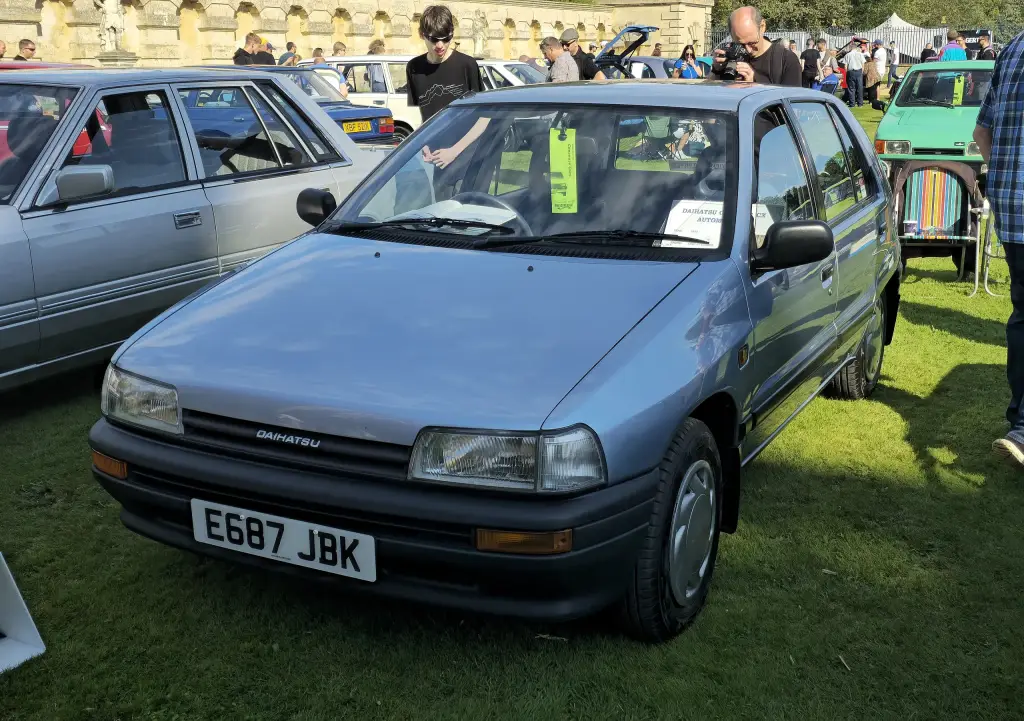
The Daihatsu Charade was the company’s supermini, sold from 1977 to 2000 and placed above the small kei cars such as the Mira. It replaced the Consorte and was the first Daihatsu of its size to be designed without a Toyota platform underneath. Its one-litre three-cylinder engine, and later turbo and diesel versions, gave the little car a character out of proportion to its size.
Daihatsu Charade at a glance
| Maker | Daihatsu, Japan |
|---|---|
| Production | 1977–2000 |
| Class | supermini |
| Predecessor | Daihatsu Consorte |
| Layout | front engine, front-wheel drive |
| First generation | G10/G20, 1977–1983 |
| Engine | 993 cc three-cylinder, all aluminium |
| Power | 50 PS in export form, 55 PS in Japan |
| Second generation | G11, from March 1983 |
| Later engines | turbo, diesel and turbodiesel |
| Body styles | three- and five-door hatchback |
| Award | Japanese Car of the Year 1979 |
| G10/G20 built | 89,792 |
| Also built as | Xiali in China, 1986–2009 |
Based on one source.
History of the Daihatsu Charade
A one-litre car that surprised Japan
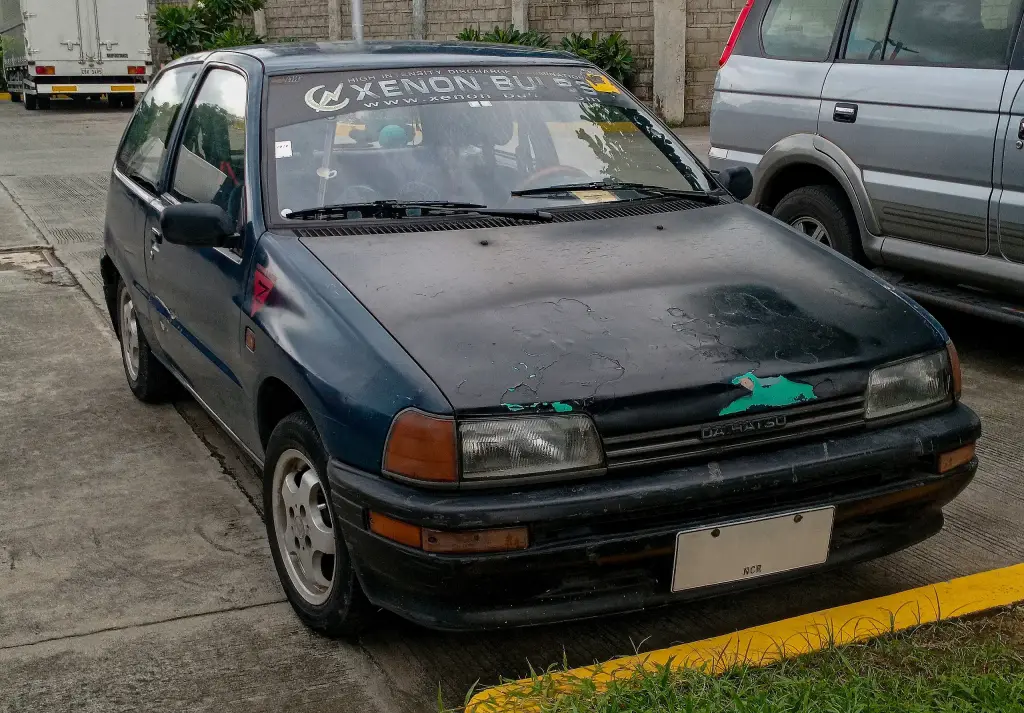
The first Charade, the G10, appeared in October 1977 with front-wheel drive and a five-door hatchback body. Under the bonnet sat the CB20, a 993 cc three-cylinder engine made entirely of aluminium, rated at 50 PS for export and 55 PS in Japan. At a time when tightening emissions rules had convinced many observers that the one-litre car was finished, the Charade became an overnight success and was voted Japanese Car of the Year for 1979. A three-door version called the Runabout followed in the autumn of 1978, recognisable by two small circular opera windows in the C-pillars.
The early cars had round headlights; a revised Series 2 with square headlights arrived in October 1980. Between November 1977 and December 1982 Daihatsu built 89,792 Charades of the G10 and G20 type. In New Zealand the facelifted car was assembled locally by General Motors from 1981. A separate Chilean version, the G20, used a downsleeved 843 cc three-cylinder of 41 PS, created after Chile cut import tariffs on cars under 850 cc in 1979; it could run on low-octane fuel or ethanol.
Special bodies and rallying
Not every Charade was a hatchback. At the 1981 Tokyo Motor Show Daihatsu showed the Charade De Tomaso, a one-litre turbo concept built with the Italian sports car maker on the three-door XTE. In Greece, Automeccanica built an off-road style torpedo version called the Zebra between 1981 and 1985, using Daihatsu mechanicals, grille and headlights. The G10 also went rallying with some success: two cars finished first and second on the 1979 Tour of Malaysia, won their class on the 1981 Monte Carlo Rally and again on the 1982 Safari Rally.
Second generation and the diesel
The second generation, the G11, was released in March 1983 as a three- or five-door hatchback. It brought new variations of the three-cylinder one-litre engine, including a turbocharged version, and naturally aspirated and turbocharged diesels. To prove the new 1.0-litre diesel, Daihatsu ran a Charade for ten non-stop laps of the Japanese archipelago, a run that lasted 117 days. The turbo diesel arrived in the autumn of 1984. Base cars used the 993 cc CB-series engine with 52 to 60 PS, good for 0–100 km/h in about 15 to 17 seconds, and the body had a drag coefficient of 0.36.
The Charade in China
In China the Charade was built as the Xiali by Tianjin FAW from September 1986, and more than 1.5 million were sold there by 2009. The second and third generation cars also provided the basis for numerous unlicensed Chinese copies, often built with fibreglass mouldings. Production of Charade-based cars in China ended in 2012, twelve years after the Japanese original had gone out of production.
Design and features
- Three-cylinder engine: an all-aluminium one-litre unit, unusual in a small car of 1977.
- Turbo and diesel options: the second generation offered turbocharged petrol and diesel engines.
- Kept above the kei class: a supermini for buyers who wanted more than a Mira.
- Long production: twenty-three years in Japan and a further twelve in China.
Daihatsu Charade versions
- G10 (1977–1983): the original five-door, joined by the three-door Runabout in 1978.
- G20: the Chilean 843 cc version, with round or square headlights.
- G11 (1983–1988): second generation with turbo and diesel engines.
- Xiali: the Chinese-built version, produced from 1986.
- Charade De Tomaso: a 1981 turbo concept on the three-door body.
The Charade replaced the Consorte and sat above the Mira in the Daihatsu range, while the Gran Move later used a Charade chassis. More cars are in the Daihatsu collection.
Sources
- Daihatsu Charade, English Wikipedia: generations, engines, production figures, China, rallying