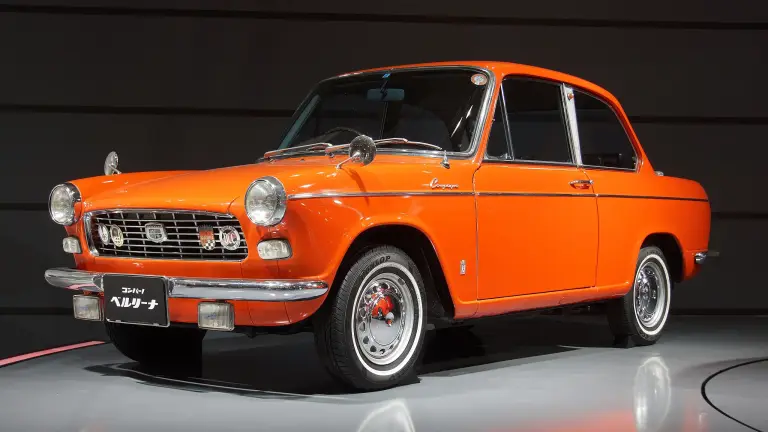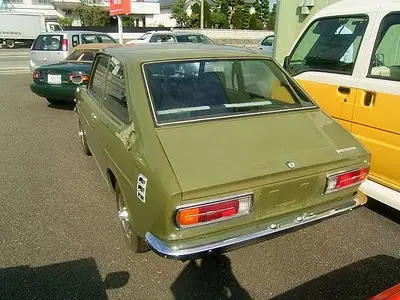
The Daihatsu Consorte was a subcompact car sold in Japan from 1969 to 1977. It was a badge-engineered version of the Toyota Publica, fitted with Daihatsu’s own one-litre engine, and it was sold through Toyota’s small-car dealer network. Its name means “consort” in Italian and continued the theme set by the Compagno.
Daihatsu Consorte at a glance
| Maker | Daihatsu, Japan |
|---|---|
| Production | 1969–1977 |
| Based on | Toyota Publica P30 |
| Engine | Daihatsu 1.0-litre FE, later Toyota 1.2 3K |
| Gearbox | four-speed manual |
| Body styles | two-door saloon, later four-door and fastback |
| Trim levels | Standard, Deluxe, Super Deluxe |
| Successor | Daihatsu Charade |
| Sold through | Toyota Corolla Store network |
Based on one source.
History of the Daihatsu Consorte
A Toyota with a Daihatsu heart
The Consorte was introduced in April 1969 as a two-door saloon and was only ever offered in that body style at first, while the Publica it was based on also came as a pickup and a van. It used Daihatsu’s in-house 1.0-litre FE engine from the Compagno, where the Publica had Toyota’s 0.8 to 1.1-litre units, and a four-speed manual gearbox. The car was sold through the Toyota Corolla Store, a network intended for small cars, which let Toyota offer the Publica at Daihatsu dealerships and gave Daihatsu a regular passenger car above its kei models.
Facelifts and new body styles
A minor facelift in September 1970 brought a new grille, a new dashboard and revised gear ratios, plus a Super Deluxe model with front disc brakes. In June 1971 a second facelift added another grille and, for the new sporty S model, Toyota’s 1.2-litre 3K engine with a K40 gearbox. The twin-carburettor versions of that engine were not offered in the Consorte.
In January 1972 the car received a new fastback body, 50 mm longer than before, and the Berlina name was dropped; the sporty S trim became GS, and a new 1.0-litre PS model was added. In May 1973 the Toyota Starlet coupé body joined the range, with the 1.0-litre car offered as HL and TL and the 1.2 as GL and GHL. A five-speed manual and a two-speed automatic were optional on 1.2-litre cars. A four-door Berlina arrived in October 1973 with the revived name, but the arrival of the Charmant ended it thirteen months later, in November 1974.
The final years
The two-door car was facelifted for the last time in December 1975, with revised emission controls for the 1.0-litre engine. In February 1976 the 1.2-litre engine was changed to the cleaner 3K-U to meet stricter emissions rules. A year later the 1.0-litre FE engine was dropped, because it could not pass the new standards, and the HL coupé went with it. The Consorte was discontinued in November 1977 and replaced by the G10 Charade hatchback.
Design and features
- Toyota body, Daihatsu engine: the first fruit of the Toyota affiliation.
- Two-door only at first: a narrower range than the Publica it came from.
- Sporty versions: the S, GS and PS models with the 1.2-litre engine.
- Starlet-based coupé: added in 1973 with the P40 body.
Daihatsu Consorte versions
- Consorte Berlina (1969): the original two-door, in Standard and Deluxe trim.
- Super Deluxe (1970): with front disc brakes.
- S model (1971): the Toyota 1.2-litre engine and a four-speed K40 gearbox.
- Fastback (1972): longer body, GS and PS trims.
- Starlet coupé (1973): HL, TL, GL and GHL versions.
- Four-door Berlina (1973–1974): dropped when the Charmant arrived.
The Consorte succeeded the Compagno and was replaced by the Charade; the Charmant took over its four-door role. More cars are in the Daihatsu collection.
Sources
- Daihatsu Consorte, English Wikipedia: history, engines, body styles, dealer network