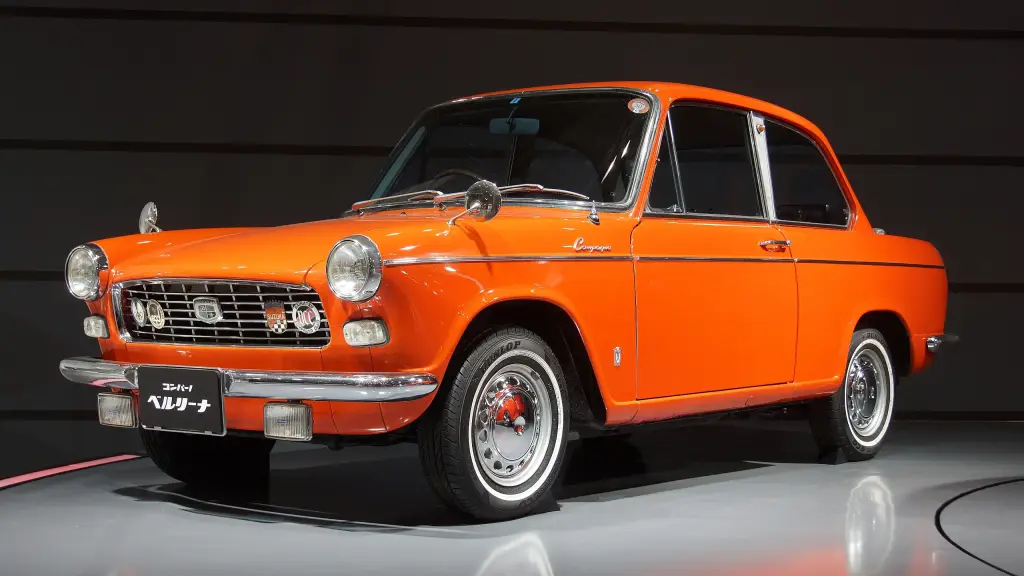
The Daihatsu Compagno was produced in Japan from 1963 to 1970, before Toyota took over the company. It was designed as a family of body styles rather than a single model, and it introduced the “D” badge that Daihatsu still uses. The name comes from the Italian word for partner.
Daihatsu Compagno at a glance
| Maker | Daihatsu, Japan |
|---|---|
| Production | 1963–1970 |
| Body styles | van, wagon, two- and four-door saloon, pickup, convertible |
| Chassis | ladder frame |
| Front suspension | torsion bars, wishbones |
| Rear suspension | semi-elliptical leaf springs |
| Engines | 797 cc and 958 cc |
| Power | 41 to 65 PS |
| Top speed | about 110 km/h (800), 130–145 km/h (1000) |
| Successor | Daihatsu Consorte |
| Built | 120,000 |
| Distinction | first official Japanese car import to the UK |
Based on one source.
History of the Daihatsu Compagno
From a Tokyo show prototype
The first Compagno prototype was shown at the 1961 Tokyo Motor Show, styled in a way that recalled the Fiat 1800 and 2100. That design was not well balanced, and the production version by Vignale ended up looking quite different. The car used a ladder-type chassis rather than the more modern monocoque, with torsion bar wishbone suspension at the front and leaf springs at the rear. It was also the first Daihatsu car to carry the familiar “D” logo.
A range, not a single car
The first model, in April 1963, was the Compagno Light Van, a light commercial vehicle in Standard or Deluxe trim. Two months later came the Compagno Wagon, a more comfortable passenger version that cost over twenty per cent more than the standard van and became Daihatsu’s first four-wheeled passenger car. In November 1963 the Japanese-designed two-door saloon appeared, called the Berlina; its Deluxe version had an Italianate dashboard with a three-spoke Nardi steering wheel.
In April 1965 the Compagno Spider introduced the larger 958 cc engine, kept below one litre to stay in the lowest road tax bracket in Japan. With twin carburettors it produced 65 PS. A month later the bigger engine went into the Berlina and a new four-door model joined the range, on a wheelbase 60 mm longer and with a single carburettor and 55 PS. A small pickup, the F31P, followed in October 1965 and could carry 500 kg, and in November the Compagno 1000 GT appeared, a two-door Berlina with the Spider engine. A two-speed automatic became available in April 1967.
Facelifts and the end
A facelift in May 1967 brought new headlights, tail lights and grille, with front disc brakes for the Spider and GT and a 1000 GT Injection with mechanical fuel injection. The grille changed again in April 1968, with black trim for the Spider and GT. The succeeding Consorte appeared in April 1969, using Daihatsu’s own one-litre engine in a Toyota Publica body; the four-door Super Deluxe stayed in production until January 1970 to fill existing orders.
The British debut
The Compagno was the first official Japanese car import to the United Kingdom, arriving in May 1965 in 797 cc form. Autocar found it lacklustre against its rivals: apart from good build quality and equipment, the magazine noted outdated styling, a poor ride and brakes, a high price and a 0–60 mph time “too slow to record”. Only six Compagnos were sold in Britain in five years, but the car encouraged other Japanese makers, including Toyota with the 1966 Corona and Nissan with the 1968 Sunny, to export to Europe.
Design and features
- Body-style family: van, wagon, saloons, pickup and convertible from one design.
- Vignale styling: the production body was reworked by the Italian coachbuilder.
- Ladder chassis: a conservative structure with torsion bar front suspension.
- First “D” badge: the logo that Daihatsu still uses today.
Daihatsu Compagno versions
- Compagno 800 Van (1963–1967): 797 cc, 41 PS, three-door van.
- Compagno 800 Berlina: 797 cc two-door saloon.
- Compagno 1000 Berlina (1965–1970): 958 cc, 55 PS, two or four doors.
- Compagno 1000 Truck (1965–1969): a 500 kg pickup.
- Compagno Spider 1000 (1965–1969): convertible with a 65 PS twin-carburettor engine.
The Compagno was replaced by the Consorte, and the later Charade continued Daihatsu’s line of small cars. More cars are in the Daihatsu collection.
Sources
- Daihatsu Compagno, English Wikipedia: history, models, engines, UK sales