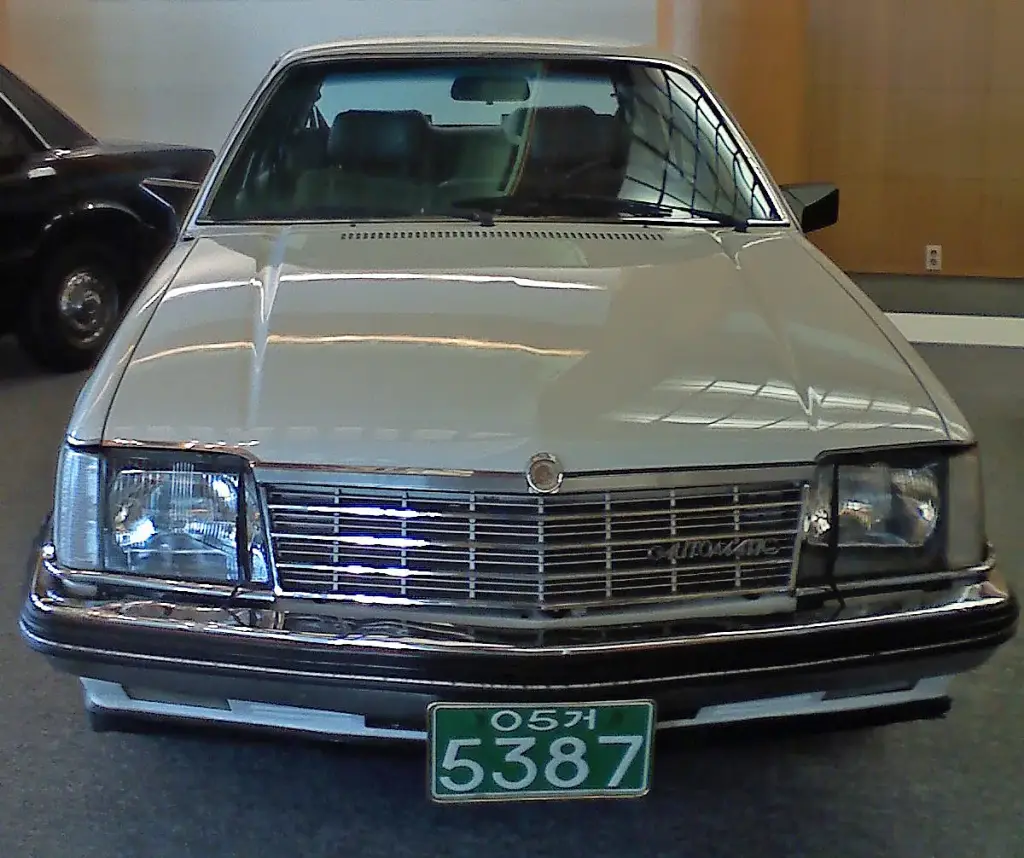
The Daewoo Royale was a series of mid-size cars produced in South Korea from 1983, when the Saehan Royale was renamed after Daewoo took control of the company. Its body was the Opel Rekord E with the front of the larger Opel Senator A, and the range stretched from a 1.5-litre base model to the Imperial, which stayed in production until 1993.
Daewoo Royale at a glance
| Maker | Daewoo, South Korea |
|---|---|
| Name used | 1983–1991, with the Imperial to 1993 |
| Base car | Opel Rekord E with the Opel Senator A front end |
| Predecessor | Saehan Royale, from 1978 |
| First Korean Rekord | General Motors Korea, August 1972 |
| Body panels | stamped by Holden in Australia until November 1984 |
| Engines | 1.5 to 2.0-litre Opel four-cylinders, plus a 2.0 diesel |
| Trim levels | Diesel, Salon, Salon Super, Super Salon, XQ, Duke, Prince |
| Top model | Imperial, from February 1989 |
| Replaced by | Daewoo Prince in 1991; the Imperial by the Daewoo Arcadia |
History of the Daewoo Royale
From GM Korea to Daewoo
General Motors Korea launched the Rekord in August 1972, a version of the German Opel Rekord D. In August 1975 a longer-engined version based on the Opel Commodore B was added as the Rekord Royale, and 12,005 Royales were built between 1975 and 1978. In November 1976 GM Korea became Saehan Motors, and the cars became the Saehan Rekord and Saehan Rekord Royale. In January 1983, after Daewoo gained control, Saehan became Daewoo Motors, the Saehan Royale was renamed Daewoo Royale and the Saehan Rekord was folded into the range as the Royale XQ, which lasted until 1987.
The second generation
The second-generation Saehan Rekord of 1978 was based on the Opel Rekord E and was introduced together with the Saehan Royale, which was essentially the Rekord E with the front end of the larger Senator A grafted on. Until November 1984 Royale body panels were stamped by Holden in Australia, where the same Rekord-Senator hybrid was built as the Holden Commodore; after that Daewoo pressed its own panels on a new line. Korean-built shells received a unique rear pressing with large, sloped rectangular tail lights that added about 5 cm to the length. A second design revision came in 1987 with a new grille and headlamps, and in 1989 the Royale Prince gained a new grille insert and a six-window glasshouse.
The specification levels
The Royale was sold at several levels of luxury. The Diesel ran from May 1980 to April 1989 with Opel’s 2.0-litre diesel, as the Royale Duke Diesel from 1987. The Salon of 1980 to 1991 had a 1,979 cc engine and three-speed automatic, 100 PS and 176 km/h. The Salon Super of 1986 used the Senator’s six-window body with a digital dashboard, trip computer and fuel injection, and the Super Salon of 1987 added a 2.0-litre injected engine, a nine-band equaliser and seat heating. The XQ of 1983 to 1987 had a 1,492 cc engine, four-speed manual and 44 kW, the Duke of 1987 a more modern 1,498 cc unit, and the Duke City a 1.6-litre LPG taxi that became the Royale Prince LPG. The Royale Prince itself, from 1983 to 1991, used the E2 body with a 1,897 cc engine and four-speed manual, 63 kW and 168 km/h.
The Imperial
In February 1989 Daewoo added the Imperial, the ultimate development of the Royale, created in answer to the Hyundai Sonata and Grandeur. Its formal roofline and heavily revised front and rear hid the car’s Opel Senator roots, and it came with a vinyl roof, Bosch anti-lock brakes, digital instruments, cruise control and automatic climate control. Royale production, apart from taxis, ended in 1991 with the arrival of the Daewoo Prince, but the Imperial continued until 1993 and was then replaced by the Daewoo Arcadia.
Design and features
- Hybrid body: the Rekord E shell with the Senator A front, built in Korea from Australian panels at first.
- Korean rear end: a unique tail pressing with sloped rectangular lights, about 5 cm longer.
- Many levels: from the 1.5-litre XQ to the six-window Super Salon.
- Imperial flagship: vinyl roof, anti-lock brakes, digital instruments and climate control.
Daewoo Royale versions
- XQ: the old Rekord body with a 1.5-litre engine, built until 1987.
- Salon and Salon Super: the 2.0-litre cars, the Super with a digital dashboard.
- Super Salon: the 1987 version with fuel injection, seat heating and a nine-band equaliser.
- Duke and Duke City: cheaper models from 1987, the City a 1.6 LPG taxi.
- Imperial: the 1989 flagship, built until 1993.
The Royale was replaced by the Prince, and its last version, the Imperial, by the Arcadia. More cars are in the Daewoo collection.
Sources
- Daewoo Royale, English Wikipedia: generations, trim levels, Imperial