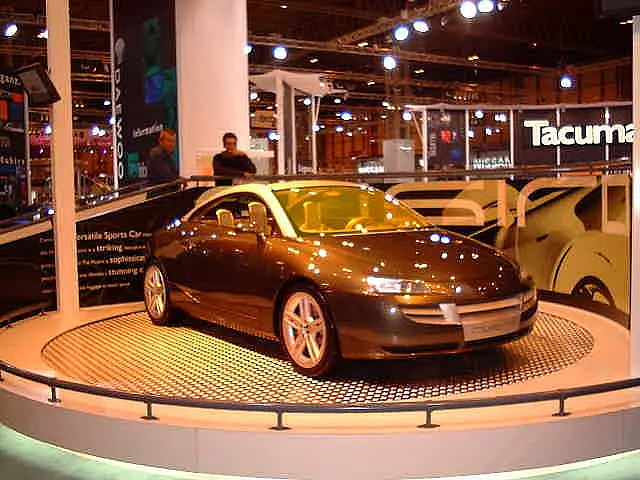
The Daewoo Musiro was a concept car shown at the 2000 British International Motor Show. Built by Daewoo’s Worthing Technical Centre in England, it was a coupe with a folding two-piece roof, a highly adjustable interior and a 2.5-litre straight-six, and it was the next-to-last concept to come out of the British studio.
Daewoo Musiro at a glance
| Shown | British International Motor Show, 2000 |
|---|---|
| Built by | Daewoo Worthing Technical Centre, England |
| Type | coupe concept with a folding roof |
| Engine | Daewoo XS6 2.5-litre straight-six |
| Top speed | 135 mph (217 km/h) |
| 0–60 mph | 7.9 seconds |
| Length | 4,250 mm |
| Width | 1,780 mm |
| Height | 1,340 mm |
| Wheelbase | 2,540 mm |
| Name | Korean for “any time” |
Based on one source.
History of the Daewoo Musiro
A show car from Worthing
The Musiro was the next-to-last concept vehicle to come out of Daewoo’s Worthing Technical Centre in Britain. It was launched at the 2000 British International Motor Show, built on Daewoo’s emerging “Designed Around You” idea, and it distilled the Versatile Sports Car concept of the earlier and more advanced 1999 Mirae show car. Its name is Korean for “any time”.
The roof
Unlike the Mirae, the Musiro sat on a future Daewoo underbody but kept the sort of reconfigurable interior usually found in MPVs. Its neat exterior reminded onlookers of the Audi TT, but the coupe lines hid an opening roof. Worthing’s designers solved the usual problems of open cars — less stiffness than a fixed roof, and almost no boot in a folding hardtop — by making the roof panel and rear window articulate along the cant rails, which also hid the tracks, and then stack vertically behind the rear seats. The boot kept almost all of its volume, rear passengers were not affected, and the body stayed stiff.
Inside and afterwards
The cabin used unusual translucent materials to let occupants see each other and avoid the closed-in feel of most coupes, with colours closer to fashion than to the car industry. The seats were not mounted on the floor but on the outer sills and a tube-like central console, which was claimed to allow a much wider range of movement; the rear seats could slide forward to help people get in, and the front passenger seat could be partly stowed under the dashboard or slid back. The design team was led by Chris Milburn as chief designer, with Mark Oldham, Juan Jose Delhom, Paul Wraith, Dominique Raye and Louise Woodward. The Musiro was well received and read as a sign that Daewoo, then collapsing and looking for a buyer, still had potential. Worthing and the Musiro were later sold to Tom Walkinshaw’s TWR group, and the centre closed in 2002 after TWR failed; in 2017 the concept appeared at a British government auction, reportedly seized as the proceeds of a drugs raid.
Design and features
- Two-piece folding roof: panel and rear window stack behind the rear seats without losing boot space.
- Seats on the sills: mounted on the outer sills and a central tube instead of the floor.
- Translucent cabin: materials chosen to keep the coupe interior bright and open.
- Straight-six power: the Daewoo XS6 2.5, good for 135 mph.
Daewoo Musiro versions
- Mirae (1999): the earlier Versatile Sports Car concept the Musiro distilled.
- Musiro (2000): the single show car.
The Musiro came from the same Worthing studio that engineered the Matiz and the Lanos. More cars are in the Daewoo collection.
Sources
- Daewoo Musiro, English Wikipedia: concept, roof, interior, specifications