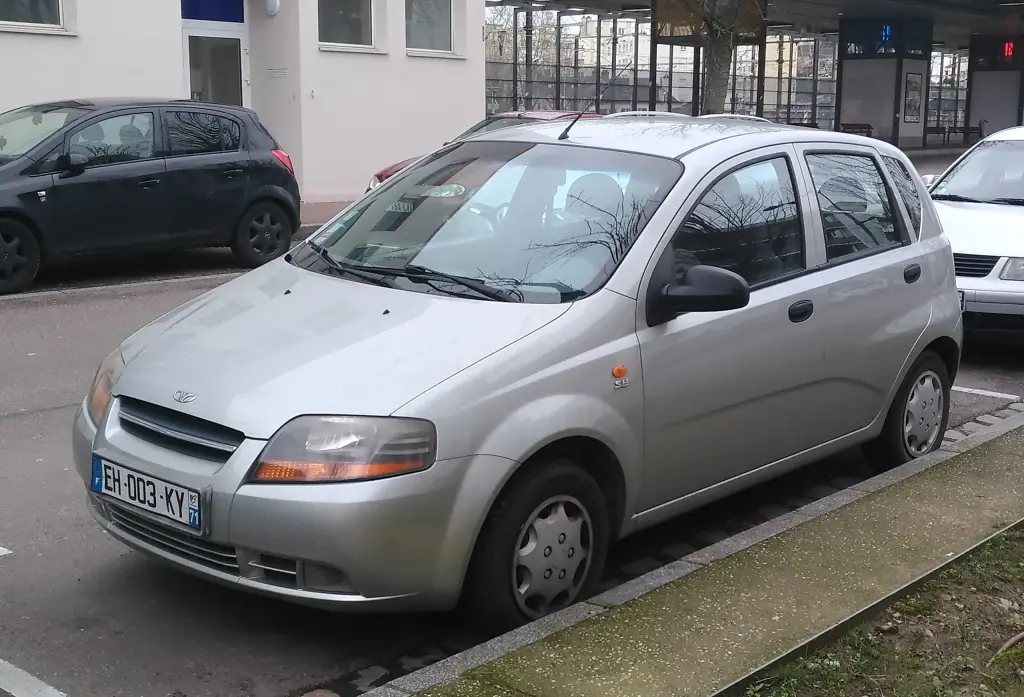
The Daewoo Kalos was a subcompact car launched in 2002, the first new model Daewoo introduced after its takeover by General Motors. Designed by Italdesign and built on the new T200 platform, it replaced the Lanos and went on to be sold in some 120 countries under seven different brands, most famously as the Chevrolet Aveo.
Daewoo Kalos at a glance
| Maker | Daewoo, later GM Daewoo, South Korea |
|---|---|
| Production | from March 2002; the generation ran to 2011 |
| Platform | T200, replacing the Lanos (T100) |
| Facelift code | T250 |
| Design | Italdesign, from the Kalos Dream concept of 2000 |
| Bodies | four-door saloon, five-door hatchback, three-door from 2005 |
| Front ends | two different T200 nose styles |
| Interior volume | 102.7 cu ft (5-door), 107.4 cu ft (saloon) |
| Cargo, five-door | 175 litres, 735 litres with the rear seats folded |
| Payload | 495 kg |
| Markets | about 120 countries, seven brands |
History of the Daewoo Kalos
Born during a bankruptcy
The Kalos was developed under the T200 code before Daewoo’s bankruptcy and became the company’s first new model after General Motors took it over. Manufacture began in early March 2002, with pre-production prototypes shown at the Geneva motor show in April 2002. The design came from Italdesign and derived directly from the Kalos Dream concept car first shown at the 2000 Paris motor show; during the three-year development the future of both the company and the concept was uncertain. Daewoo’s Worthing Technical Centre in Britain did the initial research and platform engineering, and the main technical centre in Bupyong, Incheon, completed most of the later programme, with chassis work done on British proving grounds.

Two faces and three bodies
Two different T200 front ends were sold. The 2002 car had headlamps detached from the horizontal amber turn-signal strip below them, with a semi-elliptical grille, and this style was used mainly in Korea and North America. When European sales began in 2003 the lights were an integrated unit slanting up from a V-shaped grille; in Australia the hatchback had the integrated lights and the saloon kept the detached ones. The range offered a four-door saloon and a five-door hatchback from the start and a three-door hatchback in some European markets from 2005. A swage line ran along the lower body, kinking down on the five-door, which also had a side window in the C-pillar with an angled lower edge; the interior used a circular motif throughout, and early European cars carried a “Design Giugiaro” emblem.
One car, many names
In Korea the T200 was the Daewoo Kalos until it was rebranded Daewoo Gentra, and the name comes from the Greek kalos, meaning beautiful or good. Export cars were later renamed Chevrolet Aveo, or Holden Barina in Australia, and the same generation was also sold as the Pontiac G3 and Wave, the Suzuki Swift+, the ZAZ Vida, the Ravon Nexia and the Chevrolet Lova among others — seven brands in all. Its successor, the T300, arrived in 2011.
Design and features
- Italdesign shape: a Giugiaro design developed from the Kalos Dream concept of 2000.
- Two nose styles: Korean and American cars kept the detached headlamps, European ones had the integrated V-grille.
- Roomy for its class: headroom was unmatched in the class at launch and the five-door took 735 litres with the seats folded.
- Worldwide under many badges: Chevrolet, Daewoo, Holden, Pontiac, Ravon, Suzuki and ZAZ.
Daewoo Kalos versions
- Saloon: the four-door, sold as the Aveo sedan in most markets.
- Five-door hatchback: the Aveo5 in the United States and Canada.
- Three-door hatchback: added in some European markets in 2005.
- Gentra and Gentra X: the Korean names of the facelifted saloon and hatchback.
The Kalos replaced the Lanos and was itself replaced by the Lacetti generation in Korea as the Gentra. More cars are in the Daewoo collection.
Sources
- Daewoo Kalos, English Wikipedia: development, design, bodies, names