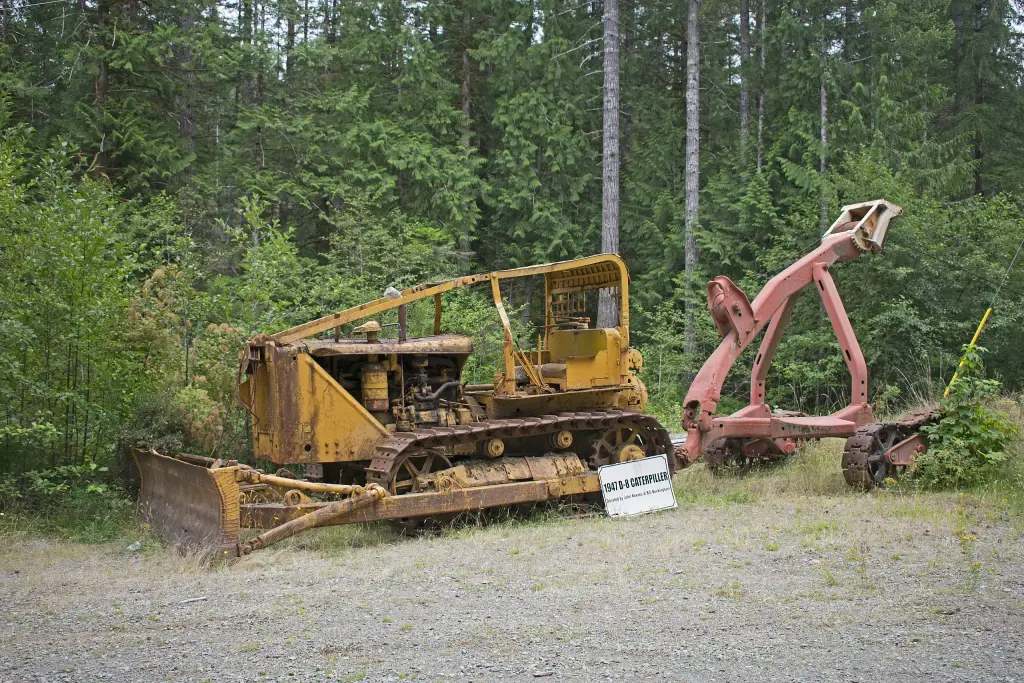
The Caterpillar D8 is a track-type tractor that Caterpillar has designed and manufactured since 1935. It comes in many configurations but is usually sold as a bulldozer with a detachable blade and a rear ripper, and the model offered in 2025 is a D8 of Tier 4/Stage V standard with a 363 hp C15 engine and an operating weight of 87,083 lb.
Caterpillar D8 at a glance
| Type | track-type tractor, usually a bulldozer |
|---|---|
| Introduced | 1935, as the RD8 of 132 hp (98 kW) |
| Named D8 | 1937, when the R prefix was dropped |
| D8 2U series | 1940s, 148 hp (110 kW) |
| D8E and D8D | 1955, 191 hp (142 kW), 1,246 cu in D342 diesel |
| D8H | 1958, 235 hp (175 kW), 270 hp by 1965 |
| D8K | 1974, 300 hp (220 kW) |
| D8L | 1982, 335 hp (250 kW), first D8 with an elevated drive sprocket |
| D8N | 1987, 285 hp (213 kW), with differential steer |
| D8R | 1996, 305 hp (227 kW); D8R Series 2 in 2000 |
| D8T | 2004, 310 hp (230 kW) ACERT |
| Today’s D8 | 363 hp C15, operating weight 87,083 lb |
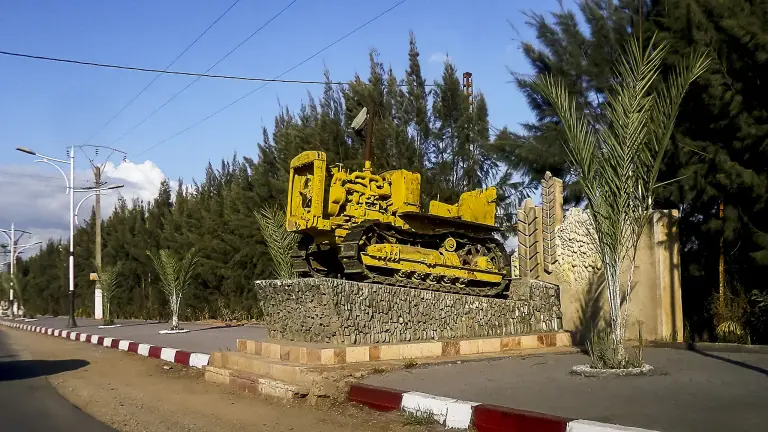
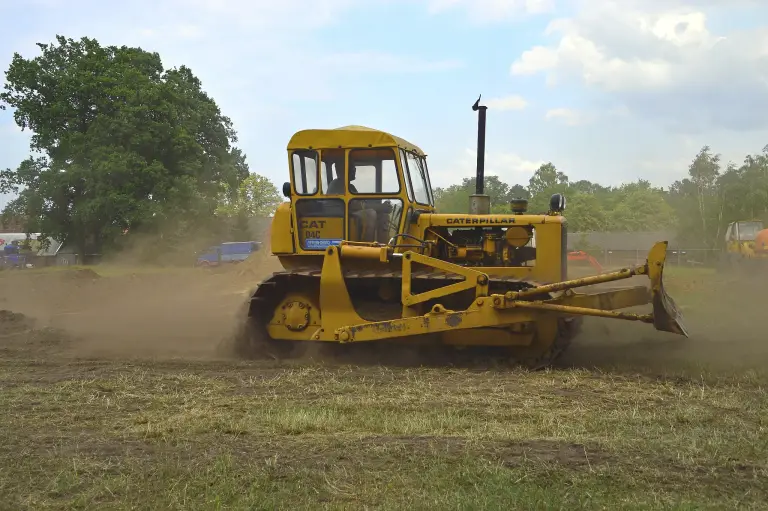
The photograph shows a D8 of 1947 preserved at the McLean Mill; later machines with an elevated sprocket look very different.
History of the Caterpillar D8
RD8 and the 2U series
The RD8 of 132 hp (98 kW) was introduced in 1935, and in 1937 the R prefix was dropped, making it the D8. In the 1940s came the D8 2U series of 148 hp (110 kW), and in 1950 the model received a new front-rounded grille that lasted until the D8K was replaced by the D8L in 1982. From 1953 to 1959 a stretched SD8-LGP was built for military use in Greenland and Antarctica, with 48 or 54 inch wide pads and a 15 to 16 foot blade.
D8D to D8K
The 1H series ended in 1955, when the 191 hp (142 kW) D8E and D8D arrived with the new 1,246 cubic inch D342 diesel; the D8D had a torque converter and the D8E a direct drive transmission. The D8D was replaced by the D8G in 1956 and the D8E by the D8F. The 235 hp (175 kW) D8H came in 1958, with power raised to 270 hp (200 kW) in 1965 and the D8 46A and 48A at 280 hp in 1970. The 300 hp (220 kW) D8K replaced the D8H in 1974.
D8L to the present
The 335 hp (250 kW) D8L replaced the D8K in 1982 and was the first D8 with the elevated drive sprocket undercarriage; a D8L SA for farming followed in 1984, available with a three-point hitch. The 285 hp (213 kW) D8N of 1987 brought differential steer transmission, the first on a Caterpillar track-type tractor, and was smaller than the D8L it followed, because the old D8L size became the D9N. The 305 hp (227 kW) D8R replaced the D8N in 1996 and the D8R Series 2 followed in 2000; the 310 hp (230 kW) D8T ACERT arrived in 2004. The D8 remains the largest of Caterpillar’s medium track-type tractors, a position it had already reached in the 1950s, when the D9 was introduced above it in 1955.
Design and features
- Since 1935: one of the oldest names in the Caterpillar track-type range.
- Elevated sprocket: from the D8L of 1982.
- Differential steer: introduced on the D8N of 1987.
- Today’s engine: a 363 hp Cat C15 in the current D8.
- Many blades: straight, angle, universal and S-U blades, plus landfill and woodchip U-blades and two-way blades for work inside ship holds.
Caterpillar D8 versions
- RD8 and D8 2U (1935–40s): 132 hp and then 148 hp.
- D8E and D8D (1955): direct drive and torque converter versions of the D342-engined tractor.
- D8H and D8K (1958–74): from 235 to 300 hp.
- D8L (1982): first high-drive D8, with a farming D8L SA from 1984.
- D8N, D8R and D8R Series 2 (1987–2000): 285 to 305 hp, with differential steer.
- D8T and today’s D8: 310 hp ACERT from 2004 and the 363 hp C15 model of 2025.
The D8 sits between the Caterpillar D7 and the Caterpillar D9, the machine that was introduced above it in 1955; more of them are in the Caterpillar collection.
Video: caterpillar D8-2U-6481 first start in 5 yrs.wmv
Video by reclineaholic on YouTube.
Sources
- Caterpillar D8, English Wikipedia: history year by year, engines and powers, elevated sprocket, blades, today’s model