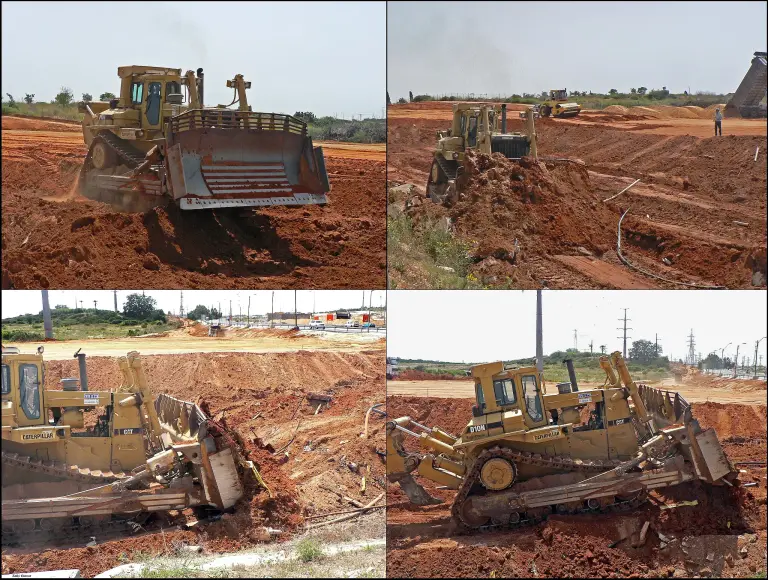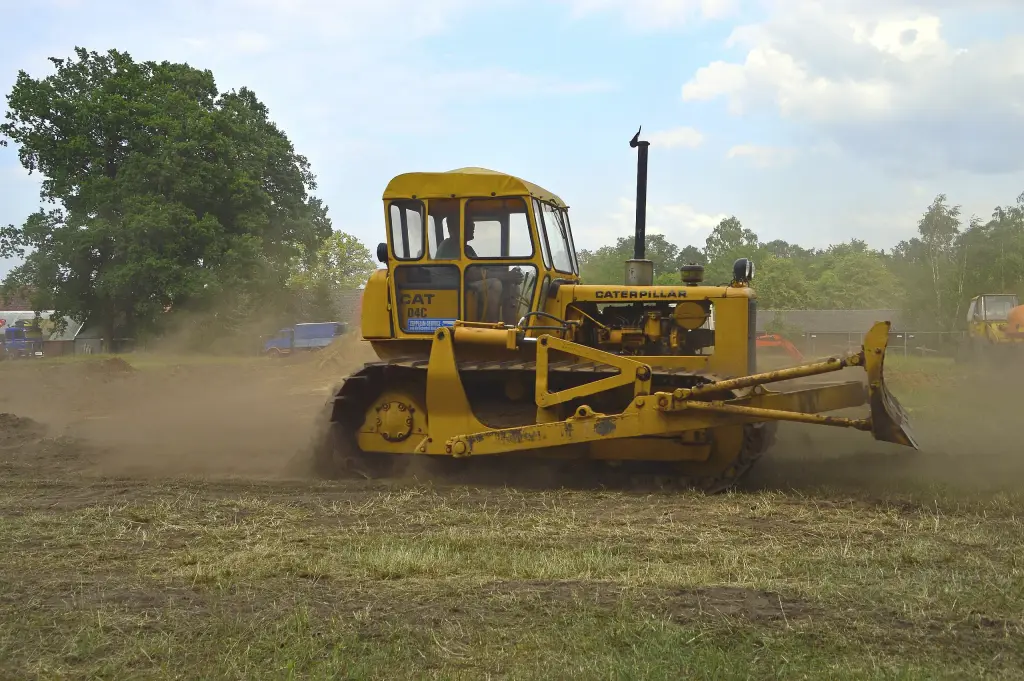
The Caterpillar D4 is the small bulldozer of the track-type range. It started life in 1936 as the RD4, the diesel follow-on to the petrol Caterpillar 30, and the same designation has carried on through a long line of versions up to the 1990s.
Caterpillar D4 at a glance
| Type | small track-type tractor |
|---|---|
| First model | RD4, 1936 |
| First engine | D4400, inline four, 4.25 by 5.50 in (108 by 140 mm) bore and stroke |
| Power at introduction | about 43 hp (32 kW) at the drawbar |
| Weight of the first RD4 | 10,000 lb (4,500 kg) |
| Track gauges | 6U narrow, 44 in (1,100 mm); 7U wide, 60 in (1,500 mm) |
| Later engine | D315 in the U series |
| Versions | RD4 and D4 through the 4G, 7J, 2T, 5T and 6U/7U series to the D4C SIII of 1993 |
| Loader version | Trackson T4, also called Traxcavator |
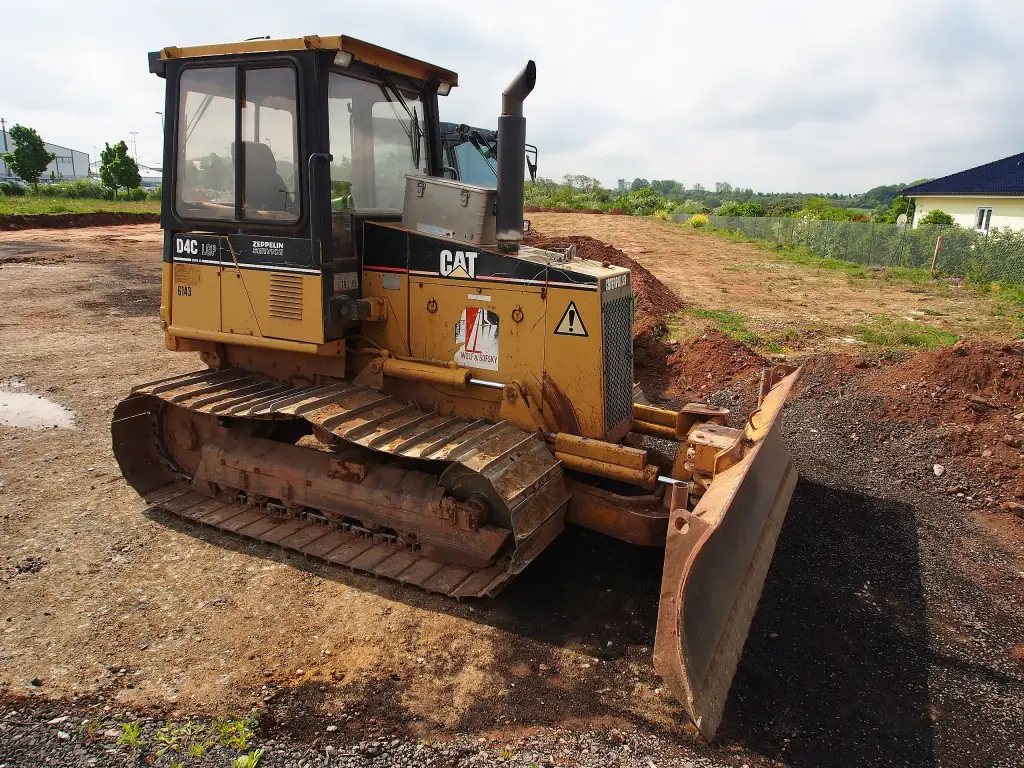
The photographs show the D4C, one of the later versions of the line.
History of the Caterpillar D4
RD4 and the naming system
Caterpillar introduced the RD4 in 1936 as the diesel follow-on to the successful CAT 30 petrol model. The first RD4 weighed 10,000 pounds (4,500 kg) and used the D4400 engine, an inline four with a bore and stroke of 4.25 by 5.50 inches (108 by 140 mm). In 1935 the company had started naming machines RD for diesel and R for regular petrol, followed by a number for the relative engine size; in 1937 the RD models became plain D models. At the time the D4400 made about 43 horsepower (32 kW) at the drawbar, so the 4 in the name was a relative indicator of engine power. Later the D4 U series received the more powerful D315 engine, and further engines raised output again, but the number 4 stayed because it marked the tractor’s place in the range rather than its power.
Versions through the years
The line ran from the RD4 of 1936–37 (4G) and the D4 of 1937–39 (4G) through the 7J series of 1939–43, the 2T of 1943–45 and the 5T of 1945–47, all with the D4400. From 1947 to 1959 came the 6U and 7U series with the D315, 6U covering the narrow 44 inch gauge and 7U the wide 60 inch gauge. Then followed the D4C of 1959–63, the D4D of 1963–77, the D4E of 1977–84, the D4H of 1985–96, and the D4C Series II of 1990–93 and Series III of 1993.
As a loader base
The D4 was also the base tractor for the loader that Trackson built and sold as the T4, or Traxcavator shovel: the track-type tractor with a bucket at the front that became the ancestor of Caterpillar’s track loaders.
Design and features
- D4400 engine: inline four of 4.25 by 5.50 inches, about 43 hp at the drawbar in 1936.
- Two track gauges: 6U at 44 inches for narrow work and 7U at 60 inches for wide.
- D315 in the U series: the more powerful engine of the post-war 6U and 7U tractors.
- Loader base: the Trackson T4 Traxcavator was built on the D4.
Caterpillar D4 versions
- RD4 (1936–37): the first diesel machine, 4G series.
- D4 4G, 7J, 2T and 5T (1937–47): D4400-engined tractors.
- D4 6U and 7U (1947–59): D315 engine and the two track gauges.
- D4C, D4D and D4E (1959–84): the next three series.
- D4H (1985–96): the last of the letter series listed here.
- D4C Series II and III (1990–93): the final variants named in the source.
The D4 sits between the Caterpillar D2 and the Caterpillar D6 in the range; more machines are in the Caterpillar collection.
Video: starting a caterpillar D4
Video by tug135 on YouTube.
Sources
- Caterpillar D4, English Wikipedia: RD4, engine, weights, naming system, version list, Trackson loader