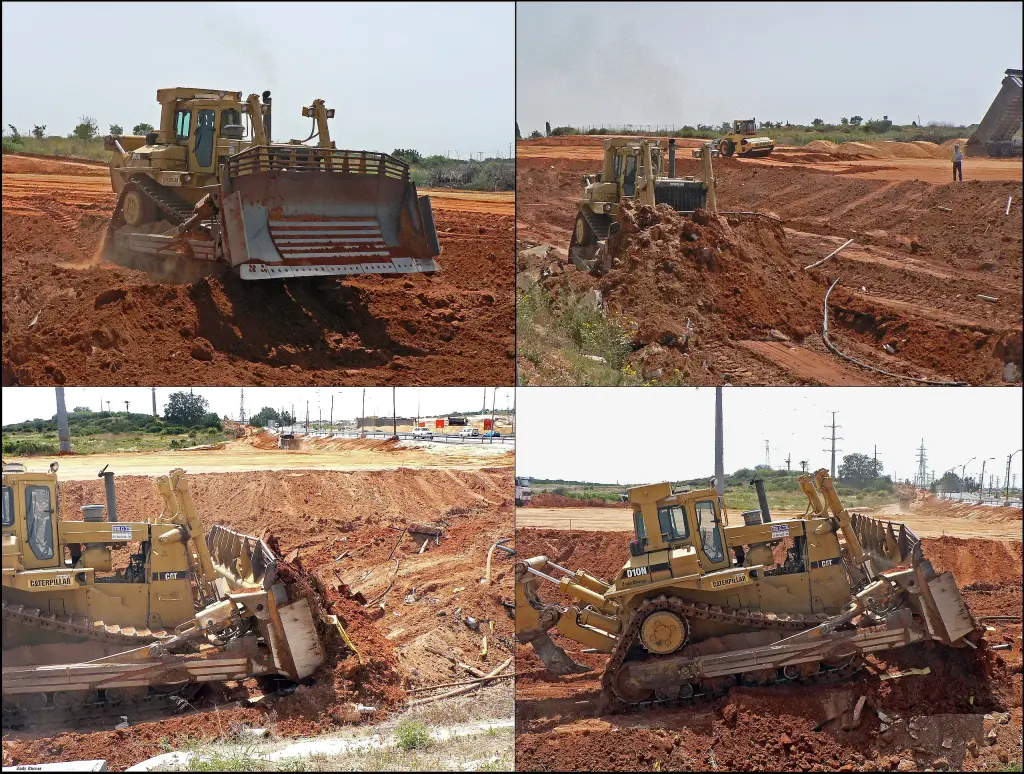
The Caterpillar D10 is the bulldozer that Caterpillar built from 1977 to 1987, when the D11 took its place. At its introduction it was the most powerful track-type tractor ever built, and it was the first modern machine to use the elevated drive sprocket, the high-drive layout that later spread through the range.
Caterpillar D10 at a glance
| Type | track-type tractor, sold as a bulldozer |
|---|---|
| Built | 1977–1987 |
| Built at | East Peoria, Illinois |
| Power at introduction | 700 hp (520 kW) |
| Engine | 1,786 cu in V-12 D348, twin turbocharged |
| Weight | 180,000 lb (82,000 kg), later 190,000 lb (86,000 kg) |
| Blade | up to a 19 ft (5.8 m) U-blade, 7 ft (2.1 m) high |
| Production | nearly 1,000 between 1978 and 1986 |
| Successor | D11N, from 1986 |
| Machine in the film | Caterpillar D10 |
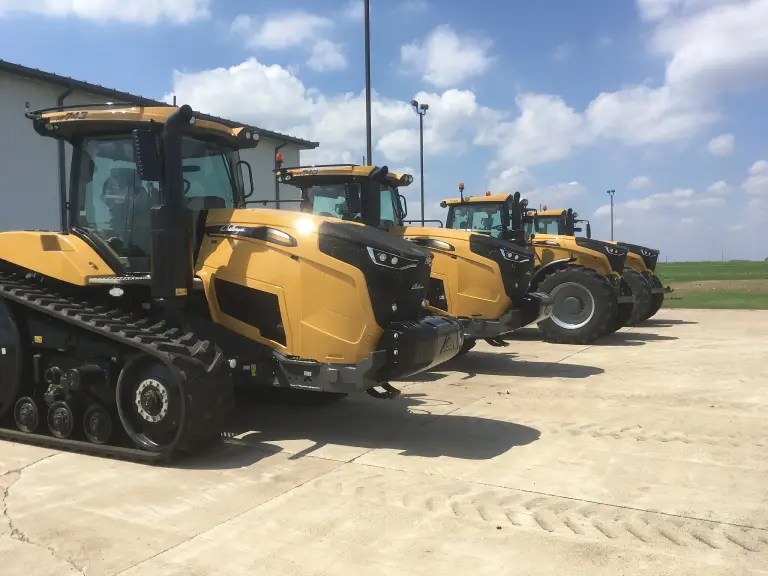
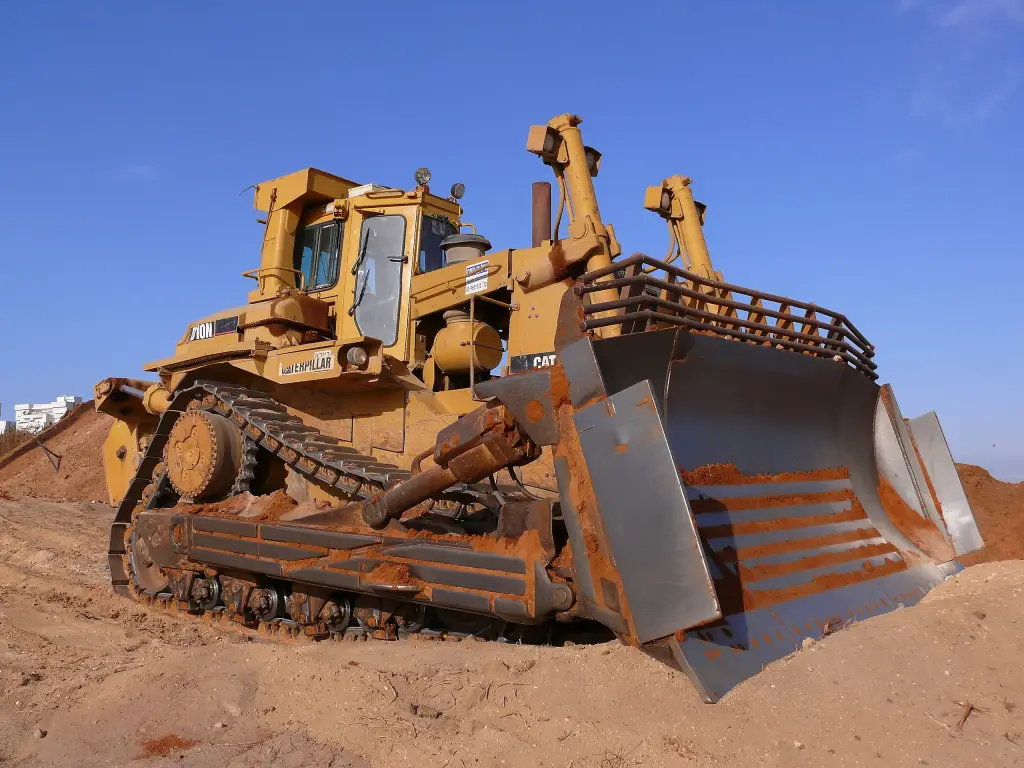
The photographs show the D10N, the model that received the D10 name from 1987; the original D10 differs mainly inside, as the L, N, R and T versions look very similar.
History of the Caterpillar D10
Why a bigger dozer
Caterpillar needed a tractor larger than the D9, because rivals were building bigger bulldozers: Allis-Chalmers had shown the 524 hp (391 kW) HD-41 at Conexpo 69, the merged Fiat-Allis built the 41-B of the same power while the D9H made 410 hp, and in 1976 Komatsu presented the D455A at 620 hp (460 kW) and 167,000 lb. The first pilot, D10X1, was shown at a Caterpillar meeting in July 1973; other prototypes followed in 1975 and 1977, and ten machines, P-1 to P-10, went to job sites before the D10 was introduced at a dealer meeting in the autumn of 1977.
The high drive
The D10 separated the suspension from the drive train by lifting the drive sprocket, which cut the stress on both and made them last longer. The layout allowed a more absorbent suspension, better traction, less wear and less operator fatigue, and it moved the transmission behind and below the operator, improving weight distribution and letting the blade and rear tools sit closer to the machine. It also replaced the geared final drive with a hydraulic planetary one. The cost was an extra idler on the track, which Caterpillar answered with its Sealed and Lubricated Track, introduced in the early 1970s. The idea was not new: C. L. Best had used it on the 30 Humpback of 1914 and Cletrac on the Model F of 1920–22, and it had been tried on ten D10s in 1977 before it went into production.
700 horsepower
The D10 arrived with 700 hp (520 kW), a 1,786 cubic inch V-12 D348 twin turbocharged engine that had already served in the 777 hauler and in the 992 wheel loaders, and a weight of 180,000 lb (82,000 kg), later 190,000 lb. The U-blade of up to 19 ft was 7 ft high and pushed 35 cubic yards according to Caterpillar’s literature, and the machine was good for about 50 percent more production than a D9H. Early machines had a single exhaust stack; from 1980 exhaust routing problems brought two stacks. Between 1978 and 1986 nearly 1,000 were built at East Peoria. With the N series of 1986–87 Caterpillar moved its large model numbers up one: the new D11N replaced the D10, and the name D10 went to the machine that had been the D9L.
Design and features
- Elevated drive sprocket: the first modern tractor with the high-drive layout that became standard on Caterpillar’s large dozers.
- 700 hp (520 kW): the most powerful track-type tractor in the world when it appeared in 1977.
- D348 V-12: 1,786 cubic inches, twin turbocharged, already proven in the 777 hauler.
- Big blade: a U-blade of up to 19 ft (5.8 m) and 7 ft (2.1 m) high, pushing 35 cubic yards.
- Modular undercarriage: a design that let the transmission be pulled out of the rear for repair.
Caterpillar D10 versions
- D10 (1977–1987): the original machine described here.
- Early single-stack D10: built before the 1980 change to two exhaust stacks.
- D10N, D10R and D10T: the later models that carried the name after 1987, descendants of the D9L rather than of this D10.
- D11N: the 770 hp (570 kW) machine that replaced this D10 in 1986.
The D10 stands between the Caterpillar D9 and the D11 that followed it; its D348 engine had already powered the Caterpillar 777 hauler. More machines are in the Caterpillar collection.
Video: Bulldozer Cat D10
Video by Keleson on YouTube.
Sources
- Caterpillar D10, English Wikipedia: development, rivals, high drive, engine, weights, production, model numbering