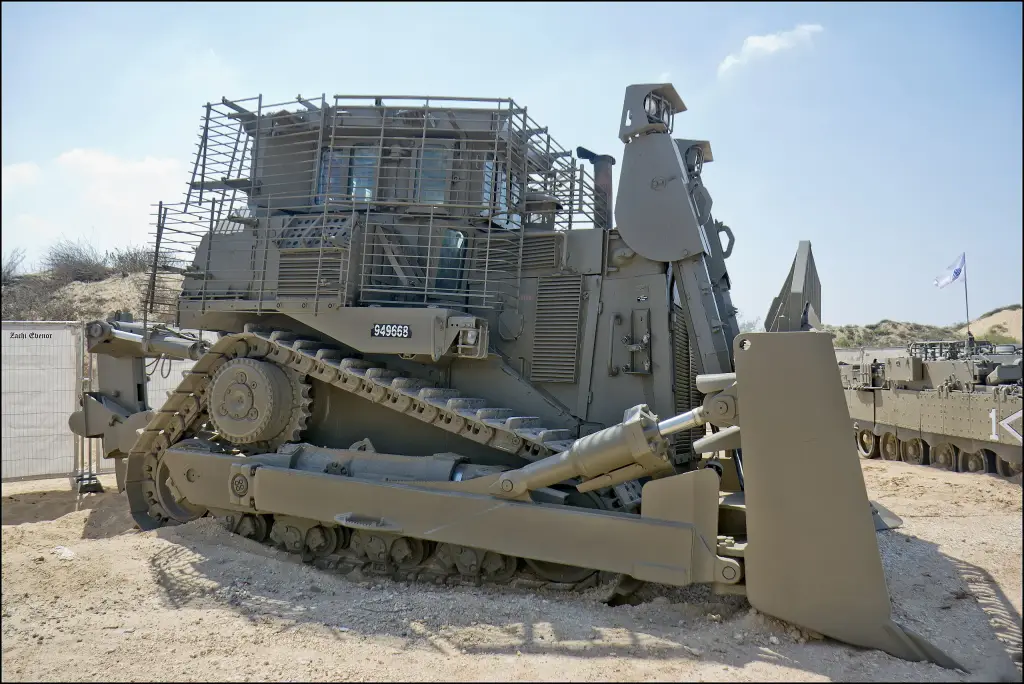
The Caterpillar D9 is a large track-type tractor, usually sold as a bulldozer with a detachable blade and a rear ripper. Its size, durability and low running costs have made it one of the most popular large tractors in the world, and it is found in construction, demolition, forestry, mining, waste and quarry work.
Caterpillar D9 at a glance
| Type | large track-type tractor, usually a bulldozer |
|---|---|
| Gross power | 354 kW (474 hp) |
| Operating weight | 49 short tons (44 t) |
| Place in the range | between the D2 of 69 kW and 9 short tons and the D11 of 698 kW and 104 short tons |
| 1954 | ten D9X prototypes |
| 1955 | D9 of 286 hp (213 kW), D353 engine |
| 1959 | D9E of 335 hp (250 kW) |
| 1961 | D9G of 385 hp (287 kW), built for 13 years |
| 1974 | D9H of 410 hp (310 kW) |
| 1980 | D9L of 460 hp (340 kW), elevated drive sprocket |
| 1996 | D9R of 405 hp (302 kW) |
| 2004 | D9T of 410 hp (310 kW) with the C18 ACERT engine |
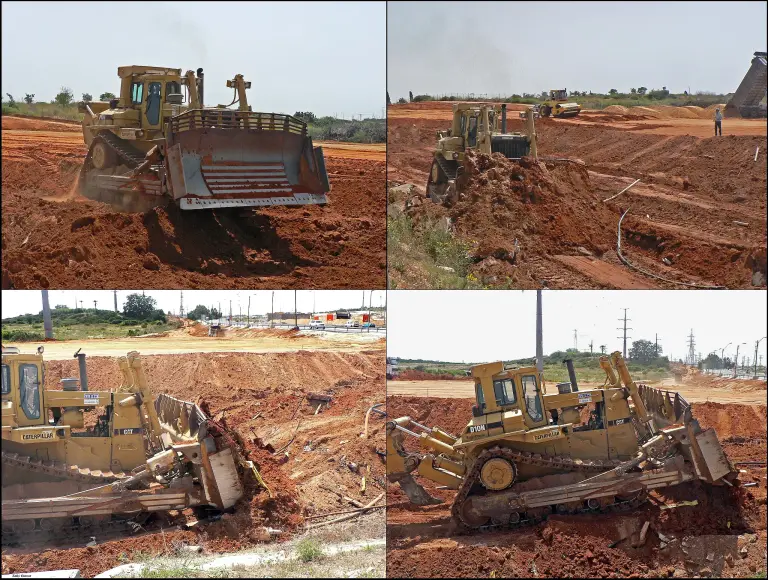
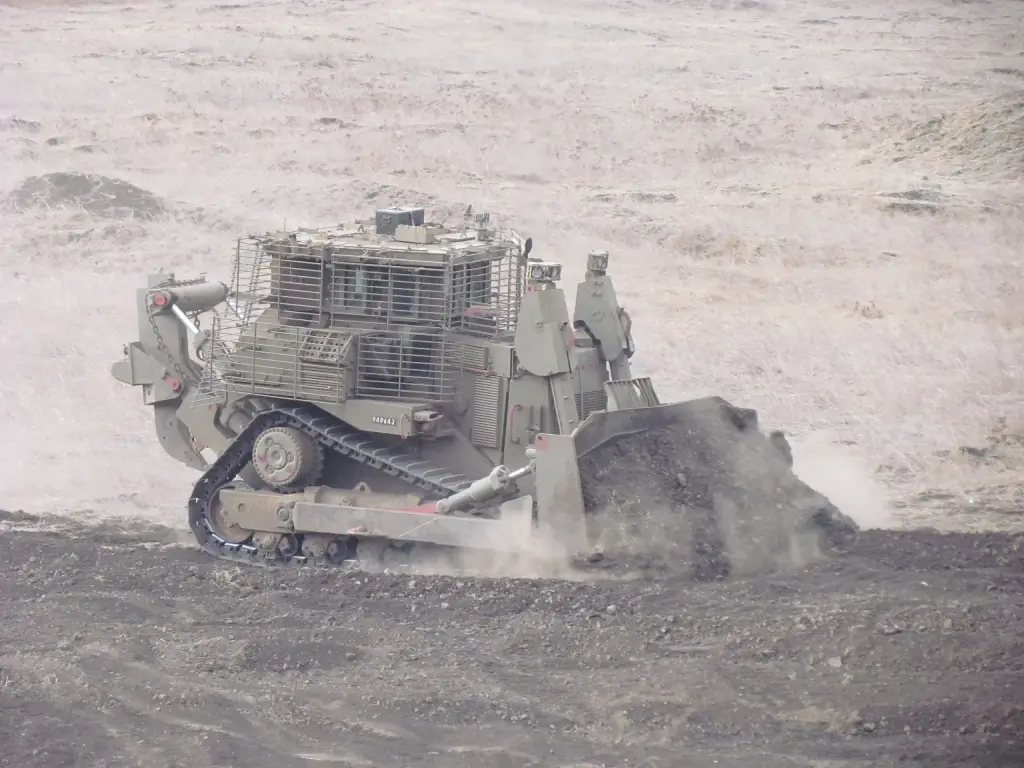
The photographs show the armoured D9R of the Israel Defense Forces, a version of the D9 that Caterpillar does not itself manufacture but which is widely associated with the model.
History of the Caterpillar D9
From the D9X to the D9G
The series began in 1954 with a prototype called the D9X, of which ten were built. In 1955 the 286 hp (213 kW) D9 was introduced to compete with the more powerful Euclid TC-12, with a 1,473 cubic inch D353 engine that powered the D9 until the D9L of 1980. Power rose to 320 hp in 1956, and the 335 hp (250 kW) D9E replaced that model in 1959. Two years later came the 385 hp (287 kW) D9G, which stayed in production for thirteen years. In 1965 the West Coast businessman Buster Peterson paired two D9Gs to pushload the largest wheel tractor scrapers; Caterpillar bought the concept in 1968 and produced the 770 hp (570 kW) DD9G, and Peterson also built the first side-by-side D9G, two tractors pushing a 24 foot blade. Caterpillar introduced its own SxS D9G in 1969.
The high drive years
In 1974 the improved 410 hp (310 kW) D9H replaced the D9G and remains the most powerful conventional track-type tractor in the company’s history; the DD9H and SxS D9H followed. In 1980 came the 460 hp (340 kW) D9L, with the elevated drive sprocket undercarriage introduced on the D10 in 1977. The design cut strain on the final drives and gave the belly pan more ground clearance, and its modular construction let the transmission be pulled out of the rear. In 1988 Caterpillar built its 25,000th elevated-sprocket track-type tractor, a D9N. Because model numbers moved up in 1987, the 460 hp D9L was replaced by the D10N rather than by another D9.
D9N to today
The 370 hp (280 kW) D9N replaced the D8L in 1987, after the range was renumbered. The 405 hp (302 kW) D9R replaced it in 1996 and the 410 hp (310 kW) D9T took over in 2004; the D9T brought the Cat C18 ACERT inline six in place of the V8 3408 HEUI and differential steering in place of clutch and brake steering. The current model is again called D9, without a letter, and older machines such as the D9T, D9R, D9N and D9L remain in common use. The L, N, R and T versions look very similar and differ mainly inside.
Design and features
- 474 hp and 44 tonnes: the size that puts the D9 among the largest track-type tractors.
- Elevated sprocket: from the D9L of 1980, with a modular undercarriage.
- D9L, the most powerful: 460 hp (340 kW) and 130,000 lb (59,000 kg), the peak of the D9 line.
- Blades and rippers: S, U and S-U blades, a rear ripper and mine plows for military work.
Caterpillar D9 versions
- D9X (1954): ten prototypes.
- D9, D9E and D9G (1955–61): from 286 to 385 hp.
- D9H (1974): 410 hp, the most powerful conventional D9.
- D9L (1980): 460 hp and the first high-drive D9.
- D9N and D9R (1987–96): 370 and 405 hp.
- D9T and the current D9: 410 hp with the C18 engine, then the letterless model.
The D9 is the large tractor above the Caterpillar D8 and below the Caterpillar D10, which borrowed its high-drive idea from the D9L; more machines are in the Caterpillar collection.
Video: Cat D9 Vs Datsun
Video by JJ’s Adv on YouTube.
Sources
- Caterpillar D9, English Wikipedia: series history, powers and weights, high drive, tools, military use