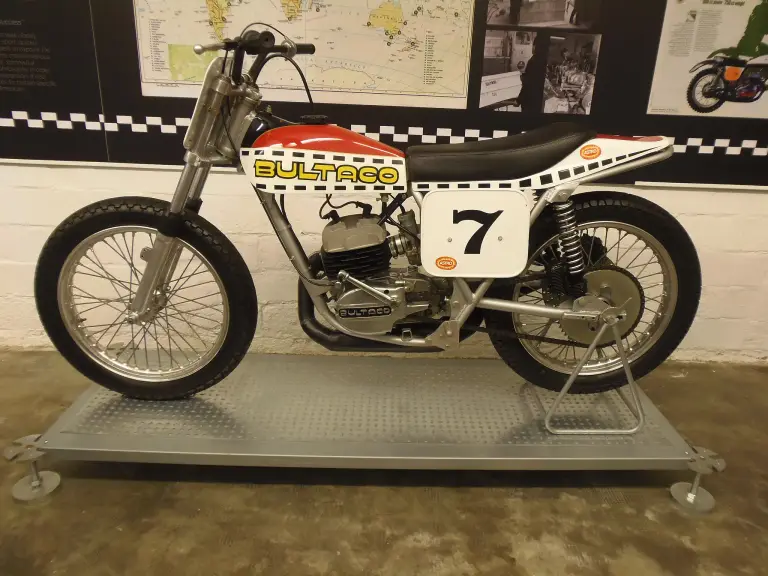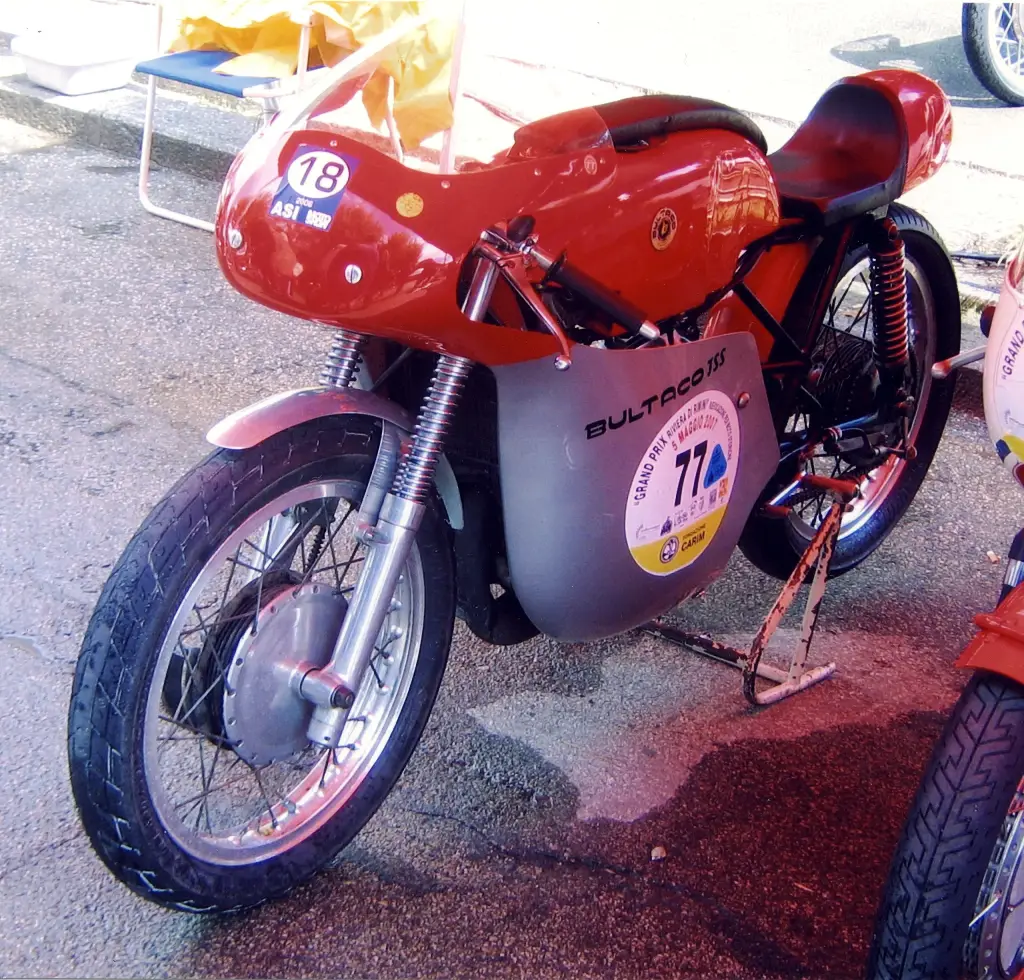
The Bultaco TSS was a racing motorcycle built from 1960 to 1970. Its name stood for Tralla Super Sport, and it was the first competition bike sold to the public, giving private riders a machine good enough for Grand Prix racing.
Bultaco TSS at a glance
| Maker | Bultaco, Barcelona |
|---|---|
| Production | 1960–1970 |
| Type | production racing motorcycle |
| Name | Tralla Super Sport |
| First model | 1960, 125 cc, 20 bhp at 10,300 rpm |
| Gearbox | four speeds, six from 1962 |
| Carburettor | Spanish Arbeo, a licensed Dell’Orto SSt 29A |
| Cooling | air at first, water from 1964–1965 |
| Frame | tubular steel |
| Brakes | drum front and rear |
| Fuel tank | 14 litres, fibreglass |
| Capacities | 125, 175, 200, 250 and 360 cc |
| Grand Prix wins | Ginger Molloy, Ulster 1966; Salvador Cañellas, Spain 1968 |
The TSS has no English Wikipedia article; this page is based on the Catalan and Italian Wikipedia articles.
History of the Bultaco TSS
Bultaco presented its first model, the Tralla 101, on 24 March 1959. It was a 125 cc motorcycle capable of 117 km/h in standard form and was well received by the specialist press, which called it the best-performing two-stroke of the moment. A few weeks later, on 19 April, Bultaco entered a dozen in the RCMC prize for production motorcycles at the Montjuïc circuit, and seven of its riders finished in the top ten, with John Grace second by only 15 cm. A month after the launch the factory riders already had special competition Tralla 101s called Tralla S, which evolved gradually, and the same improvements were almost always carried over to the production bikes. At the same time the company created its first works team, the Escuderia Dos Tiempos, formed by Marcel Cama, John Grace and Paco González and soon joined by Ricardo Quintanilla, and both the Tralla S and the future TSS were developed by it.
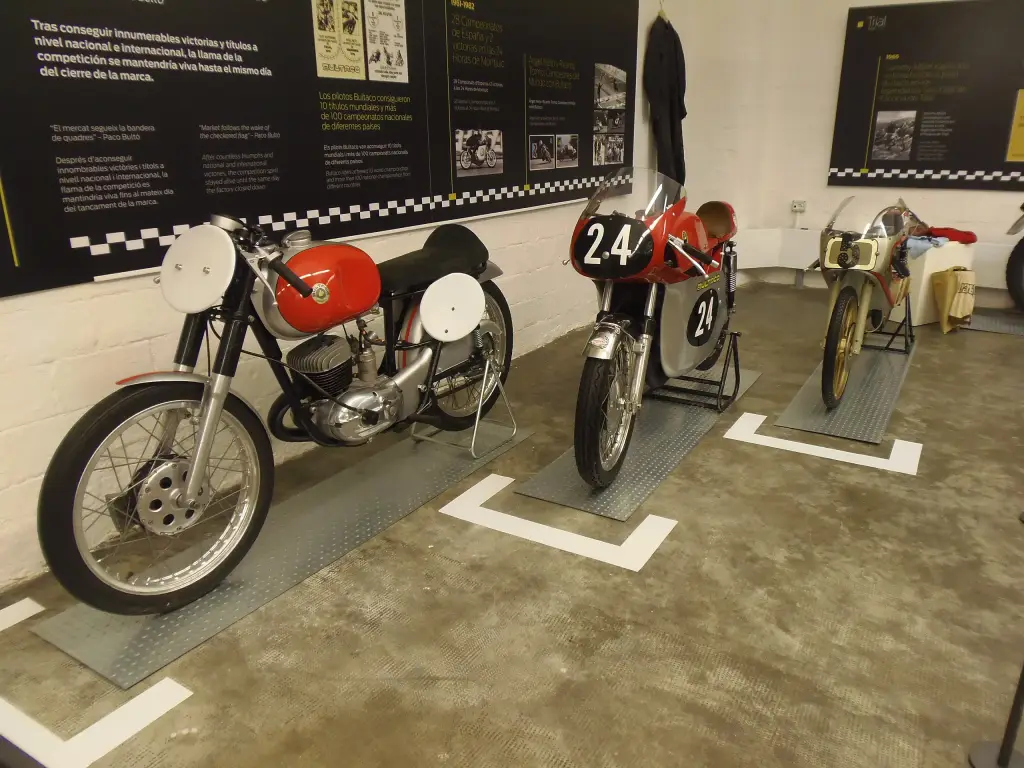
The first TSS of 1960 was the first racing motorcycle sold to the public, opening a market soon called “production racers”. It had a 125 cc air-cooled single producing 20 bhp at 10,300 rpm, fed by a Spanish Arbeo carburettor, a licensed Dell’Orto SSt 29A. The gearbox had four speeds, increased to six in 1962, and the 14-litre tank and fairing were made of fibreglass. The frame was criticised for its weight, but with its low price the TSS was considered the best competition bike a private rider could buy; in its first season a TSS took sixth place in the Ultra-Lightweight TT, ridden by Ralph Renson at an average of 83.26 mph.
From the end of 1961 the TSS was built in larger capacities. The rider Ken Martin asked for a 175 cc version, followed by the Briton Dan Shorey, already a TSS 125 owner, who asked for one enlarged to 196 cc. The TSS 200 raced in the 250 class in 1962 and did well despite the larger capacity of its rivals, while a TSS won the 125 class of the 24 Hours of Barcelona. For 1963 the 125 grew to 24 bhp and an improved 200 gave 30 bhp at 9,500 rpm. In 1964 a new TSS appeared with a 244 cc water-cooled engine, and in 1965 the water-cooled TSS 125 and 250, renamed TSS Agua, made their world championship debut. The 125 with Femsa electronic injection reached 27 bhp at 11,000 rpm and the 250 gave 38 bhp at 9,500 rpm. A TSS 350 with a 252 cc engine appeared at the 1966 Ulster Grand Prix, where Tommy Robb finished third behind Mike Hailwood and Giacomo Agostini.
The TSS took two Grand Prix victories: Ginger Molloy won the 250 class at the 1966 Ulster Grand Prix, the first win by a Catalan motorcycle, and Salvador Cañellas won the 125 class at the 1968 Spanish Grand Prix, becoming the first Catalan rider to do so. Riders who began their careers on the TSS included Barry Sheene and Jean-Pierre Beltoise, while Rodney Gould, Jack Findlay and Ramon Torras also had international successes on it. Even established champions such as Luigi Taveri and Hans-Georg Anscheidt bought one for non-championship races.
Design and features
- First customer racer: the TSS opened the market for production racing motorcycles in 1960.
- Affordable performance: low price, reliability and stability made it the private rider’s choice of the 1960s.
- Constant development: from a four-speed 125 to water-cooled and fuel-injected versions within a few years.
- Grand Prix success: two wins and numerous podiums against the Japanese factories.
Bultaco TSS versions
- TSS 125 (1960): the original, 20 bhp at 10,300 rpm, four-speed gearbox.
- TSS 175 and 200 (1961–1962): enlarged versions built at customers’ requests.
- TSS 250 (1964–1965): 244 cc, water-cooled from 1964.
- TSS Agua (1965): water-cooled 125 and 250 with Femsa electronic injection.
- TSS 350 (1966): 252 cc version that finished third at the Ulster Grand Prix.
The TSS’s road-going derivative was the Metralla, and the Pursang carried the racing approach into motocross. More models are in the Bultaco collection.
Sources
- Bultaco TSS, Catalan Wikipedia: history, racing record, riders
- Bultaco TSS, Italian Wikipedia: technical details, versions, race results