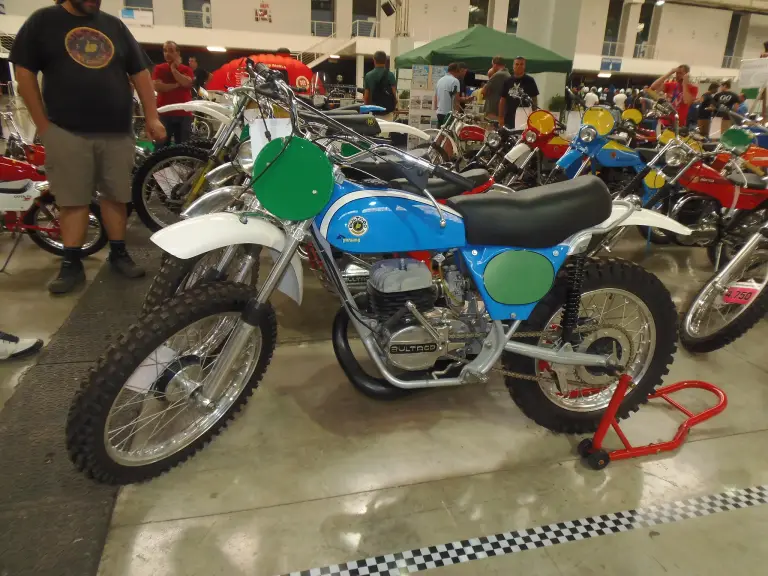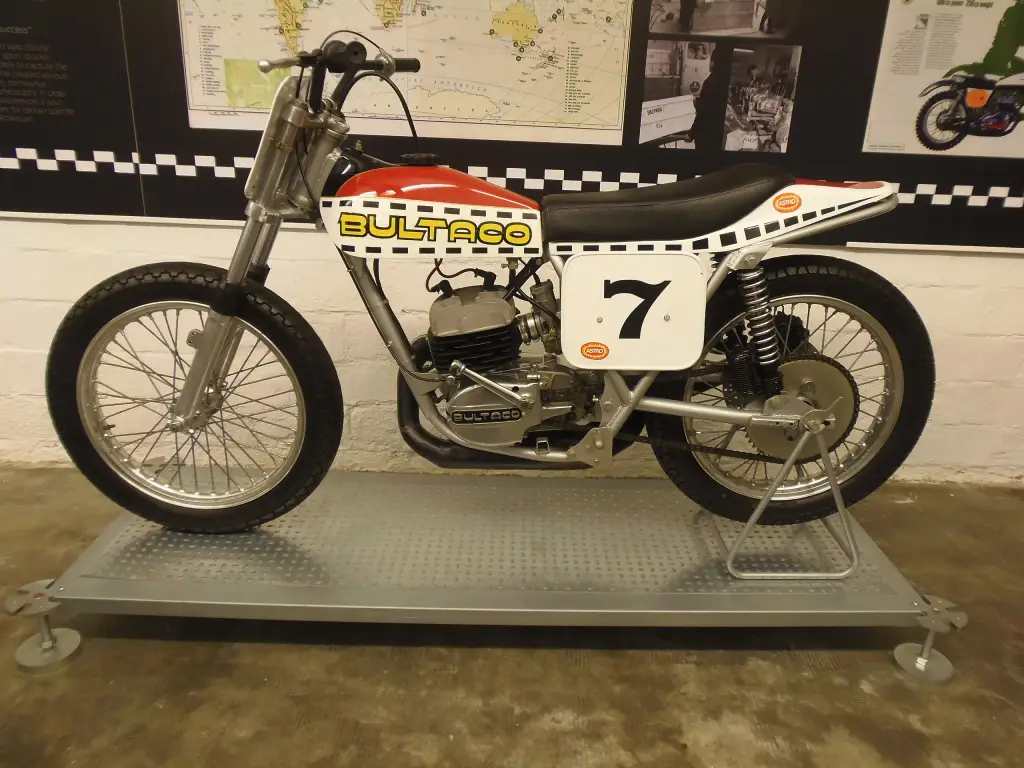
The Bultaco Astro was a motorcycle built purely for dirt-track racing. Made between 1971 and 1979 and developed from the Pursang motocross bike, it was designed for the short-track ovals of the United States and was hardly known anywhere else.
Bultaco Astro at a glance
| Maker | Bultaco, Barcelona |
|---|---|
| Production | 1971–1979 |
| Type | flat track / short track racer |
| Derived from | Bultaco Pursang |
| Engines | 244 cc, 326 cc and 363 cc two-stroke singles |
| Power | 42 CV at 9,300 rpm (250); 50.4 CV at 8,500 rpm (325); 40.03 CV at 7,000 rpm (360) |
| Carburettor | Amal 1038; Lectron on some late versions |
| Brakes | rear Brembo disc only, no front brake |
| Front wheel | 21 inches, later 19 inches |
| Weight | 101–102 kg |
| Gearshift | on the right, beside the rear brake |
| Model numbers | 90 to 195 |
The Astro has no English Wikipedia article; this page is based on the Catalan Wikipedia article.
History of the Bultaco Astro
At the end of the 1960s the most popular motorcycle races in the United States were the short-track rounds of the Grand National championship. Riders used big Harley-Davidsons, heavy British singles and twins prepared to slide at speed, and the Japanese factories were beginning to arrive with powerful machines of their own. Bultaco already had a strong reputation there for desert racing with the El Bandido and for motocross with the Pursang, and riders on the ovals soon discovered that a Pursang worked well on dirt tracks.
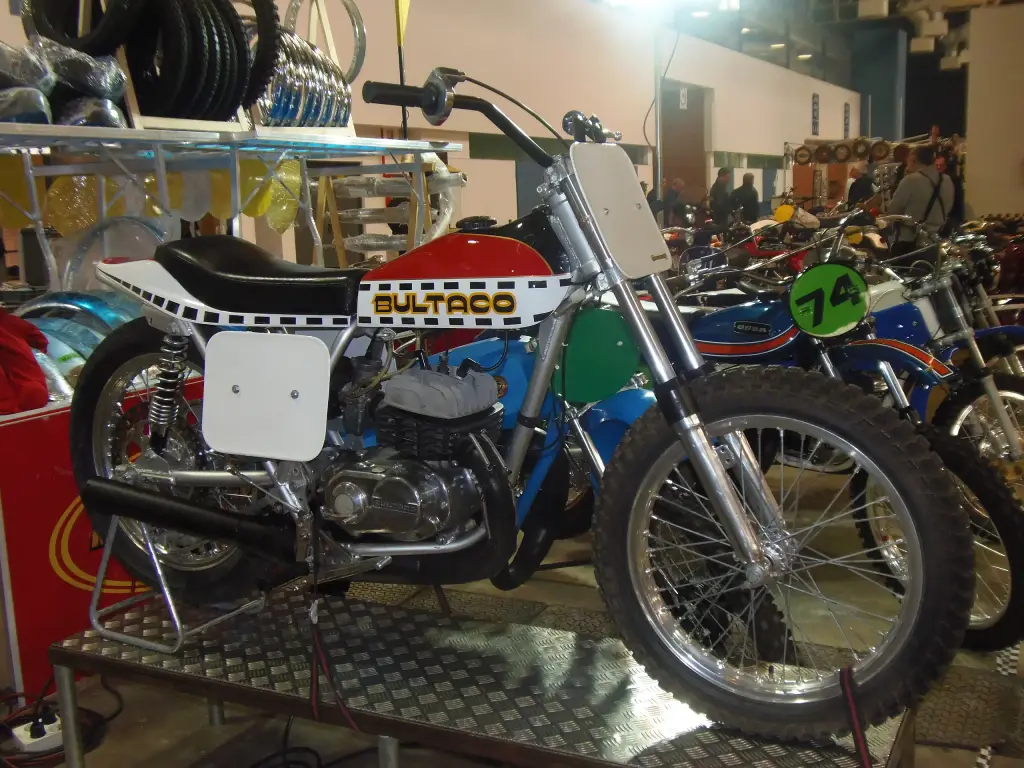
Bultaco decided to send a few factory-prepared machines to America in 1971 at the suggestion of John Grace, then in charge of that market. They looked much like the Pursangs of the period, and with Alan Kenyon and Jim Odom riding they won against the odds at Madison Square Garden and at the Houston Astrodome, beating the Japanese teams. In the Short Track National class Jim Odom beat the Harleys, Yamahas, OSSAs, BSAs and Triumphs, with Wayne Hosaka alongside him on another Bultaco. Bultaco won at the Astrodome for nine consecutive years, and those nine victories gave the new dirt-track model its name.
Every Astro was derived from a Pursang, from the first model 90 of 1971, a light evolution of the Mk5, to the last model 195 of 1979, which started from the Mk10. The prototype department kept the engine and frame but altered the swingarm to change the wheelbase, moved the footrests and put the gearshift on the right side together with the rear brake, because oval circuits are always ridden anticlockwise and the left foot is busy controlling the slide. The footrests sat at different heights, higher on the inside of the turn, and the handlebar was wider and taller than standard.
The production versions came in three capacities: 244.29 cc for models 90, 105, 145, 163 and 195 with 42 CV at 9,300 rpm; 326.203 cc for model 106 with 50.4 CV at 8,500 rpm; and 363.168 cc for models 123, 146 and 164 with 40.03 CV at 7,000 rpm. All used an Amal 1038 carburettor, although some late versions had a Lectron, and a Brembo rear disc. The front wheel went from 21 to 19 inches and from 3 to 3.5 inches in width, and the final series replaced the rear fin with a fibreglass tail. Weight was between 101 and 102 kg. In the United States a championship for these machines, the Bultaco Astro Cup, now runs for classic dirt-track bikes, while in Europe the Astro remains one of the least known and most sought-after Bultacos.
Design and features
- No front brake: dirt-track riders brake only with the rear wheel and turn by controlled sliding.
- Right-hand gearshift: the gear lever sits beside the rear brake so the left foot can control the slide.
- Pursang DNA: engine, frame and styling came directly from the motocross model.
- American career: nine consecutive Bultaco wins at the Houston Astrodome made the model famous in the United States.
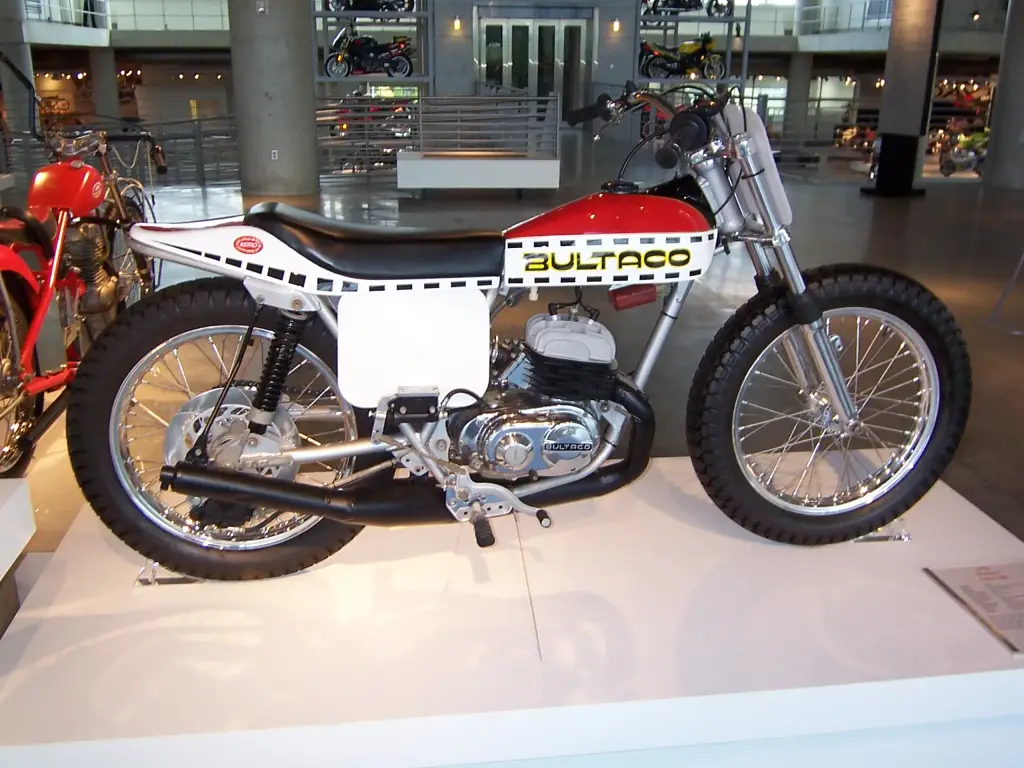
Bultaco Astro versions
- Astro 250 (models 90, 105, 145, 163, 195): 244.29 cc, 42 CV at 9,300 rpm.
- Astro 325 (model 106): 326.203 cc, 50.4 CV at 8,500 rpm.
- Astro 360 (models 123, 146, 164): 363.168 cc, 40.03 CV at 7,000 rpm.
- Final series: fibreglass tail instead of the rear fin and a 19-inch front wheel.
The Astro was developed from the Pursang motocross bike, and its enduro sister was the Frontera. More models are in the Bultaco collection.
Sources
- Bultaco Astro, Catalan Wikipedia: production years, versions, racing history