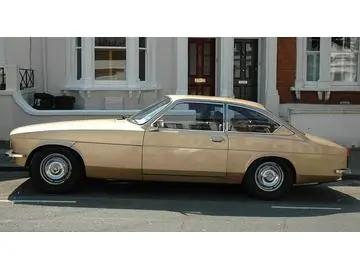
The Bristol Type 603 was launched in 1976 to replace the 411 and gave the marque its first major facelift since the 406 of the late 1950s. The design lasted until Bristol’s demise in 2011, and its later series revived the aircraft names Britannia and Brigand before becoming the Blenheim.
Bristol Type 603 at a glance
| Maker | Bristol Cars |
|---|---|
| Launched | 1976, replacing the 411 |
| Body | two-door saloon with a large curved rear window |
| 603E engine | 5,211 cc Chrysler V8, 150 bhp and 260 lb·ft |
| 603S engine | 5.9-litre Chrysler V8, 225 bhp and 280 lb·ft |
| Fuel consumption | up to 22 mpg imperial at about 100 km/h |
| S2 | from early 1978, 5.9-litre engine for all cars, new headlamp grille |
| S3 | from 1982, Britannia and turbocharged Brigand |
| S4 | Blenheim with fuel injection and a four-speed automatic |
| Built | 61 of the 603, 19 Brigands and 16 Britannias |
The English Wikipedia page covers the whole 603 family, including the Britannia, Brigand and Blenheim; production totals come from the Bristol Owners Club as quoted there. No free photographs of the model were found, so the page has no pictures.
History of the Bristol Type 603
The Type 603 was launched in 1976 by Bristol Cars to replace the 411. Along with the Zagato-built 412 it gave the Bristol car its first major facelift since the 406 appeared in the late 1950s, and the design lasted until the marque’s demise in 2011. Bristol’s chief designer Dudley Hobbs aimed to make the car more spacious and aerodynamic, using flatter body panels that were easier to hammer. The classic three-box two-door saloon gave way to a considerably more streamlined design with a much larger and more curved rear window, and Bristol pointed out that the new car had more head, leg and shoulder room than any previous Bristol.
603E and 603S
The original 603 came in two versions, largely because of the energy crisis, which raised fuel prices enough to affect even buyers of expensive cars. The 603E used the economy 5,211 cc V8, designated E44, producing 150 bhp and 260 lb·ft of torque; the 603S had the larger 5.9-litre high-performance E58 unit with 225 bhp and 280 lb·ft, both from Chrysler. The 603 improved on the 411’s fuel consumption, reaching as much as 22 mpg imperial at around 100 km/h against 17 mpg for its predecessor — as good as a Jaguar XJS. The gain came from the smaller engine and the more aerodynamic body. Transmission and suspension were carried over from the 411, but the cabin became more luxurious with electrically adjustable seats and air conditioning.
Series 2
As the energy crisis eased, all Bristols, including the 412 series 2, received the high-performance 5.9-litre Chrysler unit that would serve all later editions. This model, the 603 S2, became available in early 1978, and its headlamp clusters were set in a new grille. The 5.2-litre engine remained available in the 603E. The Bristol Owners Club lists a total of 61 603s of both series and types.
Britannia and Brigand
The third series, introduced in 1982 and built until 1994, saw Bristol adopt the names of famous Bristol Aeroplane Company models for its cars for the first time. It had a smaller radiator grille and more modern mirrors, rectangular headlamps from the Volkswagen Scirocco II and tail-lights borrowed from the Bedford CF2 van, mounted vertically. The Britannia was the standard version, while the Brigand added a Rotomaster turbocharger to the Chrysler V8 and a torque converter originally used on the 440 V8, giving a gearing-limited 150 mph. A bonnet bulge for the turbocharger and standard alloy wheels distinguished the Brigand. The Bristol Owners Club lists 19 Brigands and 16 Britannias.
Blenheim
With the Blenheim, Bristol refined the 603 further, modernising the mechanicals with a multi-port fuel-injection Chrysler Magnum engine that improved both performance and economy. Turbocharging was dropped, yet the Blenheim Series 1 was claimed to match the Brigand. It also gained a four-speed overdrive lock-up automatic transmission, paired and inboard headlamps, gas struts and a fully rectangular bonnet hinge, and split rear lamps from the Opel Senator B. The Blenheim Series 2 of 1998 to 1999 raised output to about 275 hp at 4,700 rpm with larger headlamps and grille, a wider track and a turning circle cut to 11.9 m. The Blenheim 3 of 2000 brought a new gear selector, revised instrumentation and an extensively reworked engine, estimated by period publications at 360 hp, followed by the sportier Blenheim 3S with blacked-out trim.
Design and features
- One shape for 35 years: the 603 body introduced in 1976 ran until the marque closed in 2011.
- Economy and power: a 150 bhp 5.2-litre 603E or a 225 bhp 5.9-litre 603S.
- Turbocharged Brigand: a Rotomaster conversion good for a gearing-limited 150 mph.
- Blenheim injection: a Chrysler Magnum V8 with multi-point injection and a four-speed automatic.
Bristol Type 603 versions
- 603E: 5,211 cc economy V8 of 150 bhp.
- 603S and S2: 5.9-litre V8 of 225 bhp, new grille from 1978.
- Britannia (S3, 1982–1994): standard model with Scirocco headlamps.
- Brigand (S3): turbocharged, 150 mph, bonnet bulge and alloy wheels.
- Blenheim (S4): fuel injection, four-speed automatic and new front and rear styling.
- Blenheim 2, 3 and 3S: more power and revised interiors from 1998 to 2002.
The 603 replaced the Bristol 411, and its Brigand and Blenheim variants carried the marque into the 2000s alongside the Bristol Fighter. All models are in the Bristol collection.
Sources
- Bristol Type 603, English Wikipedia: 603, S2, Britannia, Brigand and Blenheim