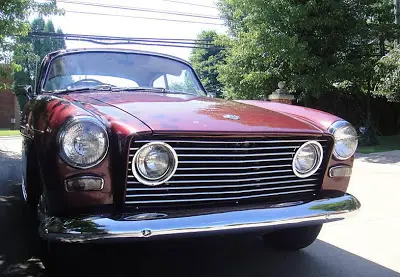
The Bristol 408 was made from 1963 to 1966 and was mechanically identical to the 407, but it looked very different from the front: the old carry-over nose was replaced by a rectangular grille with pronounced horizontal bars. Unusually for Bristol, the model was revised in the middle of its run, in 1965, as the 408 Mark II.
Bristol 408 at a glance
| Maker | Bristol Cars |
|---|---|
| Production | 1963–1966 |
| Body | four-door saloon |
| Engine | 5,121 cc Chrysler V8; 5,204 cc in the Mark II |
| Power | as the Bristol 407 |
| Gearbox | automatic, cast alloy and over 30 kg lighter in the Mark II |
| Front styling | rectangular grille with pronounced horizontal bars |
| Indicators | wide rectangular lamps, against round lamps on the 407 |
| Mark II | launched in 1965, mid-way through production |
This page is based on the English Wikipedia article on the Bristol 408; no free photograph of the model was found, so it has no pictures.
History of the Bristol 408
Mechanically the Bristol 408 was identical to its predecessor the 407, which had been a major departure for Bristol with its Chrysler V8 engine and automatic transmission. Outwardly, however, there were some major changes. The frontal styling of the 407, which had been carried over from the six-cylinder 406, was discarded and replaced by a rectangular grille with pronounced horizontal bars. The turn indicator lamps also changed: on the 408 they were wide and rectangular, in contrast to the round lamps of the 407.
The 408 Mark II
Unusually for Bristol, a slightly revised version was launched in the middle of the model’s production run in 1965, known as the 408 Mark II. Because of safety concerns, the push-button layout of the automatic transmission was modified with a safety lever that prevented an unwary person from moving the car out of Park, and the gear selector used rectangular instead of circular push-buttons.
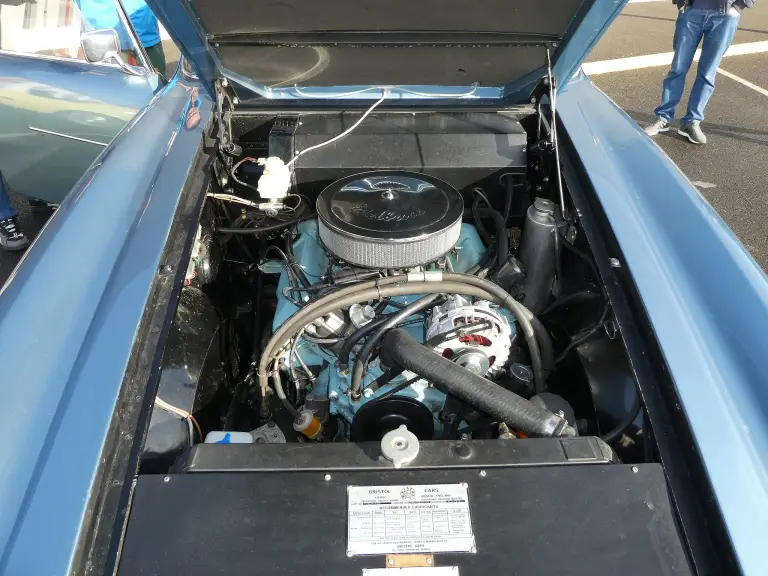
The transmission itself was now of cast alloy and over 30 kg (66 lb) lighter than that of previous eight-cylinder Bristols. The engine of the 407 and the original 408 had a capacity of 5,121 cc (313 cubic inches), but for the 408 Mark II it was changed to the newer 5,204 cc (318 cubic inch) variant.
Place in the range
The 408 sat between the 407, which introduced the Chrysler V8, and the 409, which replaced it with softer suspension and the first optional power steering. Its rectangular grille and wide indicators make it one of the easiest of the V8 Bristols to tell apart from its close relatives.
Design and features
- Rectangular grille: the 407’s carry-over front replaced by horizontal bars.
- Wide indicators: rectangular lamps instead of the 407’s round ones.
- Safer selector: a safety lever and rectangular push-buttons in the Mark II.
- Lighter gearbox: a cast alloy transmission over 30 kg lighter than before.
Bristol 408 versions
- 408 (1963–1965): 5,121 cc engine and circular transmission push-buttons.
- 408 Mark II (1965–1966): 5,204 cc engine, safety lever and rectangular push-buttons.
The 408 developed the Bristol 407 and was followed by the Bristol 409 and Bristol 410. More models are in the Bristol collection.
Sources
- Bristol 408, English Wikipedia: styling, Mark II changes, engines