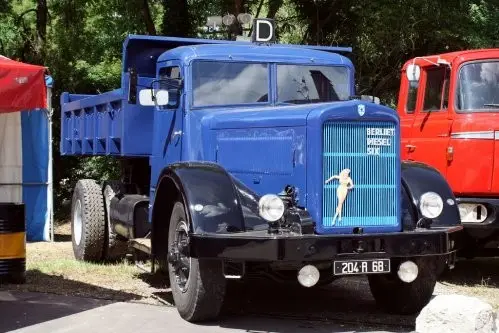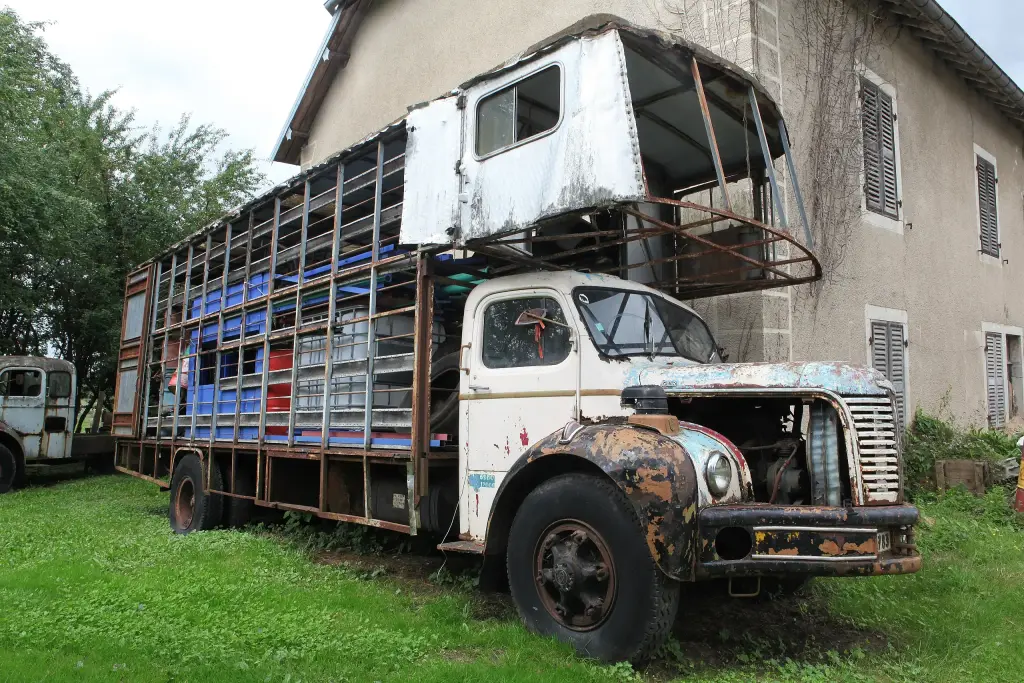
The Berliet GL series is a family of semi-cab-over lorries first presented in 1949 and built until 1977. Over 100,000 were made in 27 years, and the most famous member, the GLR, was voted Truck of the 20th Century by the French journal Les Routiers in 1994.
Berliet GL series at a glance
| Maker | Berliet, Vénissieux (Lyon) |
|---|---|
| Production | 1949–1977, the GBH until 1984 |
| Models | GLC, GLR and GLM, with TLC, TLR and TLM tractors |
| Class | semi-cab-over lorry range |
| Gross weight | 13.5 to 19 tonnes |
| Engines | in-house four-, five- and six-cylinder diesels |
| Injection | Ricardo Comet III, then M.A.N. “Magic” from 1958 |
| Cabs | Serie M, M2 (1960), M3 Relaxe (1963), M4 (1974) |
| Payload | 7 tonnes for the GLR 8 at launch |
| Built | over 100,000 |
| Award | Truck of the 20th Century, Les Routiers, 1994 |
| Successor | Renault CBH |
History of the Berliet GL series
The GLR of 1949
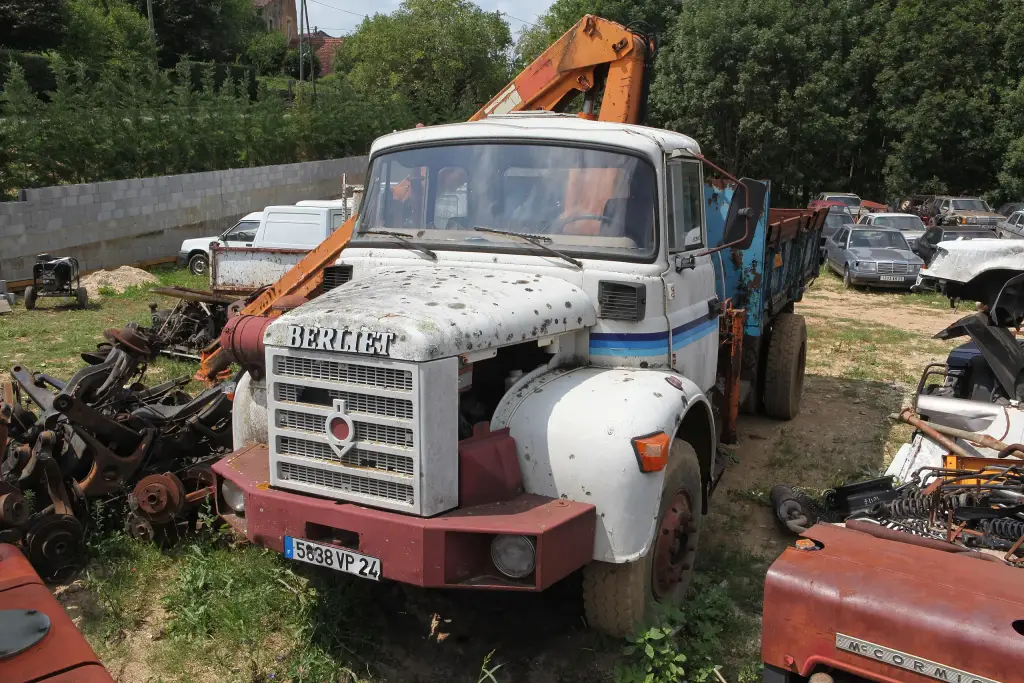
The first of the family, the GLR, was presented at the Paris Motor Show in October 1949 and went into production in 1950. It was a semi-cab-over lorry rated at 13.5 tonnes gross with a seven-tonne payload, and it could take a flatbed, tanker, tipper or van body. The GLR 8 had a five-cylinder diesel of 7.9 litres, rounded to eight in the model name, with Ricardo Comet III indirect injection and compressed-air brakes; steering was by screw and ball nut and the two front dampers were hydraulic. The all-steel cab, with its wings, bonnet and rounded front, earned the nickname museau rond, round nose. The headlamps were set into the wings, the driver’s seat was adjustable for height, and heating and demisting were optional at first.
The range grows
In 1951 came the lighter GLC, with a four-cylinder derivative of the same engine and its own lighter chassis, transmission and axles; it was slow but sold well in France and in Africa, where economy and robustness counted more than speed, and it weighed about 700 kg less than a GLR of the same wheelbase. The heavier GLM with a six-cylinder engine followed in 1953, and the family later ran from the GLC 6 to the GLM 12 and the three-axle GBH 12. Tractor versions TLC, TLR and TLM had two-speed rear axles, and the GBO and TBO were built for oversize loads in 6×4 or 6×6 form. The cabs changed more than the mechanicals: the original Serie M gave way to the M2 in October 1960 with a taller, squarer bonnet, to the M3 Relaxe in 1963 and to the M4 in 1974, which brought a new dashboard, black plastic trim instead of chrome and rectangular grilles in place of the curved bonnet vents. From 1958 the engines moved from Ricardo indirect injection to the M.A.N.-licensed Magic direct injection, which took the GLR 8 from 120 to 150 PS.
Africa, the L64 and the end
At the same 1949 show Berliet presented the smaller GLA, a 7.75-tonne cab-over lorry with a timber-framed cab and a top speed of 70 to 75 km/h that the advertising called the fast lorry; about 12,000 were built in ten years, and its GLB derivative followed in 1951. Assembly of the main range began in 1958 at the Société Africaine des Automobiles M. Berliet in Rouïba, Algeria, both for local needs and to enter the African market. In January 1962 Berliet added the light heavy-duty L62 and L64, developed from lessons of the GBC 8 Gazelle and intended for sub-Saharan conditions after testing in Gabon and the Congo. The L64 was four-wheel drive and used Herwaythorn axles built by Berliet; around 80 per cent of the roughly 3,000 built were sold in Africa, though it also found work on European road works and building sites.
The last years
The GLR disappeared in 1977, as bonneted lorries fell out of fashion, but the GBH, popular on building sites and in Africa, lasted until 1984, and those built after 1980 wore Renault Véhicules Industriels badges. The range was replaced by the Renault CBH, which used the GLR’s underpinnings with the new Club of Four cab.
Design and features
- Modular construction: the GLC, GLR and GLM shared the maximum number of components, which Berliet called modular construction.
- In-house diesels: four-, five- and six-cylinder engines, with three bonnet lengths to match.
- Evolving cab: four cab generations from the Serie M of 1949 to the M4 of 1974.
- Export strength: assembly in Algeria and the L64 developed for African conditions.
Berliet GL series versions
- GLR 8: the original five-cylinder 7.9-litre lorry of 1949.
- GLC 6: the lighter four-cylinder version of 1951.
- GLM 10 and 12: the heavier six-cylinder lorries from 1953.
- TLR and TLM tractors: semi-trailer tractors with two-speed rear axles.
- GBH 12: the three-axle 6×4 built until 1984.
- L64: the four-wheel-drive lorry for Africa, about 3,000 built.
The GL series came after the GDR and was followed by the heavier GR/TR. More models are in the Berliet collection.
Video: 2 old trucks BERLIET GLR ABANDONED
Video by Trans Vosges on YouTube.
Sources
- Berliet GL series, English Wikipedia: range, cabs, engines, tractors, L64, end of production
- Berliet GLR, French Wikipedia: launch specification, dates, GBH, production total
- Berliet GLA, French Wikipedia: the smaller GLA and GLB