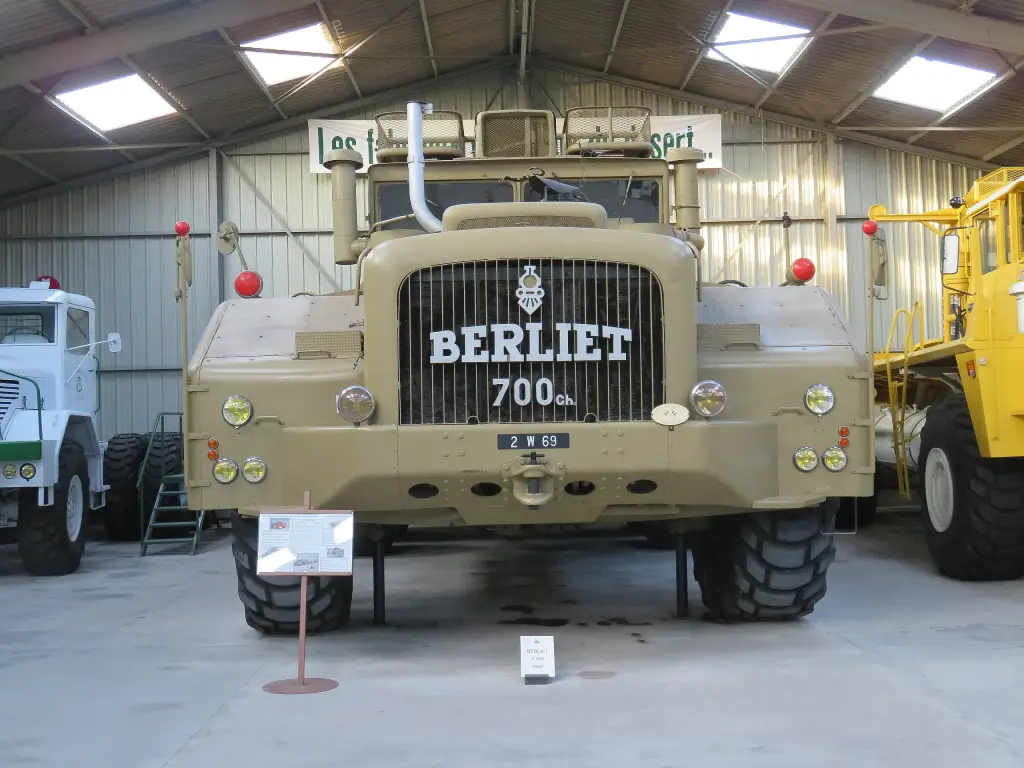
The Berliet T100 is a special-duty off-road truck designed for oil exploration in the Algerian Sahara and built in four examples between 1957 and 1959. It was the largest truck in the world at the time, and it never found the commercial success its maker expected.
Berliet T100 at a glance
| Maker | Berliet, built at Courbevoie |
|---|---|
| Production | 1957–1959, four built |
| Class | special-duty off-road truck |
| Engine | Cummins VT12, 29.61 litres, two turbochargers |
| Power | 600 hp, later 700 hp |
| Transmission | Clark semi-automatic, four speeds forward and reverse |
| Gross weight | 101 to 103 tonnes as a flatbed, 155 tonnes as a dumper |
| Dimensions | 13.32 m long, 4.96 m wide, 4.43 m high |
| Tyres | Michelin 37.5×33R, one metre wide, one tonne each |
| Brakes | Messier aircraft-type discs on six wheels |
| Max speed | 45 km/h |
| Survivors | two, one in Algeria and one in the Berliet foundation |
History of the Berliet T100
The Sahara idea
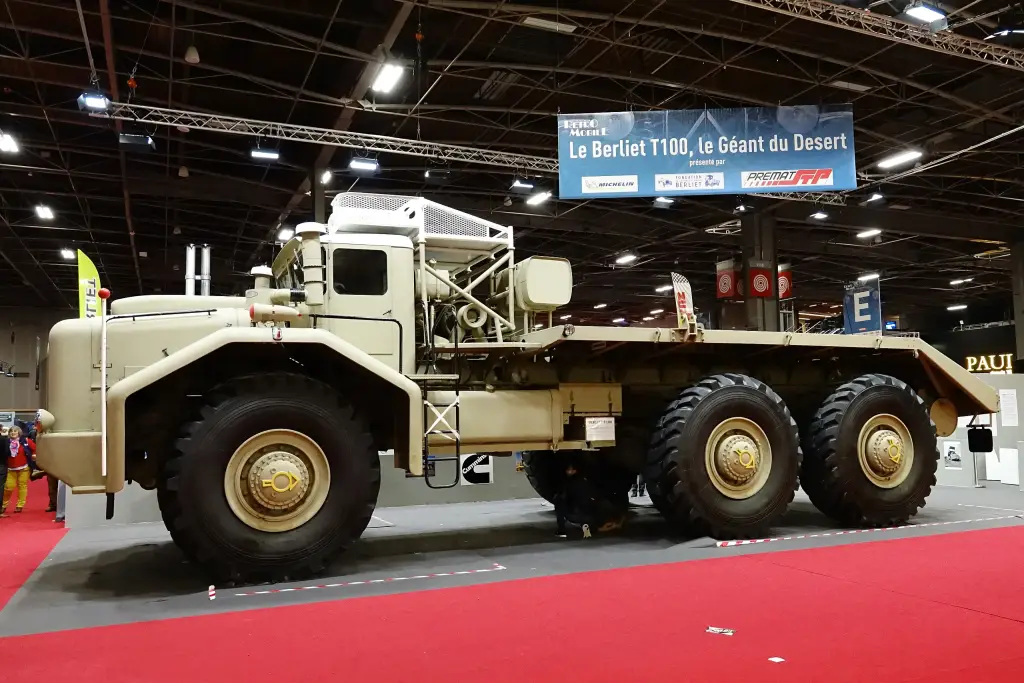
Oil was discovered in the Algerian Sahara from 1954. Late in 1956 the director of Shell invited Paul Berliet to El-Goléa, and Berliet concluded that the company’s vehicles were not suited to the work; the director asked for machines that could help with prospecting and production. Flying from Timimoun to the Shell base in the Grand Erg Occidental, Paul Berliet saw the crescent-shaped dunes, the barkhanes, and the gigantic road works needed before semi-trailers could cross them. He decided to build the biggest truck in the world, able to carry 50 tonnes through the dunes without an expensive track. André Billiez was put in charge, the largest tyres then available were chosen, and so was the Cummins engine as the best compromise between power, weight and performance. The 600 hp of the first engine proved insufficient and Berliet went to 700; by his own account 1,000 hp would have been desirable.
Unveiled in 1957
The trucks were designed and built in secret and to a tight deadline: the first was finished after nine months at the factory in Courbevoie. It was unveiled by surprise at the 1957 Paris car show, but it was too big to fit in the main exhibition hall, so Berliet built a special external pavilion for it. It then went to shows in Lyon, Avignon, Helsinki, Casablanca, Frankfurt and Geneva before going to work in the oil and gas fields of the Sahara. After Algerian independence it became the property of the Algerian government and was eventually preserved at Hassi-Messaoud. The second T100 was built in 1958 and two more in 1959; the second, after working in Algeria, returned to the Berliet Foundation’s museum in 1981.
Four trucks, four fates
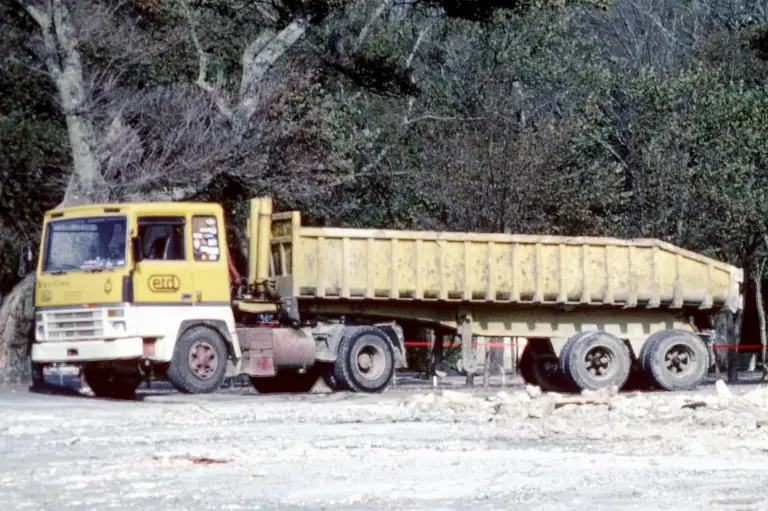
The first two were 6×6 flatbeds of 101 to 103 tonnes gross, with a four-seat cab and sand-coloured paint; the first was temporarily painted red, then white. The third, built in 1959, was a 6×4 dumper with a Marrel body of 50 cubic metres and 155 tonnes gross, used at the open-cast uranium mine of Bessines-sur-Gartempe for the French atomic energy commission; it stayed a single example because the tyres of the rear tandem wore out too quickly in quarry work, and it was destroyed in 1978. The fourth, the 102-tonne T100 Tulsa of 1959, had a forward cab with five seats and was designed for the American market with an American stylist, engine and gearbox; it was well received at the Tulsa fair, but Berliet’s sales department never received a single enquiry. Paul Berliet had the third and fourth trucks destroyed in 1978.
Engineering and legacy
The Cummins VT12 of 29.61 litres had two turbochargers, and the Clark semi-automatic gearbox had four speeds in each direction. The 6×4 and 6×6 chassis had locks for the central, front and second rear differentials. Steering was assisted by a small Panhard car engine, so that the truck could be towed when the main engine was off, and the turning circle was 13.20 m. Front suspension used leaf springs with Messier hydraulic dampers, the rear leaf springs with stabilising torsion bars, and Messier aircraft-type disc brakes worked on all six wheels. Two fuel tanks held 950 litres each. The Michelin 37.5 by 33R tyres measured one metre by 2.20 metres and weighed a tonne each; the spare was carried by the escort vehicle, a Gazelle with a crane. The T100 was a stablemate of the GBO 15, a 60-tonne 6×6 released in 1956, of which 45 were built, most exported to Algeria. In 1962 the first truck was experimentally fitted with a Turbomeca gas turbine, but fuel consumption was excessive and the diesel went back in. The trucks were too specialised to sell, and after fifteen years of dumpers and crane chassis Berliet dropped non-standard vehicles in 1970 and 1971.
Design and features
- Size: at 13.32 metres long and 103 tonnes gross, it was the largest truck in the world when it appeared.
- Cummins V12: 29.61 litres, two turbochargers and 600, later 700 hp.
- Panhard steering: a small car engine drove the steering assistance, so the truck could be towed with its main engine off.
- Aircraft brakes: Messier disc brakes of aircraft type on all six wheels.
Berliet T100 versions
- T100 no. 1 and no. 2: the 6×6 flatbeds of 1957 and 1958, 101 to 103 tonnes.
- T100 no. 3: the 6×4 dumper of 1959 with a 50 m³ Marrel body for the uranium mine.
- T100 no. 4 Tulsa: the 102-tonne forward-control flatbed designed for the American market.
- Gas turbine experiment: the first truck was tried with a Turbomeca turbine in 1962.
The T100 was a stablemate of the GL series, which included the GBO and GBH heavy lorries, and the later heavy range is described in the GR/TR article. More models are in the Berliet collection.
Video: Berliet T100
Video by kauchookie on YouTube.
Sources
- Berliet T100, English Wikipedia: design, production, history of the four trucks
- Berliet T100, French Wikipedia: origins, specifications, the fate of each truck