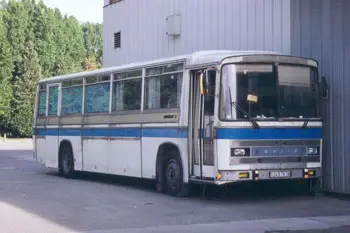
The Berliet Cruisair is a touring and intercity coach that Berliet presented at the Paris Motor Show in 1968, a year after showing a prototype. It replaced the ageing PH range, came in two lengths, and was one of the last vehicles to wear the Berliet badge before the merger with Saviem.
Berliet Cruisair at a glance
| Maker | Berliet, Vénissieux (Lyon) |
|---|---|
| Class | touring and intercity coach |
| Prototype | 1967 |
| Unveiled | Paris Motor Show, 1968 |
| Versions | Cruisair 2 (9.30 m) and Cruisair 3 (11.0 m) |
| Seats | 32 to 49, depending on model and layout |
| Luggage hold | 3.6 to 6.5 m³ |
| Engine | Berliet V-800, 6.92 litres, 175 hp |
| Alternative engine | General Motors V6 two-stroke, 200 hp |
| Layout | engine at the rear, rear-wheel drive |
| Suspension | Airlam |
| Retarder | Telma electromagnetic |
Based on the French Wikipedia article on the Cruisair, with the company’s history from the English article on Berliet. No free photographs of the Cruisair were found, so the article has no pictures.
History of the Berliet Cruisair
A coach for the Common Market
Berliet had kept the PH range on the market for a long time, and by the mid-1960s the maker needed a modern coach able to face French rivals and, as customs duties inside the Common Market fell, European ones as well. The aim was above all to win back the tourist coach market, and Berliet showed a prototype of the Cruisair in 1967 before the vehicle was really ready. It was meant to be reliable, comfortable and profitable, and to answer, in the words of the maker, the wishes of the whole clientele.
Comfort and layout
Passenger well-being was taken seriously. The seats had head restraints and folding armrests, the engine sat at the rear so that it was quiet, and the suspension was soft, which made long stages pleasant. Depending on the model and the seating layout the coach carried 32 to 49 passengers, and the glazing gave a visibility that Berliet said no other model of the brand had offered. The luggage hold took between 3.6 and 6.5 cubic metres, the first French coach with such generosity. Thermal insulation, well distributed heating and individual ventilation through adjustable diffusers were part of the specification, and the driver’s area was treated in car style, with a good view out. On the road the Cruisair relied on the Airlam suspension and a Telma electromagnetic retarder.
Engineering and faults
The chassis was a straight frame of two U-section longitudinal members, braced by cross members with X-shaped reinforcements riveted to the frame. The engine sat at the rear, as on other European coaches: a Berliet V-800 of 6.92 litres and 175 hp, or a General Motors two-stroke V6 of 200 hp. The Cruisair was not free of faults. Aluminium cladding encouraged corrosion of the steel parts, some plastic components were flimsy, the driving position was poorly studied ergonomically, and the engine’s belt drives were prone to failure. The two-circuit oleopneumatic braking worked at 17 bar: effective, but sometimes brutal. The emergency and parking brakes were badly designed, and the parking brake tended to jam without warning. The repeated trouble held back sales, and Berliet was merged into Renault in 1978 before it could answer the criticism on later models.
What came after
A fourth, twelve-metre version was planned but never built: it would have been too long and too heavy, and the PR 14 followed instead.
Design and features
- Rear engine: the power unit sat at the back, which kept the cabin quiet and the floor low.
- Comfort: seats with head restraints and folding armrests, individual ventilation and well distributed heating.
- Luggage: a hold of 3.6 to 6.5 cubic metres, unusually large for a French coach of the period.
- Driver’s area: a car-style driving position with wide glazing, set apart from the lorry cabs of the time.
Berliet Cruisair versions
- Cruisair 2: the 9.30-metre coach.
- Cruisair 3: the 11.0-metre coach.
- Cruisair with the General Motors V6: the 200 hp two-stroke alternative to the Berliet V-800.
- Cruisair 4: a twelve-metre project, abandoned as too long and too heavy; the PR 14 followed it.
The Cruisair replaced the Berliet PH range, and the later PR100 became the company’s best-known bus. More vehicles are in the Berliet collection.
Video: Moteur Berliet V 800 Cruisair 2
Video by Alex PR 100 on YouTube.
Sources
- Berliet Cruisair, French Wikipedia: design, versions, engines, faults
- Berliet, English Wikipedia: company history and the end of the marque