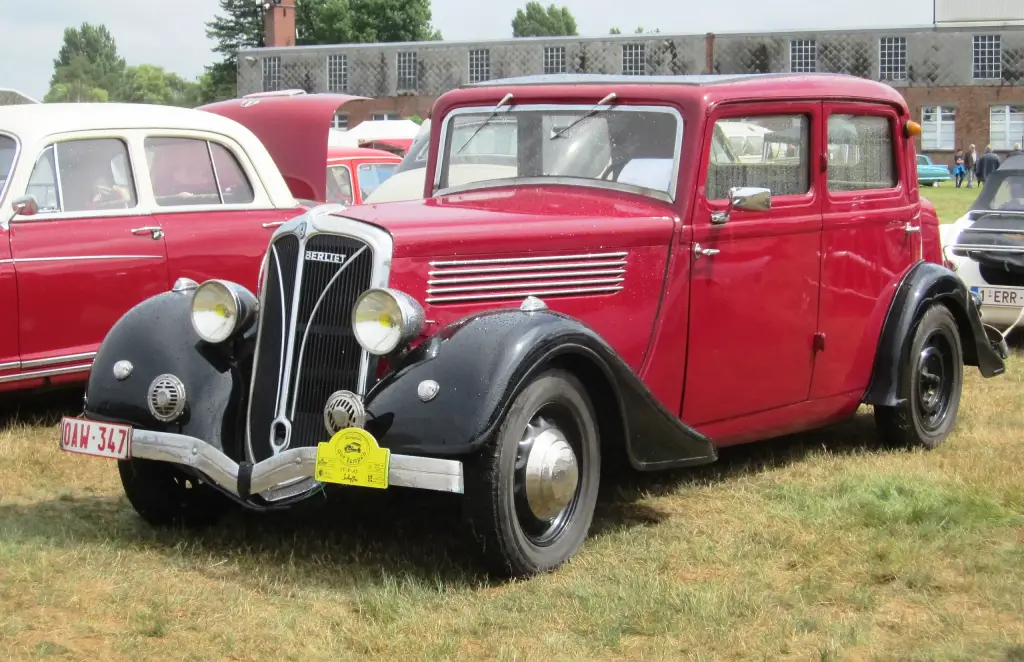
The Berliet Dauphine is a family car that Berliet built at its Vénissieux works, on the south side of Lyon, from the summer of 1934 to 1939. For most of that time it was the maker’s principal or only passenger car, and it turned out to be the last one Berliet ever made.
Berliet Dauphine at a glance
| Maker | Berliet, Vénissieux (Lyon) |
|---|---|
| Production | 1934–1939 |
| Class | family car |
| Engines | 1,990 cc four (11CV), 1,600 cc four (9CV), 14CV on special order |
| Power | 50 hp at 4,000 rpm (11CV), 40 hp (9CV) |
| Gearbox | four-speed manual |
| Wheelbase | 2,850 mm; 3,080 mm (11CV) and 2,980 mm (9CV) from 1937 |
| Front suspension | independent, transverse leaf spring |
| Bodies | Berline, Coach, Roadster, Cabriolet |
| Body structure | timber frame with steel panels |
| Built | fewer than 10,000 |
History of the Berliet Dauphine
A modern chassis
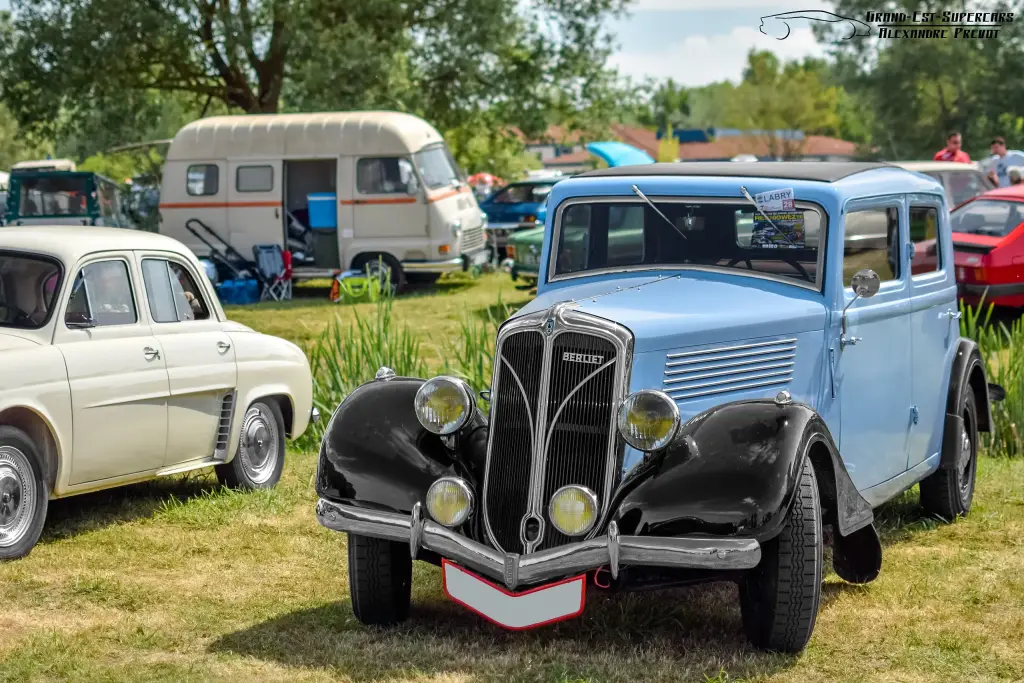
The Dauphine’s chassis had longitudinal members that curved up at the ends, so that the body sat lower on the road than on cars with a traditional 1920s overslung chassis. The front wheels were independently suspended from a transverse leaf spring and steered by rack and pinion, a recent trend, while the rear kept a rigid axle on a pair of longitudinal leaf springs.
Bodies and engines
The car came as a four-door Berline saloon, a two-door Coach, a sporting Roadster and a two-door five-seat Cabriolet; the Roadster and the Coach were delisted in 1935, leaving the Berline and the Cabriolet. The bodies were made in a way that was already old-fashioned: a timber frame carried the steel panels, where rivals such as the Peugeot 402, Renault Primaquatre and Citroën Traction had all-steel bodies pressed in heavy dies. The 1,990 cc four gave 50 hp at 4,000 rpm to the rear wheels through a conventional four-speed gearbox, the 1,600 cc unit gave 40 hp, and a 14CV engine was advertised for a few months in 1937 on special order. The 9CV was removed from the list for the 1938 model year.
Updates and the end
Between 1933 and 1938 there were few obvious changes, but for 1937 the wheelbase of the 11CV grew to 3,080 mm and that of the 9CV to 2,980 mm, from 2,850 mm for both, because customers complained of insufficient leg room. Choice kept shrinking, and by the October 1937 show only four colours were left: black, blue, green and grey. At the 32nd Paris Motor Show in October 1938 Berliet presented a completely rebodied Dauphine with the curved panels that were becoming mainstream; four cars stood on the stand, prices were announced on 28 November 1938, and production started gently in early 1939. The volumes never justified the presses and dies, and in 1939 Berliet gave up making car bodies. The last Dauphines hid a Berliet chassis and mechanical elements under the body of a Peugeot 402, with the Peugeot grille replaced by a modern one designed by Berliet. Launched at the Lyon Trade Fair in March 1939, barely 200 were built, and many were simply painted khaki and sold to the French army.
A dead end shared with others
Berliet was not the only small maker to buy bodies from a bigger rival: near Paris La Licorne used the body of the Citroën Traction, and in Germany bodies built by Ambi Budd for Adler were sold on in small numbers to competitors. After the war Berliet concentrated on lorries and buses.
Design and features
- Low chassis: the longitudinal members curved up at the ends, so the body sat lower than on an overslung chassis.
- Independent front suspension: a transverse leaf spring with rack-and-pinion steering, modern for a French family car of 1934.
- Choice of engines: a 50 hp 11CV, a 40 hp 9CV and, briefly, a 14CV on special order.
- Old-fashioned body: a timber frame under steel panels, at a time when rivals were moving to all-steel construction.
Berliet Dauphine versions
- Berline: the four-door saloon, the mainstay of the range.
- Cabriolet: a two-door, five-seat open car.
- Coach and Roadster: a two-door saloon and a sporting body, both delisted in 1935.
- 9CV: the 1,600 cc version, offered until the 1938 model year.
- 1938 rebodied car: curved, pressed-steel panels, priced from 28 November 1938.
- 1939 Peugeot-bodied car: a Berliet chassis under a Peugeot 402 body, about 200 built.
The Dauphine was the last car from a maker that went on to build the GL series lorries and the T100. More models are in the Berliet collection.
Sources
- Berliet Dauphine 11CV, English Wikipedia: chassis, bodies, engines, production and the end
- Berliet Dauphine, French Wikipedia: wheelbase changes, colours, the 1938 car