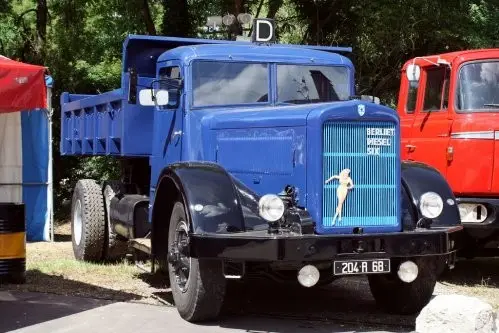
The Berliet GDR is a wide family of medium-weight bonneted lorries whose first member was presented in 1936. The last of the line, the GDR.7, was built until 1952, and the range ran on diesel, petrol, town gas and, in wartime, on wood.
Berliet GDR at a glance
| Maker | Berliet, Vénissieux (Lyon) |
|---|---|
| Production | 1936–1952 |
| Class | medium-weight bonneted lorry |
| Payload | 5 tonnes (GDR.22), 7 tonnes (GDR.7) |
| Engines | 28 versions: 12 diesel, 8 gas generator, 7 petrol, 1 town gas |
| First engine | MKB.3 petrol, 5,892 cc, 75 hp SAE at 2,000 rpm |
| Gearbox | four-speed, one reverse |
| Max speed | 58 km/h (petrol GDR.22) |
| Weight | 5,530 kg empty, 10,530 kg gross |
| Wheelbase | 4,810 mm |
| Fuel | 150 litres, 42 l/100 km |
| Built | number unknown |
Based on one source, the French Wikipedia article on the GDR, with company history from the English article on Berliet. No free photographs of the GDR were found.
History of the Berliet GDR
The GDR.22 of 1936
The first lorry of the series, the GDR.22, was designed from 1934, approved by the Service des Mines on 8 January 1936 and shown at the Paris Motor Show that year. It was a versatile five-tonner that conformed to the rail-route decree, with a deliberately oversized and reliable engine and a consumption of 42 litres per 100 km, reasonable for the period. Drive was on the right at first, and left-hand-drive versions appeared in 1937. The bare chassis weighed 3,800 kg and the lorry 5,530 kg empty, with a gross weight of 10,530 kg. It was 7,230 mm long, 2,790 mm high and 2,350 mm wide, on a 4,810 mm wheelbase, with a front track of 1,920 mm and a rear track of 1,652 mm on twinned wheels, narrow enough for the loading gauge of the French railways. Tyres were 38 by 9 or 38 by 8.
Engines for every fuel
The MKB.3 four-cylinder petrol engine of 5,892 cc, with a bore and stroke of 110 by 155 mm and a compression ratio of 5.48 to 1, gave 75 hp SAE at 2,000 rpm. The F.B.S.J.2 gearbox had four forward speeds and one reverse and allowed 58 km/h. The 150-litre tank, at 42 litres per 100 km, was meant to give a range of 300 km, and oil consumption was about one litre per 100 km; the electrics worked at 12 volts. Between 1935 and 1952 Berliet offered 28 engine versions, chosen for the fuels available at the time: 12 diesels, which took 45 per cent of sales, 8 gas generators (31 per cent), 7 petrol (24 per cent) and one running on town gas.
The GDRAG and the war
The GDRAG was one of those versions, launched in 1940 with an Imbert gas generator that burned raw wood rather than charcoal. It consumed 85 kg of wood per 100 km, two kilograms of wood standing in for a litre of petrol, and in 1944 about half of the 120,000 lorries allowed on French roads ran on gas generators. The GDRAG had a four-cylinder engine of 60 hp SAE, a four-speed gearbox, a weight of 5.7 tonnes empty and 13 tonnes loaded, and a top speed of 60 km/h; 3,699 were built between 1940 and 1945.
The GDR.7 after the war
In January 1946 Berliet launched the GDR.7D with a payload of 7,000 kg and a short-chassis variant for a tipper body, to replace the vehicles destroyed in the war; production in 1946 ran at 180 Berliet lorries a month, 100 of them GDR. The GDR.7D was powered by a 7.2-litre four-cylinder diesel of 85 hp SAE at 1,650 rpm. The GDR.7W of 1948 was a 4×2 with a gross weight of 13 tonnes, four on the front axle and nine on the rear, with Westinghouse compressed-air servo brakes and Mill-licence ball-bearing steering; the TDR.7W was the semi-trailer tractor version, with a four-speed gearbox and a double-reduction rear axle. In 1948 Berliet built 1,800 GDR and TDR lorries, 36 per cent of its turnover. The GLR.8 succeeded the line.
Design and features
- Fuel flexibility: 28 engine versions let buyers choose diesel, petrol, gas generator or town gas as supplies dictated.
- Oversized engine: the original petrol unit was deliberately large and reliable, and drank 42 litres per 100 km.
- Railway loading gauge: the 2,350 mm width and 1,652 mm rear track were chosen to fit French rail transport.
- Wartime gas generator: the GDRAG ran on wood and was built in 3,699 examples between 1940 and 1945.
Berliet GDR versions
- GDR.22: the original five-tonne petrol lorry of 1936.
- GDRAG: the 1940 gas-generator version running on wood.
- GDR.7D: the 1946 diesel with a 7-tonne payload.
- GDR.7W: the 1948 4×2 of 13 tonnes gross with air servo brakes.
- TDR.7W: the semi-trailer tractor of 1948.
- GDRK: the forward-control version of 1948, built to gain load space.
The GDR was replaced by the GL series, and the company’s later heavy trucks are described in the GR/TR article. More models are in the Berliet collection.
Sources
- Berliet GDR, French Wikipedia: versions, engines, dimensions, the GDRAG and the GDR.7
- Berliet, English Wikipedia: company history