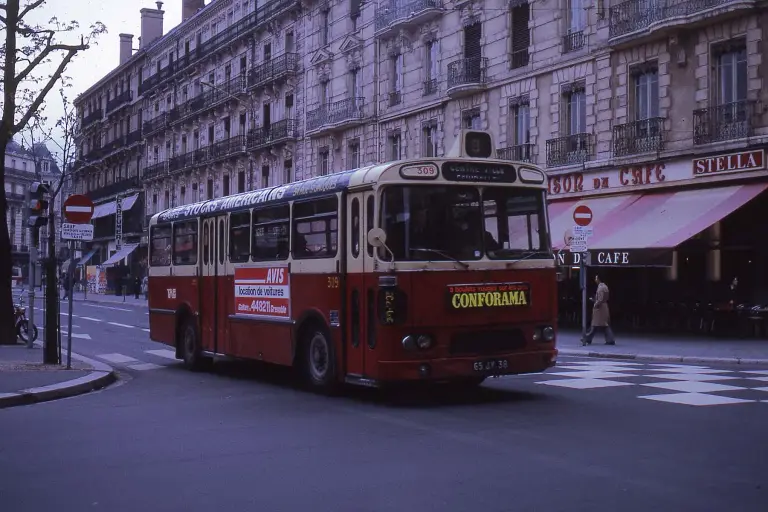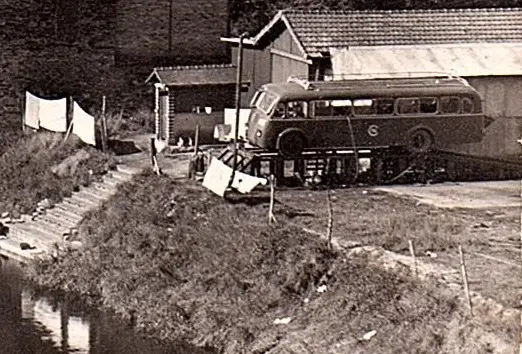
The Berliet PCK is a bus and coach built by the Lyon firm from 1939 to 1952. It was the first Berliet bus with the driving position moved forward across the full width of the body, and its diesel version developed from the PCK 7D into the five-cylinder PCK 8.
Berliet PCK at a glance
| Maker | Berliet, Vénissieux (Lyon) |
|---|---|
| Production | 1939–1952 |
| Class | city bus and intercity coach |
| Models | PCK 7, PCK 7D, PCK 8 W and PCK 8 R |
| Capacity | 33 to 57 passengers, seated and standing |
| Engines | MDB 7.5 litres and 85 hp, then MDU 7.9 litres and 120 hp |
| Gearbox | four-speed, five-speed from 1950 |
| Brakes | Westinghouse compressed air on all four wheels |
| Max speed | 60 km/h |
| Body | forward driving position across the full width |
| Chassis | strongly underslung |
Based on one source, the French Wikipedia article on the PCK, with company history from the English article on Berliet.
History of the Berliet PCK
Presented in 1939
The PCK was presented in 1939 as the first bus from the Lyon maker with the driving position advanced across the full width of the body. It was the direct competitor of the Renault ZP and AEMD. Its design was very conventional apart from a strongly underslung chassis that was specific to the model. The range came as a coach with 38 seats and as a bus, and capacity varied between 33 and 57 passengers seated and standing. The PCK 7 had a petrol engine, while the PCK 7D was the diesel.
War and revival
Production was almost nil during the Second World War and resumed in 1945. The model evolved, and only the diesel version survived. The solid disc wheels gave way to artillery-type wheels, twinned at the rear. Against the Renault, Latil and Citroën competition, however, the PCK 7D struggled, because it was too sluggish. In October 1949 the original MDB four-cylinder of 7.5 litres and 85 hp was replaced by the new MDU five-cylinder of 7.9 litres and 120 hp, and the PCK 7D was renamed PCK 8 W.
The five-cylinder face
Fitting the new five-cylinder engine meant changing the front: the radiator moved forward by about ten centimetres, so the flat grille was replaced by one forming a small box. That box became the sure sign of a five-cylinder PCK. Braking was by compressed air on all four wheels, of the Westinghouse type, which gave the W in the name, and the maximum speed stayed at 60 km/h.
The PCK 8 R and the end
A third version appeared in October 1950. The PCK 8 R was identical to the PCK 8 W apart from the gearbox, which went from four speeds to five. Production stopped for good in January 1952. By then the PCK was completely outdated next to new designs such as the Chausson AP 50 and the Renault R4190, which came to dominate the French market in the early 1950s.
Design and features
- Forward driving position: the first Berliet bus with the driver placed across the full width, ahead of the passengers.
- Low chassis: a strongly underslung frame specific to this model, which kept the body low.
- Five-cylinder engine: the MDU of 7.9 litres and 120 hp replaced a sluggish four-cylinder.
- Air brakes: Westinghouse compressed-air braking on all four wheels.
Berliet PCK versions
- PCK 7: the original petrol bus of 1939.
- PCK 7D: the diesel version with the 7.5-litre MDB engine.
- PCK 8 W: the 1949 version with the 7.9-litre five and a raised grille.
- PCK 8 R: the 1950 version with a five-speed gearbox.
The PCK was followed by the Berliet PH bus range, and the later PR100 became the company’s best-known bus. More models are in the Berliet collection.
Sources
- Berliet PCK, French Wikipedia: history, models, engines, brakes, production dates
- Berliet, English Wikipedia: company history