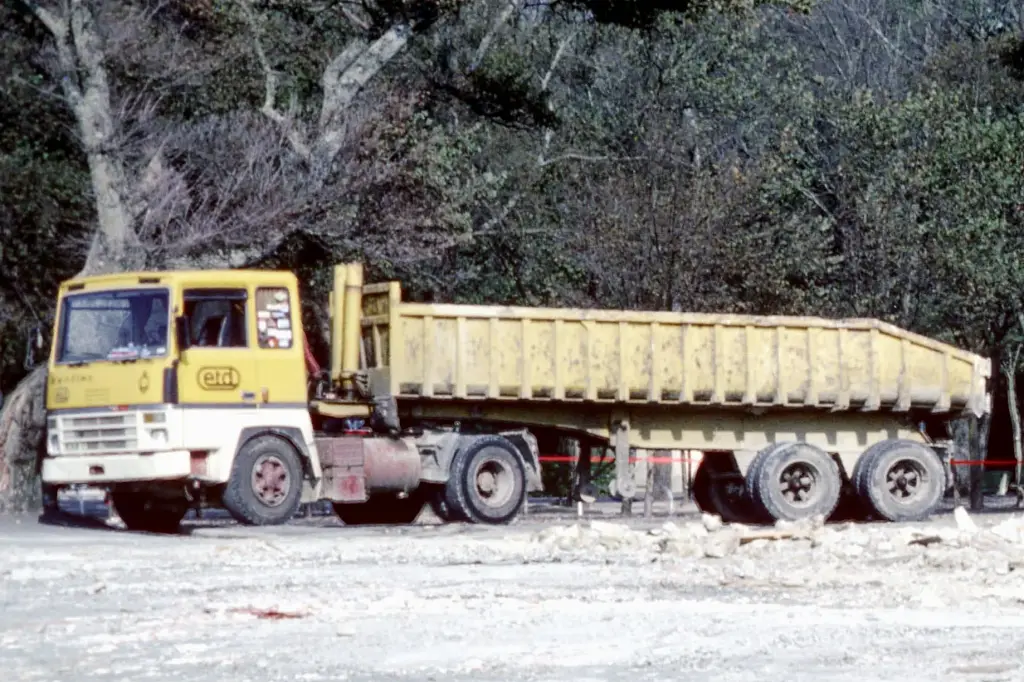
The Berliet GR and TR are a family of heavy trucks, the GR as a rigid lorry and the TR as a tractor unit, built in two generations. The first came in 1961 with the Relaxe cab, the second in 1970 with the new KB 2400 tilting cab, and the line ended when Renault took over the Berliet name in 1980.
Berliet GR/TR at a glance
| Maker | Berliet, Vénissieux (Lyon) |
|---|---|
| Production | 1961–1980 |
| Class | heavy lorry and tractor range |
| Generations | first in 1961, second in 1970 |
| Cabs | 1957 Relaxe fixed cab, then the KB 2400 tilting cab |
| Engines | straight-six diesels of 9.5 and 12.0 litres, later a 14.9-litre V8 |
| Power | from 180 hp to 310 PS SAE |
| Gross weight | 19 tonnes for the GRK10 |
| Gearboxes | six-speed at first, six choices including ZF and Fuller in the 1970s |
| Model codes | engine size until 1968, engine power afterwards |
| Successor | Renault R-series |
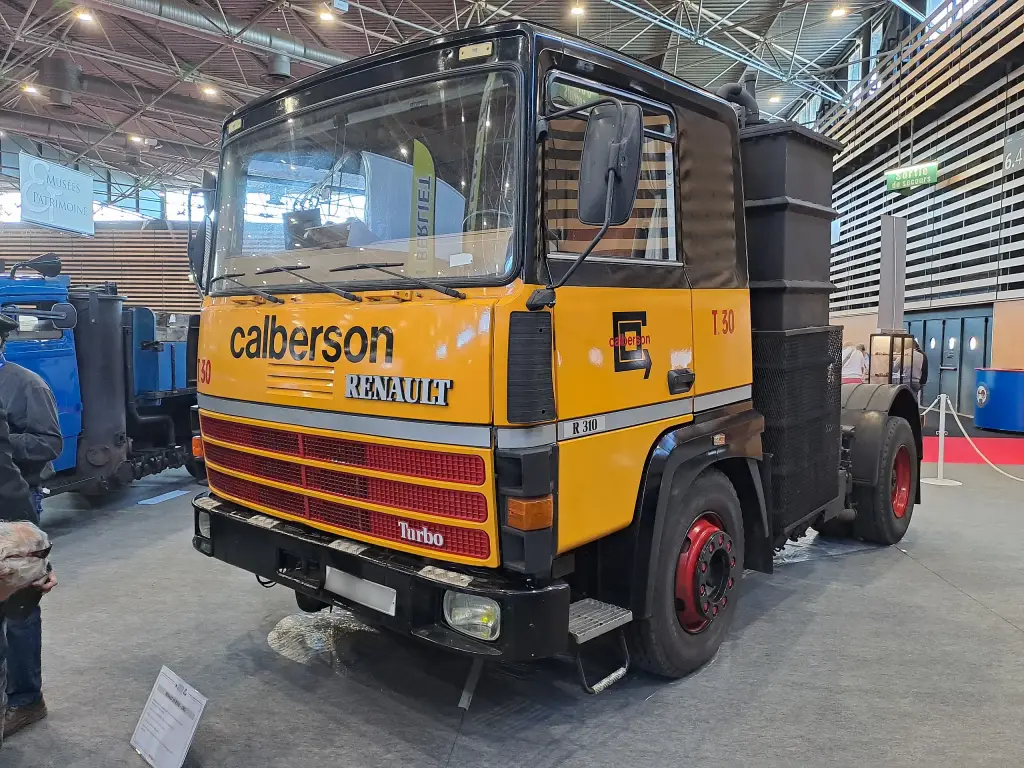
Based on one source, the English Wikipedia article on the GR/TR. The second photograph shows a Renault R 310, the 1980 facelift of the Berliet KB 2400 cab.
History of the Berliet GR/TR
The first generation, 1961
The first model was the GRK10, with the TRK10 tractor version, rated at 19 tonnes gross and fitted with the fixed Relaxe cab of 1957. The gear lever was mounted on the dashboard, and the engine was a 9.5-litre straight-six, the M 620Z, built under licence from the German firm MAN. It was credited with 180 hp, and after a 1968 update to M 620P with 192 hp. The heavier 12.0-litre GR12 and TR12 with the M 635 engine arrived in 1964, initially with 240 hp at 2,200 rpm, or 228 PS DIN for cars exported to Germany. Power was quoted in SAE by Berliet and was marginally higher than the DIN figures. From 1968 the model code gave the power instead of the engine size, so the range was marketed as the GR/TR200 and GR/TR250, although the Service des Mines still listed them as the GR/TR10 and 12. A lower-rated version for European export markets with a ten-tonne load limit, the GF12 and TF12, was built in only thirty examples.
Protecting the home market
Berliet consistently lobbied the French government to keep the permissive 13-tonne axle limit, which protected its market share from imported competitors. Models on a 6×4 chassis carried a trailing H, as in GRH and TRH, and some first-generation types, such as the TR250, stayed in production alongside the second generation until 1973.
The second generation, 1970
The GR/TR300 premiered at the 1970 Paris Motor Show with an angular, modern design by Louis Lucien Lepoix and the new KB 2400 tilting cab, the B standing for basculante. Development had been rushed and the first model proved unreliable: its 12.8-litre V8 gave 300 PS SAE at 2,500 rpm and 940 Nm at 1,600 rpm, but the engine, transmission and rear axles caused warranty costs, and only 778 were built. In July 1972, less than two years after the launch, it was replaced by the 14.9-litre GR/TR320, a much more reliable and lower-stressed engine of 310 PS SAE. A realignment in 1973 added a whole range from the GR205 to the GR320, just in time for the oil crisis, and a second facelift in 1975 brought the headlamps down out of the grille into the bumper and revised the interior.
Engines and the end
The lighter models kept the old straight-six, with or without a turbocharger: the TR205 of 1973 used the 195 PS M 620T, the 12.0-litre went into the TR260 and the TR280 when turbocharged. Late in 1977 Berliet added the GR/TR305 with the turbocharged six MDR 635, which matched the old 300’s power but gave 1,255 Nm at 1,400 rpm; in late 1979 it received Renault fuel injection as the MIDR 635, with 306 PS and 1,270 Nm. The KB 2400 cab was used by Ford for the 1975 Transcontinental and taken over by Renault for its R-series, which replaced the GR/TR when the Berliet and Saviem brands were retired in April 1980.
The Centaure
To compete with the Volvo Globetrotter, Berliet offered a luxurious version called the Centaure, converted to order by the coachbuilders Lamberet and introduced at the 1978 Paris Salon. It had a fibreglass raised roof, custom paint and plenty of chrome, including the exhaust stacks, while the interior came with a kitchenette, an external shower, a WC, a sleeping compartment and air conditioning.
Design and features
- Two cabs: the fixed Relaxe cab of 1957 gave way to the tilting KB 2400, which made engine access far easier.
- Six-cylinder diesels: 9.5- and 12.0-litre units under MAN licence, later joined by a 14.9-litre V8.
- Wide model range: from the 19-tonne GRK10 to the 310 PS GR/TR320, with 6×4 versions marked H.
- Centaure: a factory-approved luxury conversion with a raised roof, kitchenette and shower.
Berliet GR/TR versions
- GRK10 and TRK10: the 1961 originals with the Relaxe cab and 9.5-litre engine.
- GR12 and TR12: the 12.0-litre models added in 1964.
- GR/TR300: the 1970 V8 flagship, 778 built.
- GR/TR320: the 14.9-litre replacement of 1972, 310 PS.
- TR280D: a 1974 export version with a ten-tonne axle load, about 300 built.
- Centaure: the luxury conversion by Lamberet shown in 1978.
The GR/TR followed the GL series, and the company’s biggest vehicle is described in the T100 article. More models are in the Berliet collection.
Video: BERLIET GR 280 -STOUFF- IRAN 1975
Video by volvof1220 “Frachtenkontor” on YouTube.
Sources
- Berliet GR/TR, English Wikipedia: both generations, engines, models, exports, the Centaure