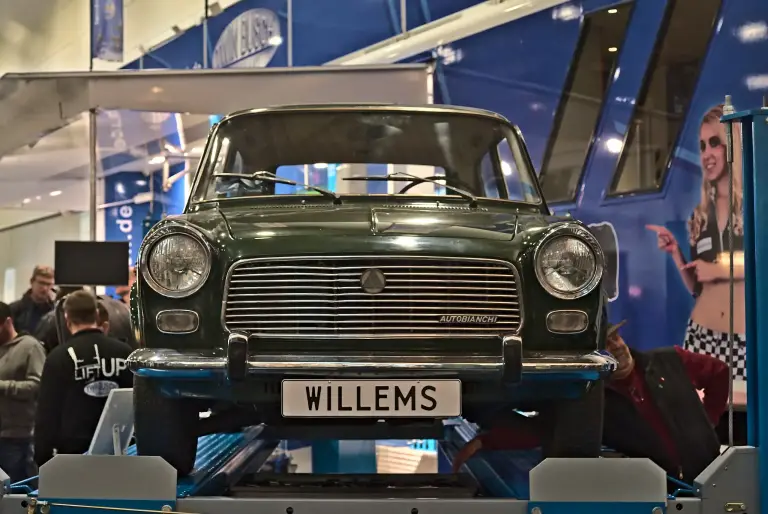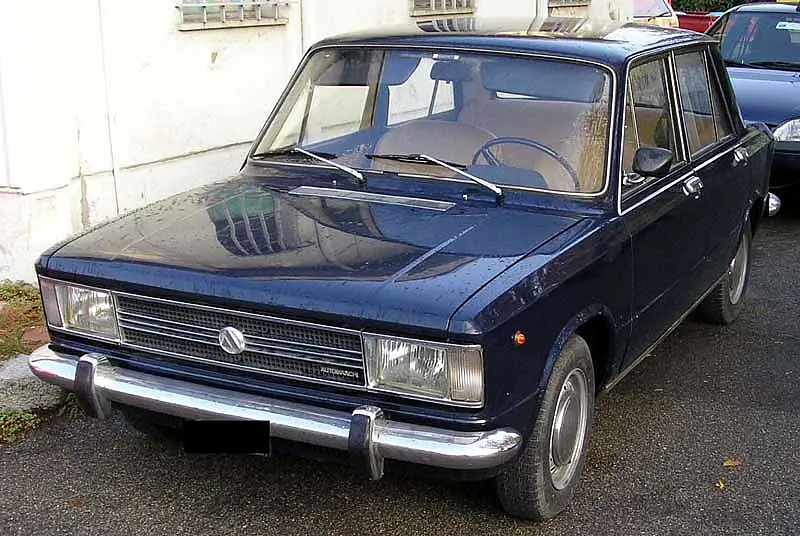
The Autobianchi A111 is a four-door saloon that Autobianchi built from 1969 to 1972. Modest by the standards of the class at roughly four metres long, it was nevertheless the largest car the small-car specialist ever produced. Under the skin it used the front-wheel-drive platform and 1.4-litre engine of the Primula Coupé S, wrapped in three-box bodywork derived from a Fiat project that never reached production.
Autobianchi A111 at a glance
| Maker | Autobianchi, Desio (Fiat group) |
|---|---|
| Production | 1969–1972 |
| Body | four-door saloon, three-box |
| Engine | 1,438 cc overhead-valve four, Fiat 124 type |
| Power | 70 PS DIN at 5,400 rpm |
| Torque | 108 N·m DIN at 3,000 rpm |
| Transmission | four-speed manual, floor shift |
| Top speed | 155 km/h (96 mph), claimed |
| Length | about 4 m; under 4 m from 1970 |
| Suspension | front wishbones and transverse leaf spring; rear beam axle |
| Brakes | discs on all four wheels, split circuits |
| Built | 56,984 |
History of the Autobianchi A111
From the abandoned Fiat 123
The A111 began as a way of using work Fiat had already paid for. Autobianchi’s managing director Enrico Ghiretti wanted a conventional three-box saloon to replace the Primula, whose hatchback and fastback bodies he thought vulnerable to the coming front-wheel-drive Fiat 128. Fiat’s own styling centre was overworked, so the most recent proposal for the transverse-engined Fiat 123 — a project dropped in favour of the rear-wheel-drive 124 — was taken over, updated with rectangular headlamp lenses and approved for production. The result inevitably recalled the Fiat 124 and 128, between which it was sized.
Launch and series 2
The car was introduced in April 1969 and deliveries started in May. The interior seated four or five, with a genuine wood fascia, individually sliding and reclining front seats, a fully carpeted floor and cloth, cloth-and-leatherette or full leatherette upholstery. Autobianchi claimed 155 km/h. Italian sales material also stressed safety equipment unusual in the class: a body designed to deform progressively, a padded lower fascia, a steering column that folded in three segments and mounting points for seat belts, including in the rear. A lightly revised car appeared at the 52nd Turin Motor Show in October and November 1970, with double-stacked tail lamps, bumpers that gained rubbing strips but lost their over-riders — bringing overall length below four metres — new tail badging, a redesigned centre console and a shorter gear lever.
The end of the big Autobianchi
As the 1970s went on Fiat launched more and more front-wheel-drive cars under its own badge, and the Autobianchis became redundant. The last A111 left the line in 1972; Fiat had decided that the role of a larger car in the group belonged to the Lancia Beta, and no direct replacement was made. Production totalled 56,984. The marque was left with a single model, the A112, and its successor the Y10. Competition history was thin: there was no works effort, but a private A111 was entered in the 1970 Monte Carlo Rally, where Federico Confalioneri and Adolfo Pasta retired. The mechanical package, slightly detuned and with a specific steering box and drum brakes, was also used for the Fiat 238 van.
Design and features
- Primula-derived chassis: front-wheel drive with a transverse engine, taken from the Primula Coupé S along with its 1,438 cc engine.
- Three-box body: conservative saloon styling from the cancelled Fiat 123, with rectangular headlamps.
- Well-equipped cabin: wood fascia, carpet, reclining front seats and leatherette or cloth trim.
- Four disc brakes: split hydraulic circuits with a vacuum servo and a rear proportioning valve.
- Comfort details: hydraulically operated clutch, steering damper and an electric radiator fan.
Autobianchi A111 versions
- Series 1 (1969–1970): original car with single tail lamps and bumpers with over-riders.
- Series 2 (1970–1972): double-stacked tail lamps, rubber-faced bumpers without over-riders, revised console and shorter gear lever.
- Rally car: a privately entered A111 ran in the 1970 Monte Carlo Rally.
The A111 was developed from the Autobianchi Primula, and when it went out of production the marque was left with the A112 alone. More cars are in the Autobianchi collection.
Sources
- Autobianchi A111, English Wikipedia: development, launch, series 2, production
- Autobianchi A111, Italian Wikipedia: equipment, safety features, price, Fiat 238