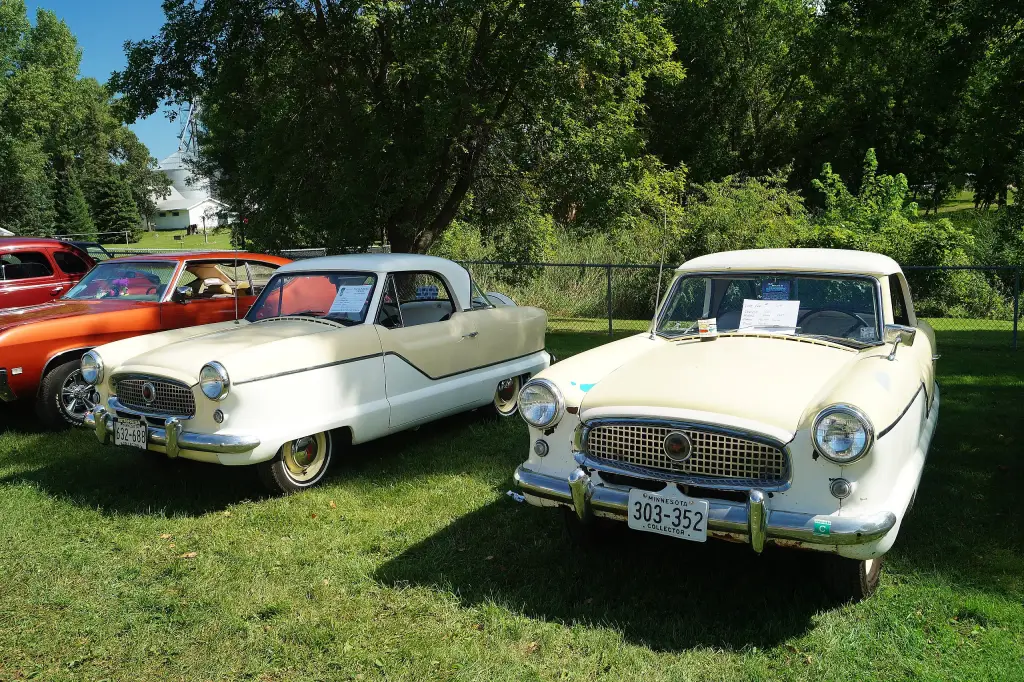
The Nash Metropolitan is an American automobile marketed from 1953 until 1962, manufactured in England. While designed and marketed in the United States by Nash and its successor companies, it was built entirely in British Motor Corporation factories using many existing BMC parts.
Nash Metropolitan at a glance
| Marketed | 1953 to 1962 |
|---|---|
| Built | entirely in England in BMC factories, with many BMC parts |
| Designed | in Kenosha, Wisconsin, from the NXI concept by William J. Flajole |
| Class | economy car; today a “subcompact” |
| Brands | Nash, then Hudson from 1954, then a standalone brand in 1957 with an “M” badge |
| Construction | unit body |
| Size | wheelbase shorter than the Volkswagen Beetle’s |
| Also sold | in the United Kingdom and other markets |
This page is based on English Wikipedia only (a trusted source), so the facts were not cross-checked against a second source.
History of the Nash Metropolitan
While most domestic automakers followed a bigger-is-better philosophy, Nash Motor Company executives looked for an economical alternative. The Metropolitan was designed in Kenosha and patterned on a concept car, the NXI (Nash Experimental International), built by the Detroit-based independent designer William J. Flajole for Nash-Kelvinator. It was meant as the second car of a two-car family, a “commuter/shopping car” resembling the big Nash but tiny in scale.
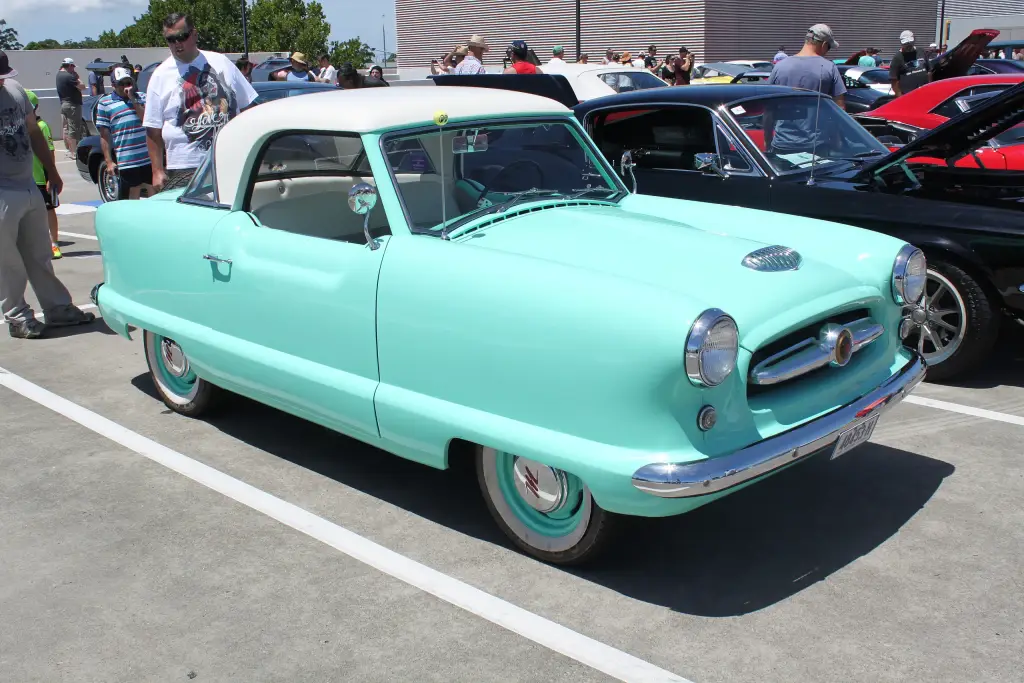
The NXI design study incorporated several innovative features and attempted to use interchangeable front and rear components, though only the symmetrical door skins were interchangeable in production. It also used Nash’s advanced single-unit (unit body) construction. It was shown at several “surviews” (survey-previews) beginning on 4 January 1950 at the Waldorf-Astoria Hotel in New York, to gauge public reaction; the result convinced Nash there was a market for such a car at a competitive price.
Hudson and standalone brand
The Metropolitan was also marketed as a Hudson model when Nash and Hudson merged in 1954 to form American Motors Corporation. The Nash and Hudson lines were phased out in favour of Rambler, and in 1957 the Metropolitan became a standalone brand, badged with a stylised “M” on hubcaps and the grille.
Design and features
- Origin: an American design built in Britain.
- Body: unit-body construction.
- Size: a wheelbase shorter than the VW Beetle’s.
Nash Metropolitan versions
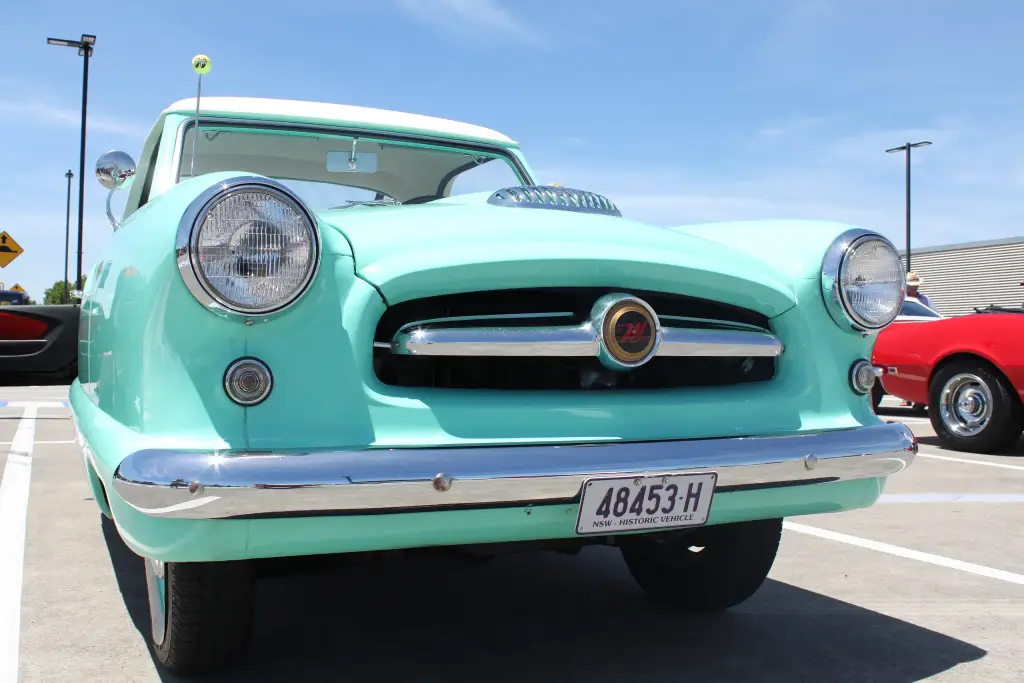
- Nash Metropolitan (1953–1954).
- Hudson Metropolitan (from 1954).
- Metropolitan (1957–1962): a marque of its own.
More Austin cars are in our Austin collection, for example the A40, the A30 and the A35.
Nash Metropolitan questions and answers
Who designed the Nash Metropolitan?
It was designed in the US at Kenosha, patterned on the NXI concept by William J. Flajole.
Where was it built?
Entirely in British Motor Corporation factories in England.
When was it sold?
From 1953 to 1962.
Was it ever a Hudson?
Yes, after the 1954 Nash-Hudson merger.
Was it a separate brand?
From 1957 it was a standalone brand badged with an “M”.
Video: Austin Classics 1961 Austin Metropolitan up close
Video by austinclassics on YouTube.
Sources
- Nash Metropolitan, English Wikipedia: design and history