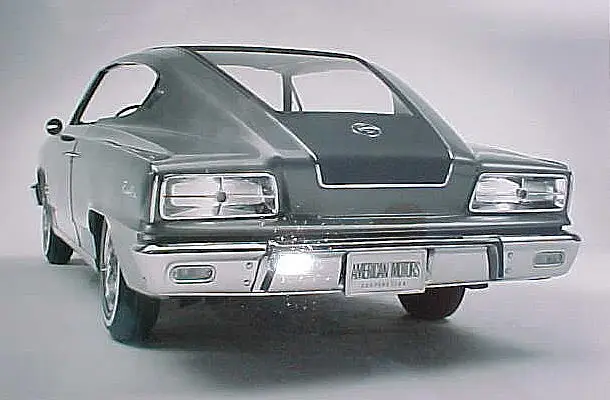
The Tarpon was a compact, youth-oriented fastback coupe built by Rambler in 1963 as a design study. It toured the American auto shows in 1964, drew strong interest from the public, and never went on sale — but its fastback roofline shaped the larger Rambler Marlin of 1965.
Rambler Tarpon at a glance
| Make | Rambler Division of American Motors |
|---|---|
| Type | concept car, 2+2 pillarless hardtop coupe |
| Built | 1963 |
| Debut | 1964 Chicago Auto Show |
| Platform | Rambler American convertible chassis, 106 in (2,692 mm) wheelbase |
| Length | 180 in (4,572 mm), against 177.25 in for the American |
| Height | 52.5 in (1,334 mm), two inches lower than the American |
| Colour | bright red with a black vinyl roof |
| Wheels | 13-inch polished aluminium |
| Outcome | not produced; its styling led to the 1965 Rambler Marlin |
Based on one source: the English Wikipedia article on the Rambler Tarpon.
History of the Rambler Tarpon
A small fastback for young buyers
Early in 1963 American Motors’ management began work on “a new car with a sports flair” to change the company’s image, as young first-time drivers entered the market and bought cars with style. Dick Teague’s styling team came up with a fastback, a shape he loved from pre-war cars; he looked at the 1963 Chevrolet Corvette split-window coupe and the 1963 Ford Galaxie Sports Hardtop, and at older fastbacks such as the 1942 Chevrolet Fleetline Aerosedan and Nash’s own Airflyte. With a much smaller budget than the Big Three, Teague’s team had to reuse existing tooling, and the Tarpon was built on the new 1964 Rambler American platform.
The show car
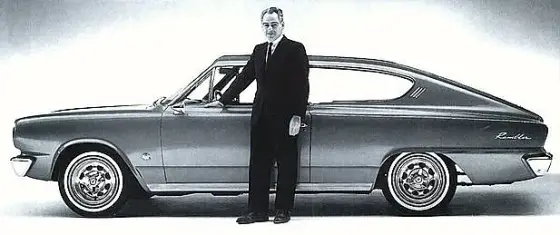
The Tarpon was a small rear-wheel-drive two-door monocoque pillarless hardtop with a sleek fastback roof that narrowed as it met the rear bumper, two large taillights flowing from the rear shoulders, and a nearly horizontal rear window. It was finished in bright red with a black vinyl roof. The convertible chassis gave a 106-inch wheelbase, but the show car was slightly longer than the production American at 180 inches, and its roof was lowered two inches to a height of only 52.5 inches. The top section of the roof was reinforced plastic, the windscreen was bulbous and swept back, the wheels were polished 13-inch aluminium instead of the production 14-inch steel items, and inside there were dial-type gauges, a deep-dish aluminium steering wheel with a walnut rim and custom bucket seats. The show car had no boot lid or outside hatch.
Reception and legacy
The Tarpon caused a stir at the Society of Automotive Engineers convention in January 1964, where designers worked on a cutaway profile of the car on stage, and then toured the auto show circuit from January 1964. It appeared at the Chicago Auto Show and at the 1964 New York International Auto Show alongside Ford’s Mustang II concept. The sales pitch was “A new car with sports flair”, and surveys found that over 60 per cent of show visitors said they would like to own a car with the Tarpon’s fastback styling; some wanted to place orders and dealers asked about production plans. The Tarpon did not go into production because AMC was still developing its lightweight GEN-2 V8 to fit the small Rambler American chassis. Its fastback design instead reappeared on the larger Rambler Marlin, introduced in 1965.
Design and features
- Fastback roofline: an unbroken sweep from the windscreen to the tail, with a skylight rear window.
- Low stance: two inches lower than the production Rambler American, on smaller 13-inch wheels.
- 2+2 interior: four seats, dial gauges and a walnut-rimmed steering wheel.
- Show-car details: reinforced plastic roof section and no boot lid.
Rambler Tarpon versions
- Tarpon concept 1963: the single red show car, first shown in Chicago in 1964.
- Rambler Marlin 1965: the production fastback that carried the idea into the showroom.
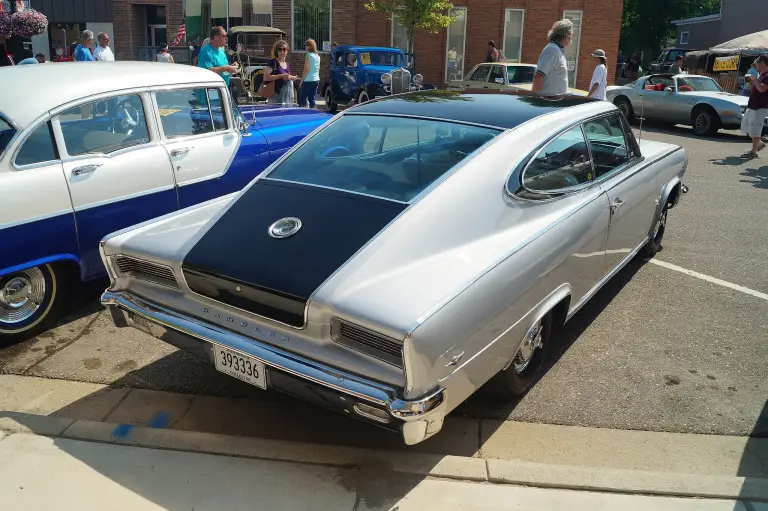
The Tarpon’s shape reached production as the Rambler Marlin, and it was built on the platform of the Rambler American. More cars are in the AMC collection.
Video: Amc tarpon 1964 (Prototype Car)
Video on YouTube.
Sources
- AMC Rambler Tarpon, English Wikipedia: design, show career, legacy