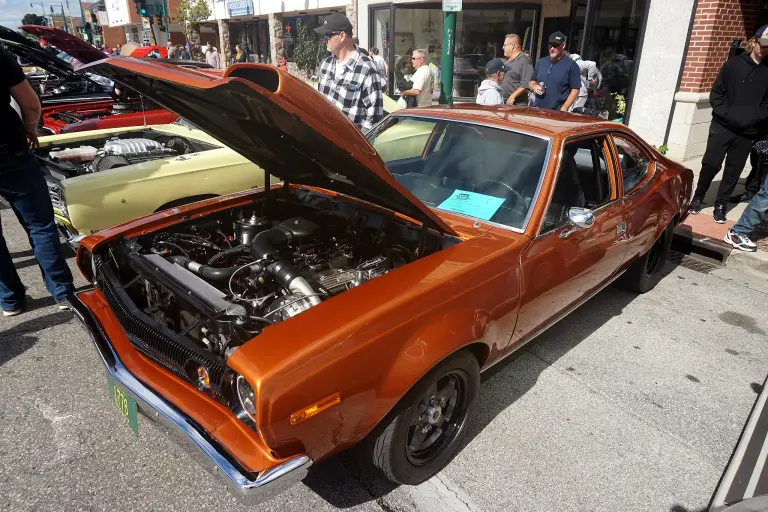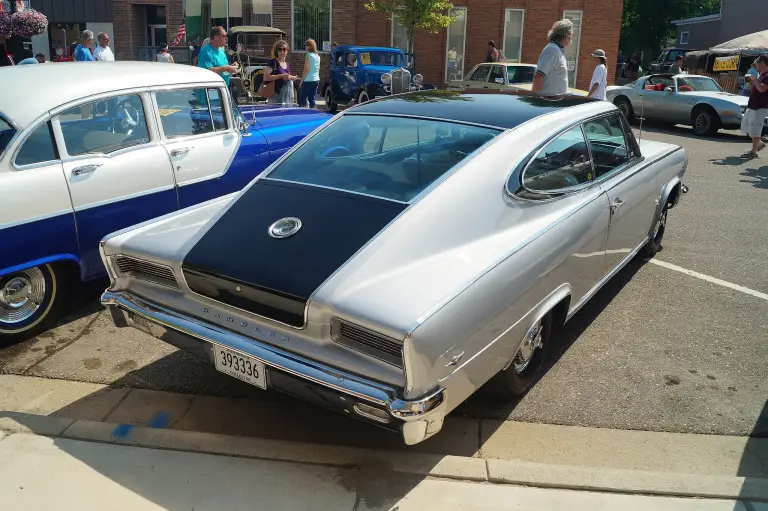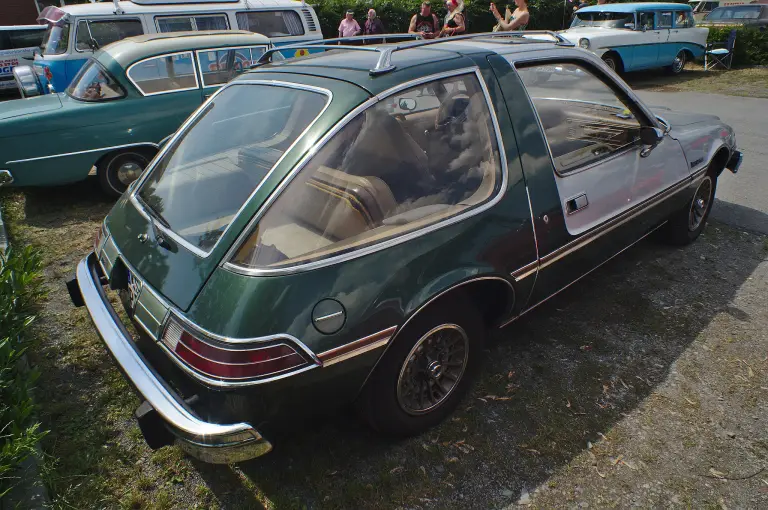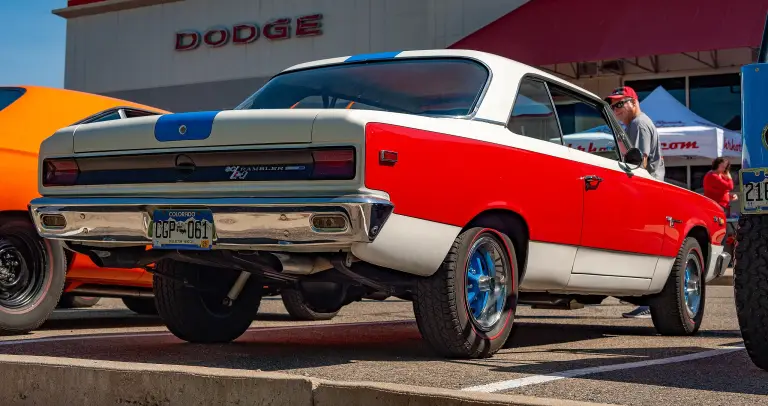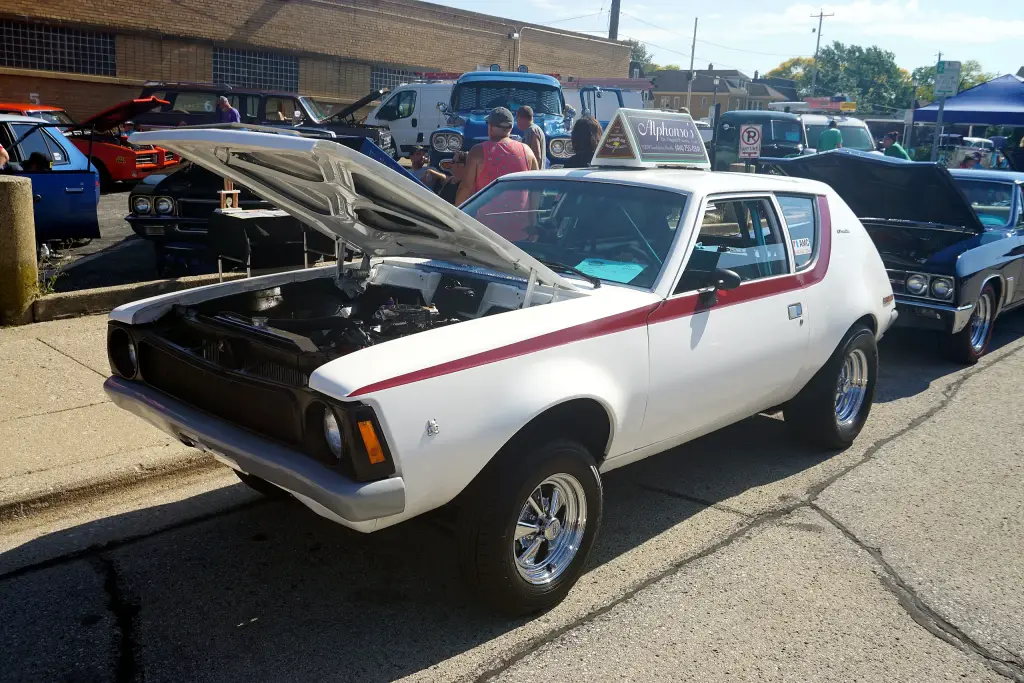
The Gremlin was American Motors’ answer to the imports: a small, cheap two-door built from a shortened Hornet, with a tail cut off almost vertically. It arrived on 1 April 1970 and stayed in production until 1978.
AMC Gremlin at a glance
| Maker | American Motors Corporation; VAM in Mexico |
|---|---|
| Production | 1970–1978 in the USA; 1974–1983 in Mexico |
| Class | subcompact economy car |
| Based on | AMC Hornet, shortened |
| Wheelbase | 96 in (2,438 mm), down from 108 in |
| Length | 161 in (4,089 mm), two inches longer than the Beetle |
| Body | single two-door style with a kammback tail |
| Engines | 199 cu in (3.3 L) six standard, 128 hp; 232 cu in (3.8 L) six optional, 145 hp |
| Price at launch | US$1,879 two-passenger, US$1,959 four-seat hatchback |
| Built | 671,475 |
Based on one source: the English Wikipedia article on the AMC Gremlin.
History of the AMC Gremlin
An air-sickness-bag sketch
The idea for a subcompact began at AMC in 1966, when design chief Dick Teague and stylist Bob Nixon discussed shortening the company’s compact car. Teague’s solution, which he said he sketched on an air-sickness bag during a flight, was to cut the tail off a Javelin. Nixon, who had joined AMC at 23, made the first formal sketches in 1967. Ford and General Motors were preparing all-new subcompacts for 1971, and AMC could not afford a clean-sheet design. Teague’s shortened Javelin idea became the AMX-GT concept shown at the New York International Auto Show in April 1968, but that car did not go into production; the production subcompact was instead based on the Hornet.
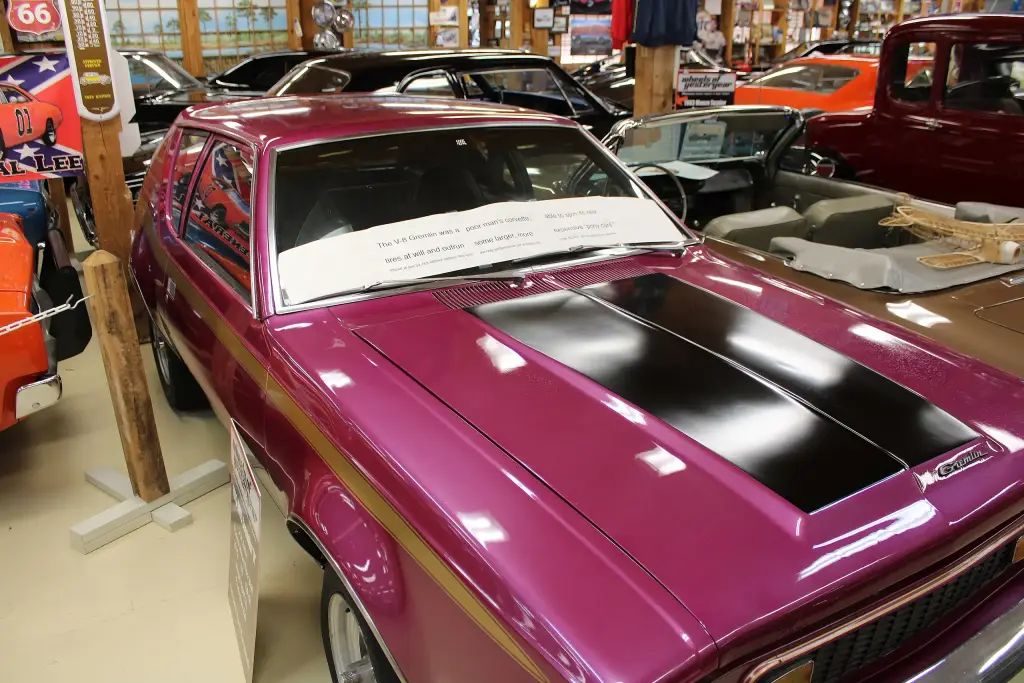
Design and packaging
The Gremlin reduced the Hornet’s wheelbase from 108 to 96 inches and its length from 179 to 161 inches, making it two inches longer than the Volkswagen Beetle and shorter than the Ford Pinto and Chevrolet Vega. From the front to the B-pillars it was essentially a Hornet. The upright tail improved interior space and was aerodynamically efficient, and Time magazine said the car “resembles a sawed-off station wagon, with a long, low hood and swept-up rear”. The base version had two seats, no rear seat and a fixed rear window; the four-seat hatchback had an opening rear window. Luggage space behind the back seat was six cubic feet, rising to 18 cubic feet with the seat folded.
On the market
The Gremlin was introduced on 1 April 1970 and made the cover of Newsweek on 6 April under the headline “Detroit Fights Back: The Gremlin”. AMC marketed it as “the first American-built import” and as “cute and different”, a strategy that attracted more than 60 per cent of buyers under the age of 35. The name was chosen by Teague to be “cute or controversial”; Time noted that Webster’s defined a gremlin as a small gnome blamed for equipment failures, while AMC called it “a pal to its friends and an ogre to its enemies”. The car was superseded for 1979 by the restyled Spirit, by which time 671,475 had been built — long after the Ford Pinto and Chevrolet Vega had gone.
Design and features
- Kammback tail: the vertical rear end gave more interior room than a conventional sloping roof.
- Hornet front: the car shared its nose and dashboard with the larger Hornet, keeping costs down.
- Two- or four-seat: the base car had no rear seat at all, the hatchback could carry four.
- Six-cylinder engines: the 199 and 232 cu in units gave more power than most imported rivals.
AMC Gremlin versions
- Base two-passenger 1970: no rear seat, fixed rear window, US$1,879.
- Four-seat hatchback: opening rear window and a folding rear seat, US$1,959.
- Gremlin X: the sporty trim level of the range.
- VAM Gremlin 1974–1983: Mexican-built cars from Vehiculos Automotores Mexicanos.
The Gremlin was built on the Hornet and was replaced by the Spirit. More cars are in the AMC collection.
Sources
- AMC Gremlin, English Wikipedia: origin, design, dimensions, engines, sales