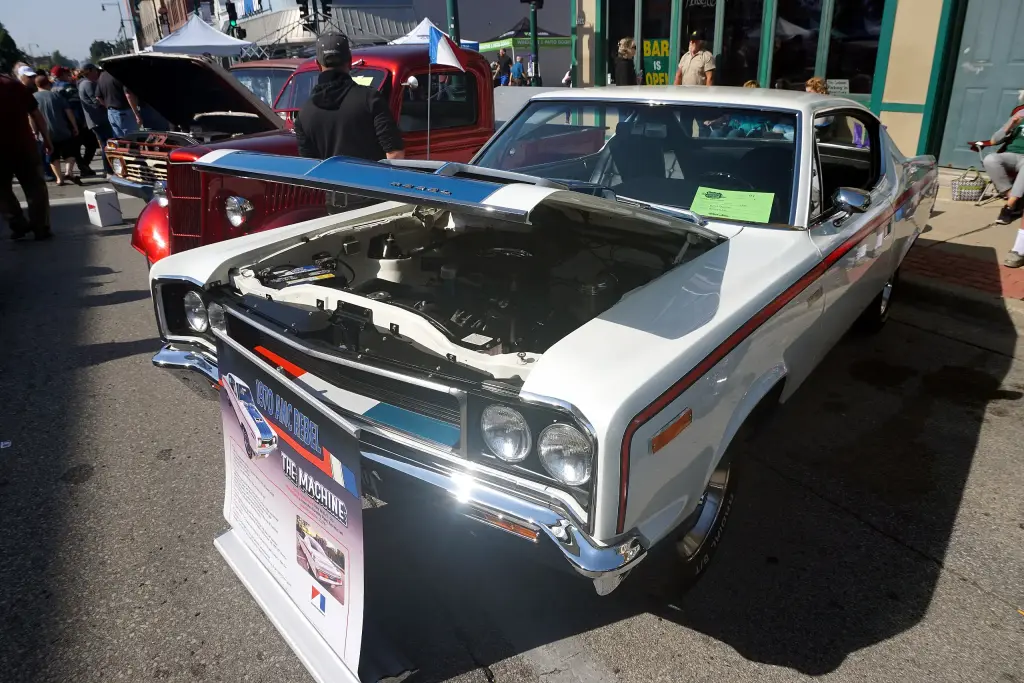
The Rebel was American Motors’ volume car of the late 1960s: a bigger, roomier intermediate that replaced the Rambler Classic in 1967. It was larger than its predecessor, shared its structure with the Ambassador, and is best remembered today for the white, red and blue Rebel Machine.
AMC Rebel at a glance
| Maker | American Motors Corporation |
|---|---|
| Production | 1967–1970 model years |
| Name | Rambler Rebel in 1967, AMC Rebel afterwards |
| Replaced | Rambler Classic |
| Replaced by | AMC Matador for 1971 |
| Wheelbase | 114 in (2,896 mm), two inches longer than the Classic |
| Width | nearly 4 in (102 mm) wider than the Classic |
| Engines | six-cylinders, plus 290 cu in (4.8 L) and 343 cu in (5.6 L) V8s |
| 343 V8 output | 280 hp with four-barrel carburettor and dual exhaust |
| Trims | 550, 770 and SST |
| Special model | Rebel Machine, 1970 |
Based on one source: the English Wikipedia article on the AMC Rebel.
History of the AMC Rebel
A name with history
The Rebel name first appeared in 1957 on a Rambler special with a big V8, described as the first factory-produced lightweight muscle car. It returned for 1966 as the top version of the Rambler Classic two-door hardtop, with bucket seats, special trim and a revised roofline. For 1967 the whole intermediate line took the Rebel name. The cars were designed under Roy Abernethy, but management changed in January 1967 when Roy D. Chapin Jr. became chairman and chief executive with the aim of changing AMC’s “frumpy” image; the new intermediates were promoted as the “now cars” with a focus on performance.
Bigger and more modern
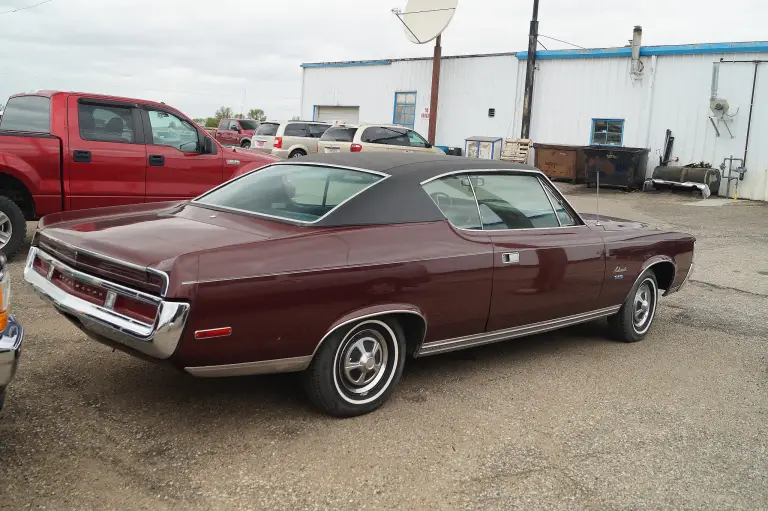
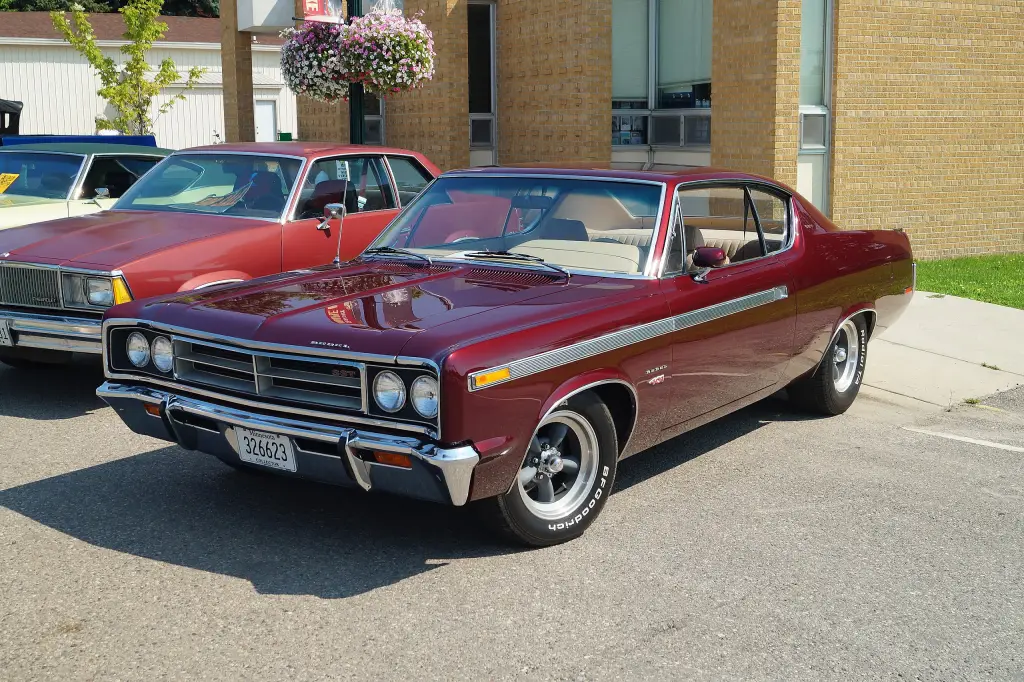
The 1967 Rebel was completely new. It rode on a 114-inch wheelbase, two inches longer than the Classic, and was nearly four inches wider, giving as much interior space as full-size Fords and Chevrolets. The styling was smoother and more rounded, with sweeping rooflines and a “Coke-bottle” body, though critics noted that the new car was harder to tell apart from its Big Three rivals. Inside, a new safety dashboard had a steering column designed to collapse on impact, with the instruments grouped in a hooded binnacle. Underneath, the old torque tube gave way to an open driveshaft and a four-link trailing-arm rear axle on coil springs for a more comfortable ride, while the front suspension kept AMC’s unequal-length arms and high-mounted coil springs. The 290 and 343 cu in V8s replaced the old generation of AMC engines; with a four-barrel carburettor and dual exhaust the 343 produced 280 hp.
Bodies and the Machine
The Rebel came as a six-passenger four-door sedan, two-door hardtop and four-door station wagon with an optional third-row seat, plus a two-door sedan with a thin B-pillar for 1967 only and a convertible in 1967 and 1968. Trim levels were the base 550, the deluxe 770 and the high-line SST, the last available only as a two-door hardtop. Wagons with themed trim and luxury equipment were sold in selected regions. In 1970 AMC added the Rebel Machine, a high-performance, low-priced muscle car best known for its flamboyant white, red and blue paint scheme. The Rebel was built at AMC’s West Assembly Line in Kenosha and at Brampton in Ontario, and was assembled from kits under licence in Mexico by VAM, in Costa Rica by Purdy Motor, in Australia by AMI and in New Zealand by Campbell Motor Industries, as well as by Renault in Europe in 1967. The Matador replaced it for 1971.
Design and features
- Roomier body: a longer, wider shell with as much interior space as full-size rivals.
- Modern chassis: open driveshaft and four-link coil-spring rear suspension replaced the torque tube.
- Safety dashboard: a collapsible steering column and instruments in a hooded binnacle.
- Rebel Machine: the 1970 muscle version in white, red and blue.
AMC Rebel versions
- Rebel 550: the base trim, including the two-door sedan of 1967.
- Rebel 770: the deluxe trim, popular as a wagon.
- Rebel SST: the top trim, a two-door hardtop only.
- Rebel convertible: offered in 1967 and 1968.
- Rebel Machine 1970: the high-performance model with flamboyant trim.
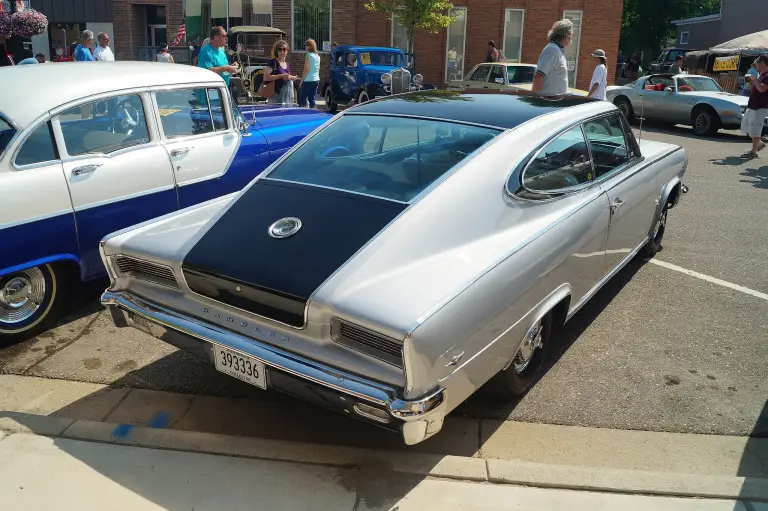
The Rebel replaced the Rambler Classic and was itself replaced by the Matador; its fastback cousin was the Marlin. More cars are in the AMC collection.
Video: 1968 AMC Rebel SST
Video on YouTube.
Sources
- AMC Rebel, English Wikipedia: history, engineering, trims, assembly, Machine