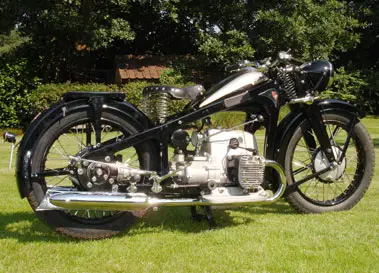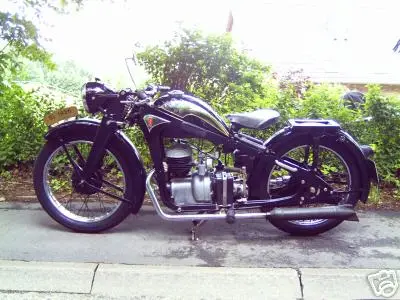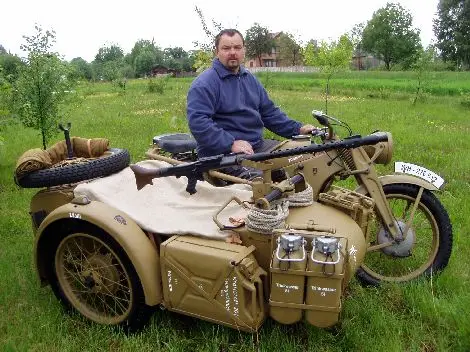
The Zündapp KS 601 is a 597 cc boxer-twin motorcycle that Zündapp of Nuremberg built from 1950 to 1957 in just under 5,000 examples. Designed by Ernst Schmidt, it was mostly used with a sidecar, and it became famous in Germany under the nickname “Green Elephant”.
Zündapp KS 601 at a glance
| Maker | Zündapp-Werke GmbH, Nuremberg |
|---|---|
| Production | 1950–1957 |
| Built | just under 5,000 |
| Engine | 597 cc two-cylinder boxer four-stroke, OHV |
| Power | 28 hp; 33.5 hp in the KS 601 S |
| Gearbox | four-speed |
| Final drive | shaft, the last Zündapp with one |
| Frame | double-tube steel |
| Sidecar fittings | four attachment points |
| Nickname | Der Grüne Elefant |
The KS 601 has no article of its own on the English Wikipedia; this page is based on the German article together with the English article on the manufacturer.
History of the Zündapp KS 601
The KS 601 was drawn up by Ernst Schmidt and went on sale in 1950. Its short-stroke boxer twin with hanging valves and a low camshaft was essentially the engine of the prewar KS 600, but with two carburettors in place of one. Where the KS 600 had a pressed-steel box frame, the 601 had a double-tube frame with four mounting points for a sidecar. The telescopic fork used a single central hydraulic damper between the fork legs ahead of the steering head, and the rear wheel was located by a sliding-axle arrangement whose “rubber shock absorbers” were in fact only a stop, not a damper.
Unlike the comparable BMW boxers, the KS 601 had a one-piece crankshaft and needle-roller big ends with split conrod caps. The fuel tank, the pulled-through engine and the typical green paint – other colours were available – led the magazine Das Motorrad to call it “the Green Elephant” after testing it in 1951; the name stuck. In January 1956, KS 601 riders including the journalist Ernst Leverkus met at the Solitude circuit for the first Elefantentreffen, a winter rally still held under that name every year.
“KS” originally stood for Kardan Sport, shaft-drive sport, and the 601 was the last Zündapp to use a shaft. For the American export trade a 32 hp engine with 8:1 compression had been offered as early as 1952; at the 1953 IFMA show the KS 601 Sport appeared with the same output but a lower compression ratio and a different camshaft. The Sport had light-alloy rims and hubs and chromed tank sides; series production began in 1954 with 34 hp at 6,000 rpm, quoted as 33.5 hp at 6,100 rpm in 1955, with a peak of 38.5 hp at 6,400 rpm.
Towards the end of production an export version with a rear swinging arm was sold as the KS 601 Elastic, or KS 601 EL. The shaft ran inside the right swing arm, the wheels were 18 inch, and the American importer advertised a compression ratio of 8:1, more than 35 hp and over 100 mph under the name 600 cc Supersport; 200 were built. With a sidecar the KS 601 won the German off-road championship in the large sidecar class without interruption from 1955 to 1960. Two travel reporters covered 32,000 km on a KS 601 outfit, and when the engine was stripped the wear measured by Helmut Werner Bönsch was remarkably small for the construction.
Design and features
- Boxer twin: 597 cc, OHV, two carburettors and a one-piece crankshaft with needle-roller big ends.
- Shaft drive: enclosed cardan drive, the last Zündapp model so equipped.
- Sidecar frame: a double-tube frame with four attachment points, built for outfit work.
- Central damper: a single hydraulic shock absorber between the fork legs ahead of the steering head.
Zündapp KS 601 versions
- KS 601 (1950–1957): the standard 28 hp machine.
- KS 601 Sport (1954–): 33.5–34 hp, light-alloy rims and hubs, chromed tank sides.
- KS 601 EL (Elastic): US export version with rear swinging arm and 18 inch wheels, 200 built.
The KS 601 followed the prewar K 800 four-cylinder boxer, and its 200 cc stablemate was the DB 200. In the 1950s the company also sold the Bella scooter. More models are in the Zündapp collection.
Sources
- Zündapp KS 601, German Wikipedia: design, engine, Sport and EL versions, motorsport
- Zündapp, English Wikipedia: place in the range, KS 600 engine, nickname